Shocktober: Day 5

The Invisible Man (1933)


Dir: James Whale
Cast: Claude Rains, Gloria Stuart, William Harrigan, Henry Travers

Claude Rains has provided some excellent supporting roles in some of the greatest films of all time . Senator Payne in Mr. Smith Goes to Washington (1939), Capt. Louis Renault in Casablanca (1942), Alexander Sebastian in Notorious (1946), Mr. Dryden in Lawrence of Arabia (1962), but it’s for his starring role in Universal’s The Invisible Man (1933) that I’ll always remember him. After all it is the film that jump started his career and his performance as the insane Dr. Jack Griffin is timeless.

Universal had originally planned this feature to be another Boris Karloff vehicle, but due to salary disputes Karloff eventually withdrew. Cyril Garnder would also step down as director handing the reigns to who else but James Whale of Frankenstein fame. Wanting a strong “intellectual voice” Whale chose stage actor Claude Rains to play the doomed scientist. Gloria Stuart (who passed away just recently) would play his love interest and horror movie history was made.

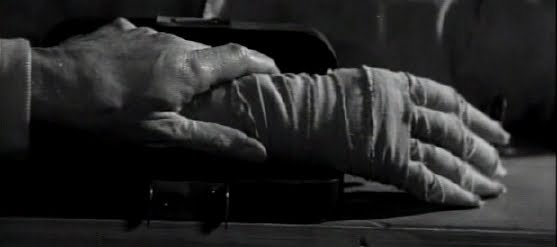
What I love about The Invisible Man is how it starts out after he’s already contracted the mutation. He enters a small English village, wrapped tightly in bandages, as his secret is slowly revealed. Really this wouldn’t of been quite as effective if it wasn’t for John P. Fulton, John J. Mescall and Frank D. Williams visual effects. There’s some creepy stuff going on here and it’s propelled even more by that old school Universal charm.
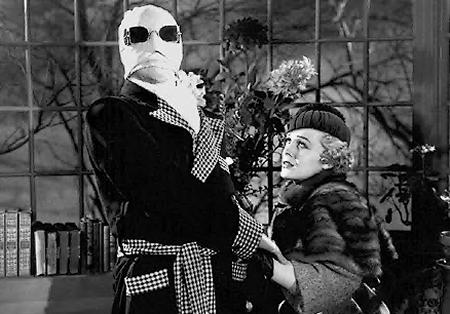
Being Universal, the sets and production value are naturally top notch. I don’t think many would argue against the 30s being the golden age of horror and this is a fine example. Great stars, great sets, good humor, and of course great scares. On a side note even author H.G. Wells was a fan, though he had mixed feelings about changing the lead character from a sympathetic figure to an insane one. Well it would appear that I’m running out of trivia tidbits, so let’s “wrap” it up huh? Get it cause he wears like bandages?
Shocktober Shenanigans


Somehow I messed up my dates when compiling my Shocktober list. I accidentally posted The Invisible Man and Vampyr instead of a film I’d planned to put before. So to keep an organized timeline, I’m gonna change some shit up. I’m just posting this brief comment so that folks know what’s going on, that’s all, let us continue the creepiness!

Shocktober: Day 4

Vampyr (1932)


Dir: Carl Theodor Dreyer
Cast: Julian West, Rena Mandel, Sybille Schmitz,, Jan Hieronimko, Henriette Gerard, Maurice Schultz

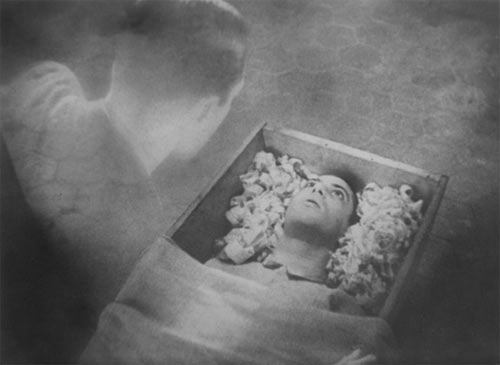
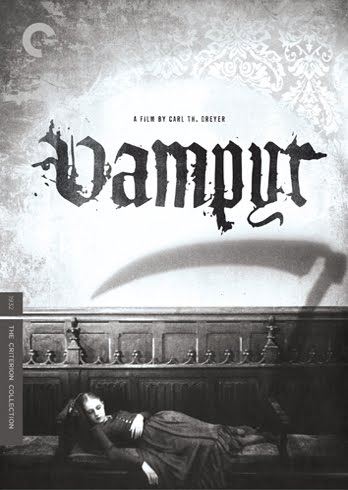
Were going a little on the obscure side today with the German produced Vampyr, a silent film that plays out like a hallucinogenic nightmare. Directed by Danish filmmaker Carl Theodor Dreyer, Vampyr is an oddity in that despite being made in the era of sound is a silent film. Dreyer being accustomed to making silent films had difficulty making the transition, thus he made a semi-silent film that’s a peculiar blending of both eras. Like Chaplin’s Modern Times, there is sound but it is used sparingly and for the most part it is effective.

The film was funded by aristocrat Nicolas de Gunzburg who in exchange for his donation got to star in the film. Non-professionals made up most of the cast and with the low key nature of this film, it’s quite befitting. Gunzburg (using the alias “Julian West”) plays Allan Gray, a man fascinated by the occult who travels to a village in Paris cursed by supernatural creatures. These creatures being “Vampyrs” who lure people into committing suicide so that they can become servants for satan. Aside from that the story is kept fairly simple, unraveling at a slow but suspenseful pace.

The years haven’t been kind to the film’s so-so image quality, but that aside there’s a remarkable atmosphere being crafted here. Filmed on location in various French villages, it feels quite authentic and upholds a certain kind of eerie beauty. It really is more of an indie “Avant-garde” piece, possibly some visual metaphors tucked away and on that level it’s quite complex. Watching it was like watching a muddled nightmare that I enjoyed being sucked into.

The downside here is that this film was made in 1932. Compare that to the kind of horror films were being made in the states. Films like Universal’s Dracula, Frankenstein and The Mummy, those wore excellently produced, with great sound, and sharp image quality. By comparison Vampyr looks like a pile of garbage. Of course it didn’t have a big studio behind it like Universal, but it definitely feels severely dated. If it had been made ten, even five years earlier maybe it would’ve of received more recognition, but who knows. Either way it’s an intriguing curiosity for horror fans.

Shocktober: Day 3

Dr. Jekyll and Mr. Hyde (1931)


Dir: Rouben Mamoulian
Cast: Fredric March, Miriam Hopkins, Rose Hobart, Holmes Herbert, Halliwell Hobbes

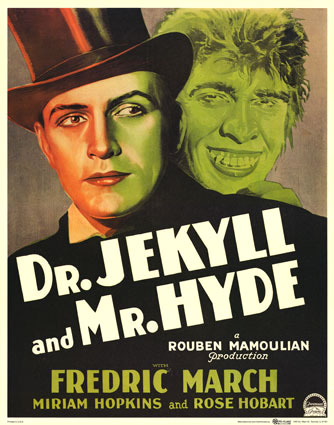
This list has it’s fair share of critical darlings but it’s Paramount’s Dr Jekyll and Mr Hyde that achieved one golden accolade rarely bestowed upon horror movies. Yes, star Fredric March took home the Oscar for Best Actor, playing a mad scientist who turns into a monster? Not the kind of performance you’d expect the Academy to honor but it’s so good that I’m sure there were no regrets. Fredric March is both charming and chilling in this creepy classic, possibly the greatest adaption of Robert Louis Stevenson’s iconic tale.

Henry Jekyll (March) is a highly respected medical doctor who claims that within each man lurks powerful impulses for both good and evil. Speaking at a university, Jekyll tells his colleagues that he believes it’s possible to divide these two personas to eliminate evil. So what happens when he tries it out? You guessed it, the evil side takes over and creates nothing but mischief.

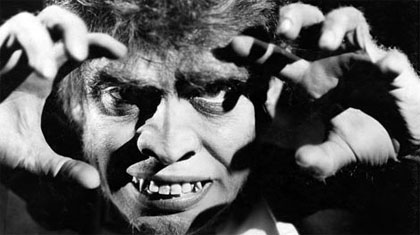
Typically in this kind of film you’d expect most of the drama and key scenes to come from the tormented Jekyll, but it is actually Hyde who receives the most development and screen time. Rather than being a simple thuggish monster that grunts an groans, Mr. Hyde is an articulate man but with devious intentions. He cackles at those he torments and frightens with his gruesome appearance. It’s an endlessly entertaining performance and though March is fantastic in both roles, I have to lean towards the monster.

Made just prior to the enforcement of the “Production Code” it is often remembered for it’s strong sexual content, but it’s fairly tame by today’s standards. Something that amazingly still holds up is Jekyll’s fantastic transformation scene, accomplished by using a series of colored filters that puts the campy yet memorable Wolf Man transformation from the 40s to shame and this was ten year earlier! It’s another one of the many gems of the golden age of horror, check it out if you (like Edward Norton) are a fan of duality.

Shocktober: Day 2

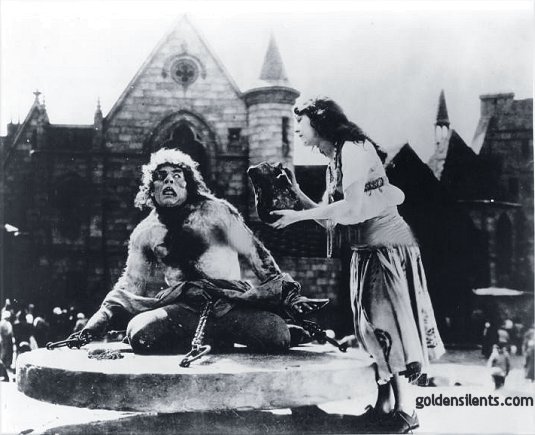
The Hunchback of Notre Dame (1923)


Dir: Wallace Worsley
Cast: Lon Chaney, Patsy Ruth Miller, Norman Kerry, Kate Lester, Brandon Hurst

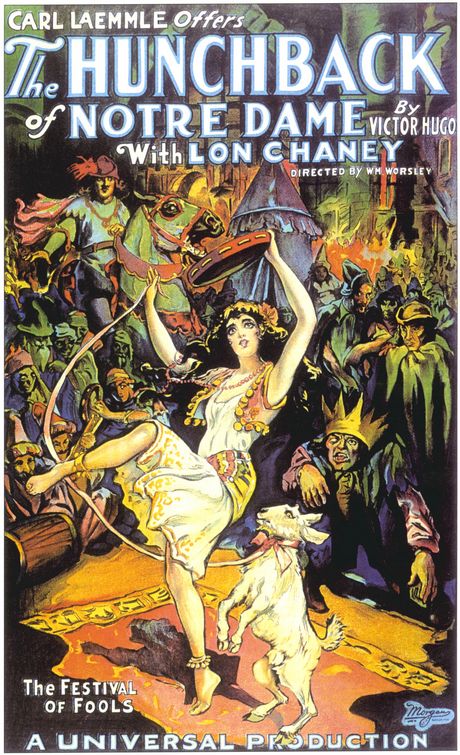
There were many legends of the silent screen, but few could be considered the “face” of their genre. In the 1920s horror had but one name: Lon Chaney, “The Man of a Thousand Faces.” A man so dedicated to creating memorable characters that he’d put his own face through extensive makeup work to transform himself. For the film in question Chaney donned a knotted wig, nose putty, false teeth, a fake eye and a 15lb hump, and yet his performance shines through.

We all know the story to The Hunchback of Notre Dame somewhat. Quasimodo is as a deformed bell-ringer who falls in love with beautiful Esmeralda, he is manipulated by the Archdeacon Frollo, forced to kidnap Esmeralda, gets between the budding romance of Esmeralda and Captain Phoebus, and it ends in tragedy. This version is a fairly faithful adaptation of Victor Hugo’s novel and is captured quite nicely with sets that take you right back to the 15th century. Though it’s Chaney’s twisted performance that has made this film the classic it is. Not to mention it’s an early trailblazer for the “Monster falls in love with Woman” sub-genre.

The film would go on to be Universal’s most successful silent film and grossed over $3 million. Chaney would go on to star in perhaps his most notable role as The Phantom of the Opera, but tragically passed away five years later at the age of 47. Today he has a star on the Hollywood Walk of Fame, a stamp, and perhaps most importantly, a thriving fan base in the horror community.

Shocktober: Introduction


I hate to cut into 80s Weeks but I can’t turn back time. Yes it’s officially October 1st and that means it’s “Shocktober.” “What the hell is Shocktober?” You might say. Well that means that for every day of October I will be reviewing a notable Horror flick. Now I already did this once on my old blog “The Ottman Prophecies”so that means most of the heavy hitters, Frankenstein, Dracula, etc will not be featured. Rather I’ll put the spotlight on some slightly more obscure titles with your occasional classic. I look forward to sharing my fondness for some of these flicks and even a few I don’t care for, but it’s all about what’s made an impact. So sit back with a nice cup of witches’ brew and slip on that monster mask, it’s time for Shocktober!

Shocktober: Day 1

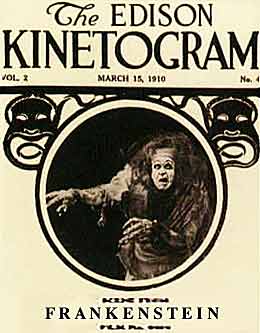
Frankenstein (1910) <i”http://sites.google.com/damorgue.org/home/” />


Dir: J. Searle Dawley
Cast: Augustus Phillips, Charles Ogle, Mary Fuller

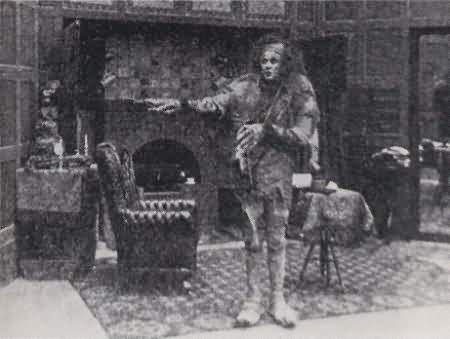
The year is 1910; a loaf of bread costs five cents, Theodore Roosevelt became the first president to ride a plane, Mother Teresa is born, and Edison Studios releases Frankenstein, one of the first horror films ever made. You could possibly categorize some of Georges Méliès early shorts as “horror” but those were only about 2 minutes long. Today’s film is a whopping 12! Adapted from the classic novel, this version, although relatively simplistic, still manages to hit some compelling themes.

It’s basic in its narrative, introducing Dr. Frankenstein, chronicling his experiment, the moment he creates an out of control monster, and so on. A series of title cards fill us in but they rarely seem necessary. They’re painfully obvious, much in the vein of a high school yearbook caption. Though considering this film is 100 YEARS OLD! Much of these minor flaws are forgivable. Just the fact that this movie is still entertaining and interesting is a feat to marvel at.

The ending is rather peculiar as the monster walks into a mirror, which Frankenstein then looks upon in horror. I suppose it’s addressing the matter of “Who’s the real monster?” That’s deep, it’s amazing to see such a complex idea tackled in such an early film. If anything this is fun to watch simply for the historical value, a real blast to the past.