Shocktober Day 14: Equinox

Equinox (1970)

If I had, to sum up, Equinox in one sentence I would say “That’s pretty good for a first try.” This is because Equinox was more of a student film than anything. The brainchild of Dennis Muren—who would go on to win nine visual effects Oscars for films like The Empire Strikes Back, E.T., Terminator 2 and Jurassic Park—while attending business school, Equinox was made for as close to nothing as you can get.

Co-helming the picture with future sound editor Jack Woods (Star Trek III, The Naked Gun 2 1/2) and screenwriter Mark Thomas McGee (Sorority House Massacre II, Stepmonster), Equinox was a stop-motion sci-film shot in Pasadena for $6,500. How does what is essentially a student film become a midnight movie and later a Criterion? Let’s see if we can find out.

Continue reading

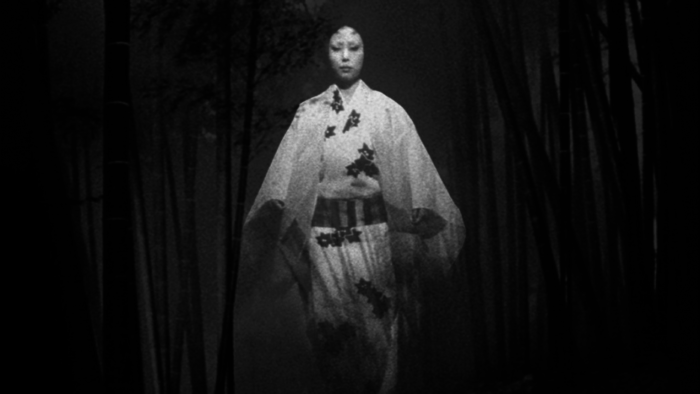
Shocktober Day 13: Kuroneko

Kuroneko (1968)

I hope you’re not too superstitious, because today we’re doubling down on bad luck. Not only is it Friday the 13th, but we’re we’re making matters worse by talking about a movie called Kuroneko, or “Black Cat.” It’s the second film in this marathon from director Kaneto Shindo, who also made Onibaba. Kuroneko is also a return for a few of the stars from that film, as well as its brutal treatment of humanity. What sets it apart? Way more flips.

A woman (Nobuko Otowa) and her daughter-in-law (Kiwako Taichi) are living together after her son is dragged away by a war – that sounds familiar right? Except this time, a band of soldiers happen upon their home and quickly steal their food, rape the women to death, and burn the house down. After the fire dies down, a black cat appears and licks the charred corpses. Soon enough, the women reappear as ghosts, dressed in fine clothes. They start leading samurai, one-by-one, into the woods, where they seduce them in an expansive, ghostly manor and finally maul them to death.

Meanwhile, a young man (Nakamura Kichiemon) kills a massive man in a battle that leaves him the lone survivor. The man returns to his governor, Raiko (Kei Sato), who is pleased with him enough to make him a samurai and give him the name Gintoki. Gintoki gets cleaned up and heads back to his home, which he discovers has been burnt down. What’s worse, he can’t find any trace of his mother and wife. He returns to the governor, who assigns him to kill the ghosts that have been murdering samurai.

You get the idea, right? The ghosts have vowed to kill every samurai, which includes Gintoki. Gintoki has vowed to kill the ghosts, but soon after he meets them, he realizes that they’re his dead wife and mother. So he doesn’t really want to kill them either. Like a lot of horror movies, there’s not going to be a happy ending here. But who’s going to break first? And what does this all have to do with cats?

It’s hard to say what the answer to that last question is. The Japanese title for this film is “A Black Cat in a Bamboo Grove,” which might be a reference to the famous Japanese short story In a Grove, and is sort of an idiom for mysteries that are hard to solve (you might know that short story for its film adaptation, Rashomon). What’s not ambiguous is how well Kuroneko creates a beautiful, eerie atmosphere and simply revels in it. This is more of a horror movie than the other Shindo movie I’ve seen, and for that reason, probably an easier movie to recommend. But maybe watch ’em both and have yourself a real bummer of a double feature.


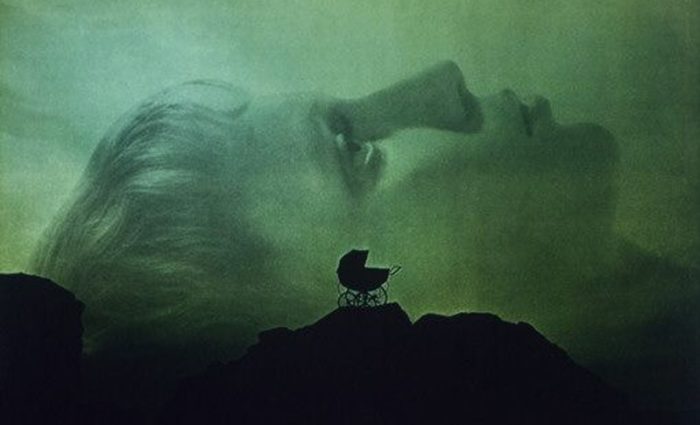
Shocktober Day 12: Rosemary’s Baby

Rosemary’s Baby

During any other week, I might be inclined to play devil’s advocate against John’s dismay toward Roman Polanski, and say that there is such a thing as separating the art from the artist. But the fact of the matter is… I can’t. Because it is just not a great week to be ruminating on someone who used his status in Hollywood to take advantage of a younger woman. Granted, with Polanski, I think it’s complicated, since he’s lived a uniquely tragic 20th-century life. And also, unlike a lot of powerful, shitty men in Hollywood who’ve taken advantage of women, you could argue he’s been sufficiently punished for it. Well shit. I guess I did play devil’s advocate there a bit. But the truth is, he sucks. And guys like him suck. But unfortunately, Rosemary’s Baby sucks less than most of the horror movies I’ve ever seen. Continue reading

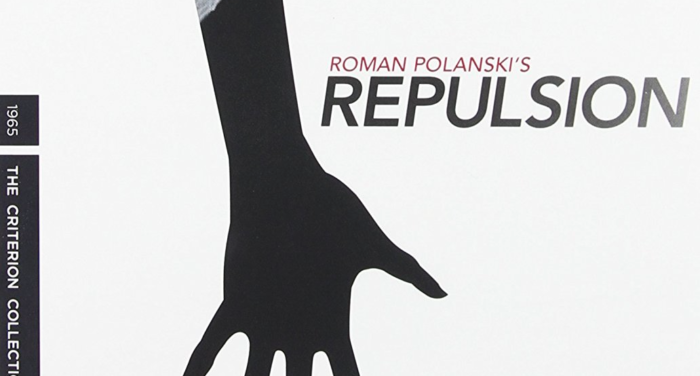
Shocktober Day 11: Repulsion

Repulsion (1965)

Roman Polanski is a controversial figure, to say the least. Just this year Polanski has been accused of the sexual assault of another underage woman in the ‘70s. Polanski’s life apart from his personal crimes has been no less surreal. He survived the Holocaust at a young age and in 1969 his pregnant wife Sharon Tate was murdered by the Manson Family. Of course, neither of those excuse his actions.

Honestly, Polanski’s personal history makes writing about his films incredibly difficult. The more I read about Polanski the harder it is to appreciate his accomplishments. This is a man who recently said “trying to level the genders is purely idiotic.” “Offering flowers to a lady has become indecent … The pill has greatly changed the place of women in our times, masculinizing her. It chases away the romance in our lives.” Jesus Christ.

Continue reading

Shocktober Day 10: Onibaba

Onibaba (1964)

Onibaba, which I think literally means “demon old lady,” is a theatrical fable of a film. It’s a small story with minimal dialogue, a tiny cast, and only a few sets. Nonetheless, it aspires to, and I believe succeeds at, being insightful about the absolute worst aspects on the human condition. I’m talking about starvation and desperation, lust and jealousy, opportunism and selfishness – the aspects of ourselves we’d like to overcome, laid bare in a time of survival. But is it any good?

Continue reading

Shocktober Day 9: Kwaidan

Kwaidan (1964)

Kwaidan is like that film you watch in your Asian Cinema studies class in college. It takes a week to finish and afterward you’re assigned a ten-page paper addressing the theme of guilt in post-WWII Japan as represented in the film’s take on classic Japanese folklore. You read a film analysis book by a dork who sold one screenplay in 1982 (it was never produced), you Google images and examine the lighting and color, you watch and re-watch scenes to appreciate the sense of framing and how they use negative space. At the end of the grueling ordeal, you come to appreciate the film, but you never love it. At least I didn’t. Let’s find out why.

Continue reading

Shocktober Day 8: Carnival of Souls

Carnival of Souls (1962)

Going into Shocktober, Carnival of Souls was my most anticipated film. Mainly because I was enamored with the backstory of the film. Herk Harvey was an average director/producer on industrial/educational films in the ’60s, until one day he drove by the abandoned Saltair Pavillon in Salt Lake City and was inspired. He pulled together every resource he had, raised $17,000 himself, was deferred another $13,000, took three weeks off of work and shot a movie in and around Kansas and Utah.

It’s Inspiring not just because of how Harvey made this film, but because of the kind of film he wanted to make. Carnival of Souls isn’t a “Jump-out-of-your-seat and say BOO!” movie. Nor is it a rubber suit monster movie. It’s a psychological drama about the thin line between life and death, and even though it doesn’t always work it’s admirable in the best way.

Continue reading