If you’ve tried to take you’re PlayStation 3 online in the past week or so, you might have noticed something: you can’t. That’s because Sony was forced to shut down the PlayStation Network after a massive breach in security. According to the official blog, hackers have taken every single PSN users’ name, email address, password, location and possibly even credit card information. All 77 million PSN users are now at risk for identity theft.
What’s worse, we can’t play our games. I was looking forward to playing Portal 2 coop all last weekend, but the network was down and remains down as Sony is forced to rebuild their entire network. There are people who have online game subscriptions that can’t get online right now, this downtime is literally costing them money.
The identity of the hackers is unknown. Anonymous had threatened to hack Sony in the past, but it seems unlikely that it was them, since they seem more interested in sticking it to the man than stealing from the innocents. Also they’ve denied being responsible and condemned the hack, so there’s that. Even Geohot, Sony’s previous public enemy number one, said the attack made the hacking community look bad.
There are rumors that PSN might be up again next week. Sony has quite the hole to dig themselves out of, what with mainstream press and even congress criticizing the corporation for letting this happen. This has led a lot of people to discuss how Sony will compensate everyone at PSN who was inconvenienced by this situation. There’s even a class action lawsuit.
While I think that reaction (my ID was stolen? Free stuff, please) is weird, Sony is going to have to do something to bring people back to PSN. I have a PS3 and I want to play on it, so I’m certainly going to be back as soon as I can be, but I’m not sure I’d be comfortable putting my credit card information in. I’m certainly not going to use my new password, which I came up with because of this hack, for my PSN account. But I already favored my 360 anyway.
What about the people who only play PS3? Do you expect some sort of compensation from Sony? Will you just stop going online? Has the outage affected you, or did you not notice at all? The vocal minority is rightly enraged, but I have to wonder what the common man knows and thinks about this ridiculous situation.
There has been some excellent symmetry between my first year of college and my last. When I was a freshman, I remember being really excited to play Halo 3, Assassin’s Creed and The Orange Box, which included the runaway hit Portal. As a senior, I’ve gotten to play Halo: Reach, Assassin’s Creed: Brotherhood and now Portal 2 and they’ve all yet to disappoint. Like so many other things have.
While the first Portal ended in a way that certainly suggested a sequel, I never thought it would come. I thought the only successor to that amazing game would be references to portals or Aperture Science in Half Life 2: Episode 3. Instead, Valve decided to get back into that dark domain, greatly expanding its scope and narrative, along with introducing new gameplay mechanics that make the already trippy series a full on mind-bender.
To talk much about the story of Portal 2 is to deprive you of one of the great joys in gaming, so I’ll just say this game picks up were the first one left off. You’ve been in storage at Aperture Science ever since you killed the evil GLaDOS and you’re woken up by a delightful new robot friend Wheatley (Stephen Merchant) who helps you once again try to escape. Along the way you’ll learn more about the history of Aperture Science and its eccentric founder, Cave Johnson (J.K. Simmons). The story is fun to watch unfold around you in that classic Valve style, and this is easily one of the funniest games I’ve played.
You can’t afford to just think with portals this time around, the game has changed. Now you have to worry about lasers, light bridges, various types of goo and even anti-gravitational fields. If you’ve watched the trailers for Portal 2, it all looks super complex. In reality, the game does such a good job of slowly introducing these mechanics that things never seem truly daunting. Instead, you’ll just feel like the smartest little boy in the world when you figure these out on your own.
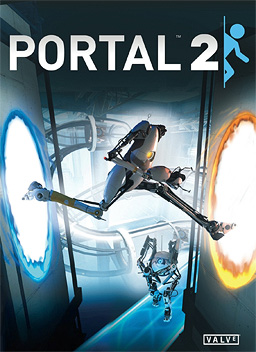
Of course, you’re not on your own in all of Portal 2. There’s an entire second campaign for two players to work their way through. In coop, you play as two lovable robots GLaDOS built to do the testing that was too dangerous for humans. Valve did a great job including in game functionality for countdowns and pointing out stuff to your partner, but for maximum enjoyment, make sure you both have mics.
It’s obvious the Source Engine is getting old. Portal 2 looks surprisingly great, but no one is going to say it’s an amazing game, graphically speaking. The worst part is the load times, which are too frequent and too long (at least on the PS3 version). But all that really means is that I liked Portal 2 so much that it really bothered me those few seconds I couldn’t spend playing it.
Over the past few weeks I’ve replayed the first Mass Effect and made it about half way through Mass Effect 2. It has cemented them as among my favorite games. Before I shift my focus to next week’s Portal 2 I wanted to share the wealth with anyone who has yet to delve into this fantastic vision of the future.
What’s Mass Effect All About? In the beginning of the first Mass Effect, humanity is a recent arrival on the the galactic stage. Mankind got there thanks to the discovery of ancient technology from an extinct alien race called the Protheans. The Mass Effect is what makes FTL travel possible. The central hub of galactic civilization is the Citadel, and that is where the most powerful body of inter-species government, The Council, resides. Humanity wants a seat on the council and our chances would be improved if a human could become a Spectre, an agent of the council with incredible autonomy and authority. Commander Shepard is probably mankind’s best candidate.
Who is Commander Shepard? That’s largely up to you. Shepard is a human, but that’s about all that’s set about the commander. You are free to choose is Shepard is a man or a woman, what kind of upbringing Shepard had, why Shepard is famous and what kind of combat Shepard specializes in. Both Mass Effects are engaging because you are usually free to make your own choice on how to tackle a situation. Your choices are categorized as Paragon or Renegade and if you consistently make choices down one of those paths, you are able to do more. As a Paragon, Shepard is a compassionate hero, always willing to help others and maybe even able to charm his or her way out of some sticky situations. As a Renegade, Shepard is a more intimidating, apathetic and selfish figure, willing to shoot enemies who spend to much time monologue-ing and even betray people for his or her own benefit.
For what it’s worth, choosing to have a background as a spacer war hero will boost your Paragon points at the beginning of the game and choosing to be a ruthless earth-born will boost your Renegade points. To start as neutral as possible, choose to be a sole survivor colonist. Personally, I think the female Shepard voice actor is better as a Paragon and the male actor is better as a Renegade. But most importantly, you should just make Shepard the kind of hero you want to play. You’ll be commanding the commander for quite a while.
What are the Classes? There are six classes in the Mass Effect games. They are broken into three focuses: combat, tech and biotic abilities. The soldier is pure combat, the only class able to master all the weapons in both games. The engineer is pure tech and which is handy for locked doors and crates in the first game and the ability to summon an attack drone in the second. The adept is pure biotic, able to use powers not unlike those of a Jedi. Lots of throwing people around. The other three classes are mixes of the first three. The infiltrator is a combat and tech specialist and an expert sniper in the second game. The vanguard is a combat and biotics specialist, a master of close combat. The sentinel is a tech and biotics specialist, arguably the most versatile of all the classes.
When I first played through Mass Effect, my Shepard was an infiltrator. I liked that, since I never felt obligated to bring another tech specialist just to unlock crates. I turned that Shepard into a soldier in Mass Effect 2, because I wanted access to all the guns. My second time through both games I played as a vanguard and have been really enjoying it. In Mass Effect 2, vanguards get the ability to charge, which I think is the most fun power in the game, although it takes a bit of skill to use properly. I’ve been told that sentinels and soldiers have the easiest time getting through both games. Once again, you should really just choose what sounds fun to you.
Why Should I Play These Games? If you like third person shooters, RPGs or engaging stories, both Mass Effect games are worth your time. The first game is like great Star Trek, it builds an amazing new universe that you’ll love to explore and learn about. The second game is like a Star Wars, less focused on the science fiction and more about real drama and an epic story. Except you get to make all the choices.
Both games focus on your ability to assemble a team of misfits to overcome ridiculous odds. They feature a great cast of characters who you will genuinely enjoy getting to know and will make it difficult for you to choose who to bring to a battle, and, eventually, who lives and who dies. I have never enjoyed conversation more in a game than in both of the Mass Effects.
Admittedly, the first Mass Effect has started to show its age, especially if you’ve seen Mass Effect 2. If you have a PS3, that’s a non-issue, since the game never came out on that platform. You get a bonus interactive comic at the beginning of Mass Effect 2 that catches you up and lets you make the critical decisions from the first game. If you’re on Xbox or PC, suck it up, bitch. Get past the technical jank, the bad inventory management, the terrible Mako sections. At the heart of it all, the first Mass Effect is still quite an enjoyable title.
If you’re scared because of the RPG aspects of the games, don’t be. In Mass Effect 2, there basically is no wrong choice you can make, the leveling and inventory systems are so streamlined. More importantly, the combat is great fun, like Gears of War with magical sci fi powers. This isn’t turn-based at all, it’s a straight-up shooter that you could play without ever pausing.
Mass Effect 3 is supposed to come out at the end of this year. You’ve still got time to join me in line on opening night. It’s time you catch up with one of the greatest game series of all time.
I usually try wait a little while for someone else to review a new album, or at least until I’ve listened to it enough that when I hear a track I like I don’t have to go look up what it’s called. But you know what? I really like TV on the Radio and I really like their new album. Since it came out I’ve listened to it every chance I’ve gotten, which hasn’t been often enough, let’s be honest. But I’m really enjoying Nine Types of Light and I wanted to talk about it before it was too late and we discover the tenth kind of light (did we already? Are types of light a thing?).
It seems like just yesterday I listened to Dear Science for the first time and wondered where these guys had been my whole life. But that was almost three years ago. Just like Radiohead, now they’re back and not really bursting into new territory. But, come on, Dear Science would be pretty hard to top, don’t you think. What Nine Types of Light misses in not being pretty much perfect, it makes up in being TV on the Radio’s most consistent, accessible album yet.
Sometimes “accessible” is a euphemism for boring or safe, but this is not the case with Nine Types of Light. The songs the band included are not about how the world is falling apart, rather, they’re about more familiar, warmer subjects, like love. And damnit, why not? Can’t these guys focus on the lighter side of life for a change? I think so.
Things seem a little slower this time around, they lack the desperation of a “Wolf Like Me” or “Dancing Choose,” instead taking their time to build up into sonic pleasure-centers. At times, Nine Types of Light is soulful, funky and even rocking. Even though this album might be a little less grim and a little more comfortable than you might expect, if you’re a fan of the band of even bands kind of like TV on the Radio, you’ll find something to cling on to here.
The discussion surrounding Dragon Age II has taken a bizarre turn of late. The game features four potential romantic partners, two women and two men. All of them will express varying degrees of interest in your character, regardless of your gender, and you can take those feelings “all the way,” if you know what I mean. Some people are upset about playing as male characters and having other male characters hit on them and wish the game had a “no homo” feature. That is literally one of the saddest and dumbest complaints I’ve ever heard leveled against a game. God forbid gay characters acting gay. For the record I played a female warrior who got with the lovable female elf mage. It was hot. Well, as hot as my PC graphics card could render.
2009’s Dragon Age inspired me to upgrade and get somewhat serious about computer gaming again. Well, the insane Steam sales of that Christmas season helped to, but it was mainly Dragon Age. And that was a worthwhile investment. Bioware’s knack for character development combined brilliantly with the deep tactics only a PC could truly deliver. Dragon Age was one of the most sprawling adventures I’ve ever played, and I gave it a lot of my time.
So I was surprised to hear that the second Dragon Age game would be out early this year, shortly after Bioware stopped delivering DLC for the original game. It felt like the first game was in development forever, how could the followup rise to the bar that was set before it in so little time? Bioware’s answer, as it turns out, was to make a smaller epic.
That’s not necessarily a bad idea, but it didn’t quite work out. You play as Hawke, a human who flees to the Free Marches during the Blight you battled in the first game. Gone are the various origin stories from the first game, Hawke is who s/he is, and you’ve got to deal with it. You end up in the city of Kirkwall, and you will spend almost the entire game there. You’ll make friends, enemies and rise through society over the years. The main conflicts are more personal this time, instead of a war with villainous monsters, you deal with the political struggles between the humans and the qunari and between the templars and the mages. Sadly, it ends just as things are getting really interesting, a rushed finish that clearly sets up a Dragon Age III.
The gameplay of Dragon Age II has been greatly streamlined. The supporting cast no longer wears armor, leaving only equipment slots for weapons and trinkets. Combat is more fun than ever, with warriors and rogues upgraded to almost match the dominance of mages from the first game. A new mechanic, cross class combos, adds a new layer of strategy to fighting. However, enemies often spawn out of nowhere after you defeat a group, throwing a wrench into your long-term strategic plans. This is probably a huge problem on the highest difficulty, but on the one I was playing on, I was having so much fun I didn’t really mind this admittedly gamey aspect of the combat.
It’s clear that Bioware both rushed Dragon Age II out the door and tried to bring the innovation that made Mass Effect 2 so good to this game. The result is fun and kept me engaged for more hours than I’d like to admit. But the adventure is a lot smaller, building up to an exciting climax we never see. With a sequel to such a sprawling adventure, that’s just not acceptable. Dragon Age II is a worthy sequel, but not nearly as worthy as it should have been.
Let’s be clear about one thing: Unknown wanted to be 2011’s Taken. It was released early in the year, has a sexy European setting, is practically a one-man Liam Neeson show and is about him trying to get something back. This time it’s his identity, a bit more abstract an idea, and it all goes downhill from there.
The film opens with a loving couple arriving in Berlin for a big biochemistry convention, or something. Anyway, the big man accidentally leaves his suitcase at the airport and he has to go back. Unfortunately for him, his taxi gets in a terrible accident and he wakes up in the hospital days later. When he tries to meet with his wife he finds her with another man – who goes by his name. Indeed, somehow this other man knows everything about the life of Dr. Martin Harris. So, how did he manage to steal Harris’ life? Or is there something even more sinister going on here?
Well it sure takes a long time to find out. At almost two hours, Unknown is able to twist a little too much. This should have been an action movie, and the action sequences are quite good, but much of our time is spent wandering, contemplating. And as the truth slowly, slowly, is revealed, the movie goes from exciting to a bit of a letdown. That said, Neeson is good, the supporting cast is fine, and there is at least one good chase scene in the movie. Surprising lack of ass kicking, though.
Ultimately I was fine with having seen Unknown, but did I chastise my friends who chose not to see it? No, they didn’t really miss anything. If you like Liam Neeson playing the confused yet capable action guy, you might get a kick out of this movie. Otherwise, well, I dunno, go see something else. The pickings are pretty slim these days, however. Maybe buy a video game instead.
The second Killzone game came out under some pretty intense pressure. The original trailer seemed, and in fact was, too good to be true. Killzone 3 not only needed to be one of the PlayStation 3’s first killer apps, it needed to be Sony’s Halo. That’s asking a lot for a sequel to a hyped-but-largely-forgotten PS2 game. Did Killzone 2 deliver? Well, it looked really good and the single player campaign had some incredible moments. The multiplayer had an interesting take on the idea of game modes, and ultimately the game was successful. That said, a lot of people struggled with the controls, and the game never felt like it was quite in the same league as Halo 3 and Call of Duty 4. Now it’s a few years later and Killzone is back and better than ever.
Killzone 3 picks up immediately after the ending of the last game. Like, literally, seconds later. Once again you play as Sev and are teamed up with resident douchebag Rico. You’re still stranded on your enemy’s home world, desperately struggling to put an end to the war between the ISA and the Helghast, who are, as you might remember, basically British space nazis. With Brian Cox dead, the Helghast are caught it in a leadership struggle, between the rightful heir Ray Winstone and the chairman of a massive PMC, Malcolm McDowell. The story is great for giving you exciting battles in visually interesting locales, but the actual dialogue is pretty flimsy. Malcolm McDowell is great as the main villain. I really enjoyed that the biggest threat to our heroes was the constant infighting, even though the payoff for that was not written that well.
The actually gameplay of Killzone 3 is so much more satisfying. The controls have been tightened up something fierce, if I hear anyone complaining about the controls this time around, I might have to destroy them. Everything feels faster and smoother. There are a numerous sequences when you won’t be on foot, instead you’ll be the gunner in a few vehicles, drive a mech, and even fly with a crazy jet pack. This is always fun, although I did feel a few moments made it way to easy for you to die. You’re supposed to feel empowered at those segments, not worried about getting blown up.
Killzone 3 is really good. The characters are fleshed out really well, the combat is top notch, the graphics are still shockingly good. The singleplayer campaign will keep you going for a few hours, the mutliplayer many more hours after that. This is an awesome game and a welcome addition among the PlayStation 3 library.