Criterion Month Day 11: Charade

Charade (1963)

Happy 7/11 everyone! I hope you enjoyed your free frozen treat. Personally, I didn’t even try, around these parts the consensus is Slurpees were ruined by the switch to paper straws. If you haven’t guessed, I’m having trouble coming up with an angle to attack Charade from. It’s the most Hollywood movie I’ve ever watched for Criterion Month, and that means my experience watching it was a lot less emotional and I was left with much less to chew on when it ended. Which betrays how much fun Charade was to watch. It feels like having to write about It Happened One Night or North by Northwest, except for some reason this movie isn’t as talked about as those classics. Why would that be? Let’s see if we can figure it out.


Continue reading →

Criterion Month Day 10: Ivan’s Childhood

Ivan’s Childhood (1962)

Russia sucks. At least that’s the impression I get from watching Andrei Tarkovsky films. Every time I see Russia in a Tarkovsky film it’s either war-torn or a post-apocalyptic wasteland, both filled with liars and deceit. Is that just Russia? Or is that Tarkovsky’s view of Russia. If it’s worth anything Tarkovsky wasn’t a fan of the Soviet Union, particularly its censorship. There are rumors that Tarkovsky’s premature death at 54 was from being assassinated by the KGB. There are also rumors that Tarkovsky’s lung cancer was due to radiation he received from filming Stalker at an abandoned chemical plant. Either way, Russia sucks. Yet Tarkovsky finds a way to show the beauty in this totalitarian dumpster fire.

Continue reading →

Criterion Month Day 9: Floating Weeds

Floating Weeds (1959)

It seems it has become a tradition for me to review a Yasujiro Ozu movie each Criterion Month, as I previously reviewed Tokyo Story and Late Spring, which I both gave five stars. So you might be assuming by the rating that Floating Weeds can’t help but feel like a letdown. There may be some truth in that, but unless you’re a total fanboy, it’s impossible to believe that you’re going to see every film in any director’s filmography as a masterwork. Even though I wouldn’t put Floating Weeds quite on that level, it’s still a very strong film, and proof that Ozu was still doing great work towards the very end of his career. Continue reading →

Criterion Month Day 8: Shadows

Shadows (1959)

I went through a Mumblecore phase in my early twenties. For anyone not familiar, “Mumblecore” is a label that was given to a slew of low budget, no script, indie dramas from the mid-2000s. Andrew Bujalski, Joe Swanberg, and my personal favorite the Duplass Brothers all burst out of this scene with intimate dramedies about the struggles of love and life in your twenties and thirties.

Continue reading →

Criterion Month Day 7: Hiroshima mon amour

Hiroshima mon amour (1959)

When I think about the period following WWII, the first thing that comes to mind is fuckin’ boomers, man. America and the Soviet Union leapt straight into the Cold War, totally skipping over the decade of celebration that came after WWI (side note: the hundredth anniversary of the signing of the Treaty of Versailles was June 28, did you know that?). And so my focus has always been on Germany being divided, the Korean War, and the global ideological battle between capitalism and communism. But in some places, rebuilding after the war took precedent. Seeing an insight into that experience was my favorite aspect of Hiroshima mon amour.

Continue reading →

Criterion Month Day 5: Aparajito

Aparajito (1956)

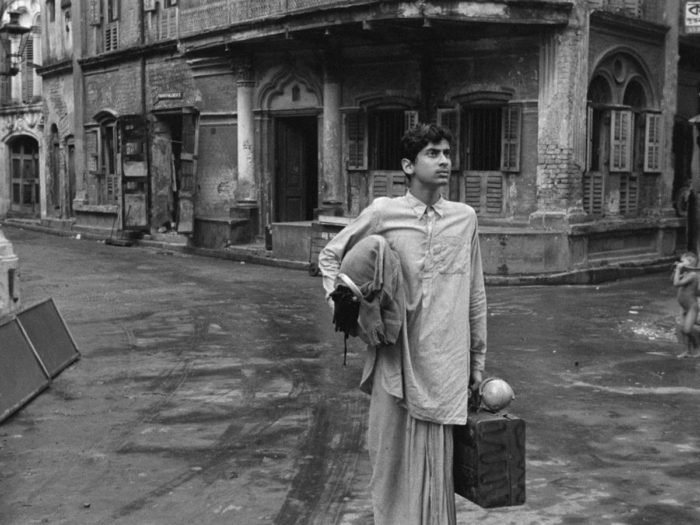
One thing that’s tricky about reviewing an older movie is balancing how it feels to see the film for the first time today versus appreciating its historical context. So when I have to write about a film like Aparajito, I have a hard time not making it sound like a typical coming-of-age story. But if I go too hard the other way, focusing entirely on the history of the movie doesn’t do it justice either. Cinematographer Subrata Mitra invented bounce lighting during the production of Aparajito, do you have to be the type of person who knows what cinematographers do and what bounce lighting is to enjoy it? Not at all, this is a much more universal experience than that.

Continue reading →