Shocktober: Day 10

Freddy vs. Jason (2003)

I wasn’t planning on reviewing this one but you have to give the people what they want. The fact that this movie exists is fucking hilarious. Why would two of the biggest slasher villains of all time need to fight each other? They both share the same enemy (sexy teens.) The only explanation is New Line Cinema wanted to give fans the biggest horrorgasm of all time. The results are one of the best/worst movies I’ve seen.

The “plot” (and I use the word lightly) concerns Freddy, trapped in hell, who decides the citizens of Springwood, Ohio need to feel fear again. So Freddy poses as Jason’s mother and manipulates Jason into a killing spree. That’s all the motivation I need. The victims… I mean protagonists are Lori Campbell (Monica Keena), a young adult who lives with her widowed father, and Will Rollins (Jason Ritter), a former victim of Freddy living in an insane asylum. Also, for some reason, Kelly Rowland from Destiny’s Child. The human characters don’t matter. That’s why we have scenes like THIS ONE.

I was 12 when I saw this in theaters with my German born, Horror-movie-loving stepdad. I don’t think either of us thought it was good, but we had a good time. In one corner you have Freddy Krueger (Robert Englund), slicing up teens in LSD inspired dream sequences and then you have Jason Vorhees (Ken Kirzinger), swinging a machete like a mentally challenged caveman. As if it wasn’t hard enough for teens to face off against one supernatural monster. But it’s not just the teens caught up in the chaos. For no logical reason, Freddy and Jason most also face off.

Freddy and Jason don’t exchange fisty cuffs until the film’s end but it’s worth it. Their fight mostly consists of Freddy going into Jason’s mind and scaring him like a stupid baby and Jason chucking Freddy around like a rag doll. It doesn’t really make sense for what’s essentially a ghost (Freddy) to be fighting a zombie (Jason) but who gives a shit? I don’t.

In conclusion, here’s one of the “greatest” fight scenes set to some of the worst metal music ever written:

P.S. My favorite moment is at the 59-secondd mark.

Shocktober: Day 9

Ju-On: The Grudge (2003)

My first encounter with The Grudge came in 2004 after renting the American remake. The film was a piece of shit but I do fondly remember a half-awake Bill Pullman as Peter Kirk (same name as the founder of my hometown Kirkland, WA). Since I hated the film I never had any interest in seeing the original. Eventually, I took a Film and Religion class and oddly enough, Ju On: The Grudge was one of the films we watched. It was intriguing delving into how Japanese culture recognizes the power of spirits. “The Grudge” itself in the film represents a curse that is born when someone dies in the grip of a powerful rage or extreme sorrow. This curse is passed on person-to-person through the place of its inception and the aftermath isn’t pretty.

The film is split up in a non-linear fashion following the paths of six characters. The whole acts more as a series of jointed short films than a single narrative. The crux of the plot stems from a house where a tragic murder took place five years ago. There a father killed his wife and son in a fit of rage before killing himself. Since then, anyone who comes in contact with the house becomes a part of “The Grudge”.

What sets apart The Grudge from your typical ghost movie is the pacing. There’s plenty of time to develop story and character and then work you into a situation where you think you’re safe… But then you’re not. The Grudge even manages to add tension to scenes in the broad daylight, not an easy feat. Though a ghost movie is only as scary as its ghosts. In The Grudge we have the ghost of a young boy who makes cat noises and the ghost of an older woman with long dark hair. Each character carries pained visages frozen in terror, but it all comes home with the film’s infamous “death rattle”. A death rattle being one of the last sounds a person makes before they die. The buildup of saliva in the throat leaves for a rattling moan, and The Grudge utilizes this masterfully.

The Grudge is one of the finest in its sub-genre of intelligent, character-driven, Japanese ghost stories. It has gone on to spawn a handful of sequels (it itself being the third of a series) and remakes. There’s a charm to its simplicity but also a great uneasiness. It’ll make the drool drip down your throat.

still-of-megumi-okina,-takako-fuji-and-yuya-ozeki-in-ju-on
My kind of Ménage à trois.

Shocktober: Day 8

High Tension (2003)

France’s Haute Tension or “High Tension” is a film that I knew about for many years only because I knew it had a twist ending. A make or break twist ending that changes everything you’ve just seen. It’s this ending that won the just as much applause as boos by viewing audiences. Sadly, I find myself in the latter category. Let’s try to find out why.

French college students, Marie (Cécile de France) and Alex (Maïwenn), travel to Alex’s family farmhouse to study for upcoming exams. What seems to be a quiet environment is quickly interrupted by a sadistic killer (Phillipe Nahon). When the killer binds and kidnaps Alex, Marie sets out to save her friend, resulting a violent game of cat and mouse. A fairly typical setup to a fairly typical slasher, until later.

[toggle title_open=”Major Spoiler!” title_closed=”Major Spoiler!” hide=”yes” border=”yes” style=”default” excerpt_length=”0″ read_more_text=”Read More” read_less_text=”Read Less” include_excerpt_html=”no”]So in the end it turns out that the killer is actually an alternate personality of Marie. This killer, who we see kidnapping Alex and murdering many people on the way is in fact the murderer. This makes no sense. Not only are the killer and Marie often seen in two different places at the same time, but we see the killer accomplish things that Marie never could. How is it that a 90lb girl with a Mia Farrow haircut is able to decapitate someone by ramming a bookcase into their head? I think someone needs to throw the book at this one. Eh?

It doesn’t get more cliche than High Tension. What’s weird is how much of a breakout hit it was for its director Alexander Aja. Since then, Aja has directed: The Hills Have Eyes, P2, Mirrors, Piranha 3D and the upcoming Horns, which I now believe will suck. Why do people keep giving this man work? Its not like he had any original ideas to begin with. High Tension may have its following but I’ll go my own way.

high-tension-killer
Now that’s a hot chick.

C.A.T: Walk Among Us

Misfits – Walk Among Us (1982)

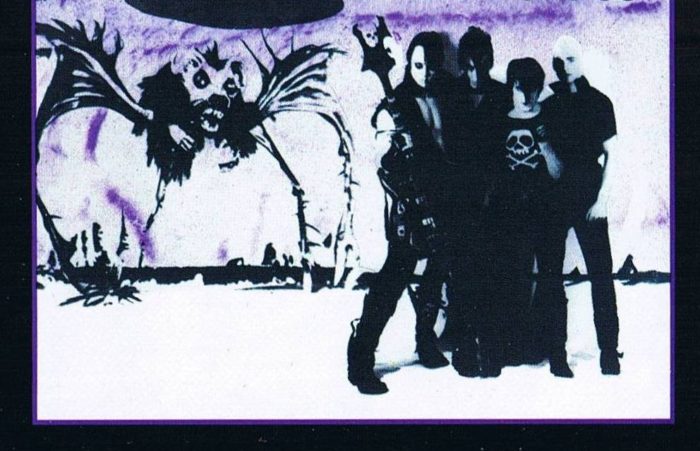
Somewhere between the corporate fuck glam of Kiss and the shock rock of Alice Cooper lies Misfits. A gritty combo of monster makeup and hardcore punk, Misfits brought Horror Punk from the depths of hell and unleashed it upon this mortal coil. Led by Glenn Danzig, a stocky figure so imposing he was once considered by Twentieth Century Fox to play Wolverine, despite no acting experience, Misfits were rock mutants in a league of the own. Beginning their rampage in 1977, 1982’s Walk Among Us was the band’s first full-length release. Stitched together from previous recordings Walk Among Us is a punchy 25 minutes of monster mayhem.

Songs tell tales of Martians, vampires, and Astro-zombies, all while embodying a monster mash party vibe, fueled by the sheer attitude of 60s garage rock. “Woah-Ohs!” and “Yeah! Yeah! Yeahs!” boom behind the brooding croon of Glenn Danzig. Arthur Googy pounds away on drums as brothers, guitarist Doyle Wolfgang von Frankenstein and bassist Jerry Only (originator of the Devil Lock haircut) forge Satan’s favorite soundtrack. It’s hard to think of another band that has so encapsulated horror movies into their music. There’s no political confrontation here, just freaky fun and high voltage power.

Walk Among Us feels surprisingly upbeat considering its grisly wrappings. It just goes to show that you can embody a love for horror without guttural howls about burning through witches. You don’t have to be on 24/7 suicide watch to write horror songs. From its Sci-Fi inspired album cover to it’s kitschy lyrics, Walk Among Us is spooky good fun.

Favorite Tracks: “Astro Zombies,” “Skulls,” “Vampira”

Shocktober: Day 7

Cabin Fever (2002)

Cabin Fever is a fuckin’ mess. It tries to be funny, it tries to be scary, it tries to be political satire, and fails, fails, fails. I’ll give props to the film’s threat: a contagious skin disease that infects a group of teenagers in the backwoods but everything else is tired and uninspired. There’s a lot I could say about Eli Roth’s Cabin Fever; it’s derivative, it’s cliche, it’s gross for the sake of being gross, but why bother when you can just watch this:

You think that seeing the movie would explain that scene, it doesn’t. In the kitchen of horror movies Cabin Fever is just another burnt short stack.

Shocktober: Day 6

Bubba Ho-Tep (2002)

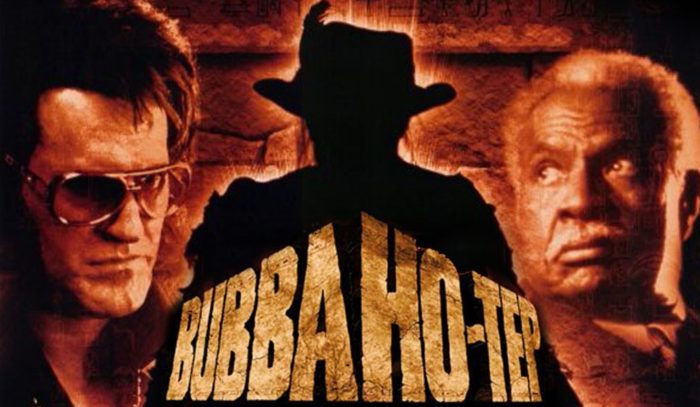
Where does an idea like this come from? An aged Elvis awakens from a twenty year coma to team up with Black JFK against a re-animated Egyptian mummy? Let’s start with the film’s writer: Joe R. Lansdale. Wikipedia describes Lansdale as an American author and martial-arts expert. Who better to write a film about Elvis than a man that shares a passion with the King for the arts and the martial arts? Lansdale is perhaps best known for his darkly comic short stories and for penning several episodes of Batman: the Animated Series. What began life as a novella, Bubba Ho-Tep was picked up by cult filmmaker Don Coscarelli (Phantasm, The Beastmaster) and cast with America’s favorite son: Bruce Campbell.

Bruce Campbell plays “The King”, but if you’re asking the individuals of the Shady Rest Retirement Home, he is the King of Crazy: Sebastian Shaff. According to Shaff (let’s call him Elvis from here on out), in the 70s he escaped the demands of fame by switching names and places with an Elvis impersonator. After a brief retirement, the impersonator died and Elvis became unable to prove his identity after a propane accident destroyed all his documentation. Elvis then fell into a coma after botched hip surgery. He awakens thirty years later and finds himself pitted against an escaped museum mummy invading the retirement home.

I know, I know. This all sounds absolutely ridiculous. Elvis fighting a mummy? It doesn’t sound like it should work but it does. It does because this movie has heart. Most of this heart comes from a warm performance from none other than Ossie Davis. Ossie plays a wheelchair bound resident of Shady Rest who believes he was once John F. Kennedy. According to him, the government dyed his skin black and then dumped him in a retirement home to hide him after his assasination. JFK and Elvis form a quirky relationship and work together to fight evil. Just the idea of people bonding after being forgotten and told they don’t matter. If that doesn’t make you feel bad for putting old people in retirement homes than I don’t know what will.

Naturally, Mr. Campbell brings the machismo but dials it down just enough to match the now dethroned king. The performances are the real draw in this monster mummy shootout. In fact, the movie would have worked without the mummy, he’s just the icing on this kooky cake. Weird to think that in a movie with an aging Elvis, a black JFK, and a western wear adorned mummy, that the mummy is the least absurd. That’s a wrap!… Please… Kill me.

BUBBA_HO_TEP
The boys are back in town!

Shocktober: Day 5

The Devil’s Backbone (2001)

Like precious blood, I’ve been absorbing anything Guillermo Del Toro for the past few months. I’ve been reading the Strain trilogy, re-watching Del Toro’s movies, and eagerly await his upcoming book of artwork and story notes. Revisiting the Del Toro library I watched The Devil’s Backbone for the first time in almost seven years and wow, a film like that only comes once in a blue moon. Where it may not match the whimsy and magic of Pan’s Labyrinth, its emotional core and symbolic imagery may make it Del Toro’s most personal film.

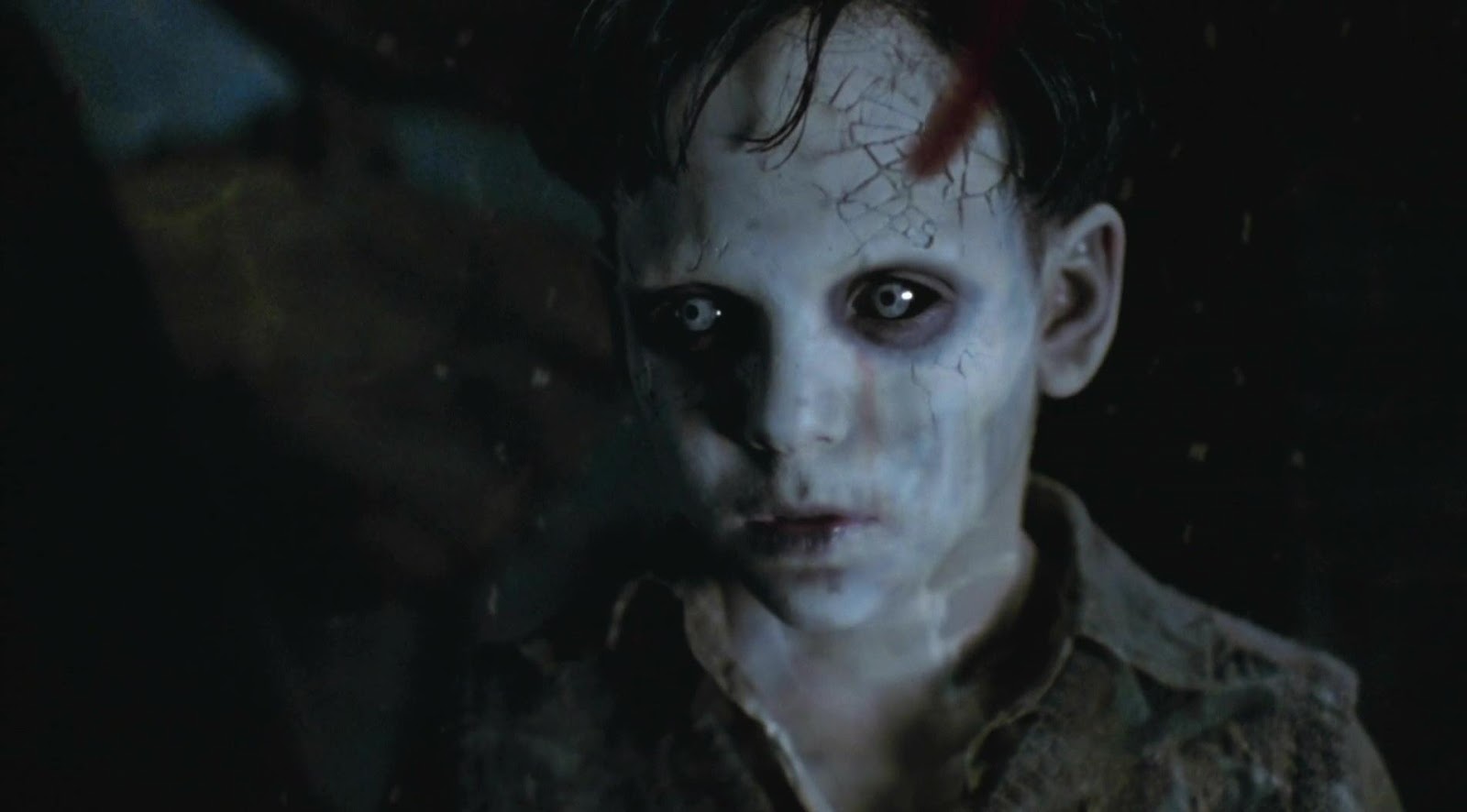
The film is set in Spain, 1939, during the final year of the Spanish Civil War. Fernando Tielve plays Carlos, a young boy who’s been left behind at a reclusive home for orphans. The orphanage is run by Casares (Federico Luppi – a favorite of Del Toro’s) and Carmen (Marisa Paredes), who are aligned with the Republican Loyalists, and are hiding gold for the Republican Treasury. This creates tension between Casares/Carmen and Jacinto (Eduardo Noriega), the orphanage’s greed-driven groundskeeper who wants nothing more than to take the gold. Meanwhile, Carlos must not only adjust to his harsh peers but to a mysterious ghost of a former orphan named Santi, who now haunts the grounds. What happened to Santi? To what heights will Jacinto reach to claim the gold? The stakes are high and always getting higher.

Immediately, The Devil’s Backbone strikes you with its powerful imagery. Many symbols in the film parallel to the idea of being stuck in limbo. A large bomb that was dropped during the war sits center stage on the orphanage grounds, yet has never exploded. There’s a countertop in Casares’ office adorned by fetuses in jars (born with a spinal condition called: The Devil’s Backbone) that represent life that got lost along the way. Even Santi represents a moment of pain forever immortalized as a sorrowful spirit. The film is as touching as it is tragic.

A great deal of Del Toro’s influence comes from his own background as a lapsed Catholic. The fears that we carry forever due to the struggles of life. Much in the way of its sister work, Pan’s Labyrinth, The Devil’s Backbone Shows the hardship of a troubled childhood but also the spirit to overcome that hardship. It gives me nightmares in my mind and in my heart. A must see!

1289122983_45656
AAAAHHH!!!