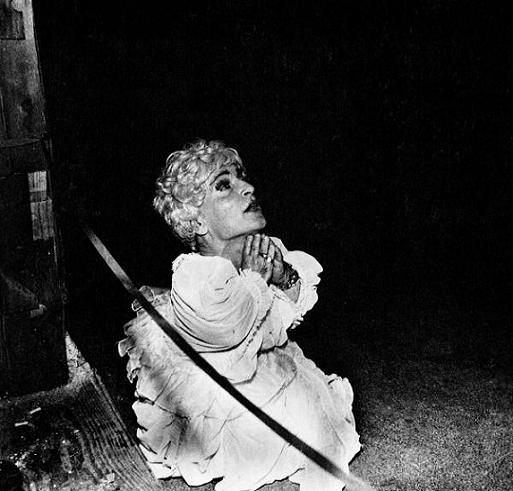
It’s seems that every fall I must find an amazing alternative album by a band that I’ve never heard of but it turns out they’ve been around for a while. It looks like this year that band will be Deerhunter and that album will be Halcyon Digest.
It’s been a little while since I listened to an album this icy hot; at times it reminds me the terrific Teen Dream by Beach House and the legendary Merriweather Post Pavilion by Animal Collective. That is not to say Halcyon Digest is derivative, just that it is able to tap into that airy, beautiful world that exists just outside of pop.
Like most things in life, Halcyon Digest starts slow, with the chunky sounds of “Earthquake” that evolves into a crushing cacophony that sweeps you away into the land of Deerhunter for the next 10 tracks. I think the standout track for me is “Helicopter,” a dreamy, sad song that always grabs me when it comes on.
What really makes Halcyon Digest stand out is that it all seems so laid back. I haven’t seen Deerhunter play, but this album feels effortless, like these sounds just flew out of them. Or perhaps they flew out of us.
Seriously though, this shit is hotter than the Donkey Kong Country soundtrack.
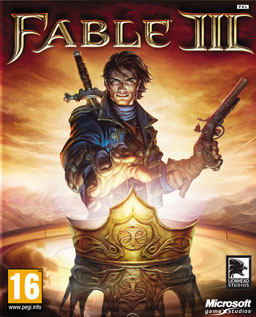
When Fable III came out a couple of weeks ago, it didn’t seem real to me. I hadn’t really seen much of the game and the first two in the series seemed like they were in development for years. Yet here it was, only a couple years after Fable II, the next entry in Microsoft’s answer to Zelda. Unfortunately, Fable III feels like it could have benefited from some more time in development.
It’s 50 years since Fable II and you play as the younger son or daughter of your hero from the first game. Your older brother, Logan, rules Albion as a tyrant, quickly forcing you to run away with your mentor, loyal butler, and not-as-important-as-Fable-II’s dog. Despite being a prince or princess you have no money and no one trusts you, so you must go around Albion inspiring the people to bring about a revolution.
Normally, a game would stop when you win the crown. But Fable III tacks on another plot and a few hours of gameplay with you acting as the monarch, forced to choose between honoring the promises you made to those who helped you dethrone your brother. This part of the game is all about money; you’re forced to choose between popularity and security, which the game equates to being good or evil. Which is messed up. Sometimes a leader has to make unpopular choices for the greater good, but Fable III does not offer that depth. You simply have to be a saint or a dick. Giving rewards based on morality and making choices black and white really hurts what could have been a compelling aspect of the game.
The core of the game is not much changed from Fable II. One button combat returns, and it is as easy as ever to defeat every enemy. Magic has been changed, now you equip two spell gauntlets, allowing you to “weave” two spells together, instead of power up through tiers of spells like in the last game. This is less interesting and strategic, although it does look pretty cool. Also, you can now spam the spell attack button, basically allowing you to shield yourself in magic and make every fight stupid easy. Oh, and the dog helps out in fights and finds loot and dig spots for you too. He has no story importance, however.
The story is quite good, although the characters are less memorable than the motley crew from Fable II. There are plenty of funny moments and the cast is one of the best I’ve heard in a video game. Stephen Fry is back as Reaver, Bernard Hill (the king of Rohan guy) is your mentor Walter, John Cleese is your butler Jasper, Michael Fassbender is your brother Logan, and your companions include Sir Ben Kingsley, Simon Pegg and Naomi Harris. It’s just a shame that the monarch stuff at the end feels rushed.
What feels the most rushed is the interface, which is a real problem. In Fable II, the biggest complaint people had was the menu system. It was slow and took too long to browse through. So instead of just making a better menu, Fable III introduces the Sanctuary. Now when you press start you’re teleported to this place where you can choose to go to a rooms to level up, change weapons, change clothes, and look at your fortune. It’s really a neat system for looking at your wealth (it’s a Scrooge McDuck style pile) and gear, but it gets really frustrating in practice.
Let’s say you’re leveling up a weapon (they have achievement style goals now, i.e. “kill 300 mercs”). You have to press start, run into the weapon room, find your weapon on the rack and select it. Even if you just want to check your quest log, you have to return to the sanctuary and run to the world map and then open in. They really should have had an in game map and quest log, especially since the game suffers from a number of fast travel and questing bugs.
The game has a lot of janky qualities. The breadcrumb trail breaks some times. Selecting fast travel from the quest list sometimes teleports you farther away than if you had just fast traveled to the town. One story quest straight up bugged out for me. I had to seduce a lady but could not interact with her. This was about halfway through the game, and remains broken even now, after I’ve beaten it and Lionhead has even released a patch. When I got married, I paid for the fancy royal wedding, only for my and my wife’s models not to appear in the cinematic. I could not interact with the wife after the ceremony, and when I rebooted the game she ceased to exist.
Fable III is a good game in spite of itself. The adventuring during most of the game is a lot of fun, helped further by its excellent cast. There are plenty of things to do and collectibles to obtain. The multiplayer is fully functional, everything we wanted from Fable II. However, some of the game is straight up broken and a lot more is stupidly annoying. Hopefully Lionhead can fix some of this with patches and DLC, because the product on the disc is far from what it should have been.
With Rock Band 3, Harmonix has reached the logical conclusion for music games. Guitar Hero popularized the genre, Rock Band made it a party game, Rock Band 2 showed how one game could be a platform for content. Now they introduce keyboards and a pro mode to teach gamers how to really play their instruments. While I probably won’t ever actually get to play with the special Rock Band guitar or drums, I am certain that those modes are as competent as everything else in this package, which is easily the greatest music game of all time.
Not that the title was hard to win, since in my mind the previous holder was Rock Band 2 (yes, The Beatles: Rock Band was very special too). The way Harmonix has kept the Rock Band platform interesting with DLC while Neversoft has destroyed the Guitar Hero franchise like a 1,000 lbs pumpkin smashing a car, meant that basically they had to not fuck up Rock Band 3 to make it great. And they did.
You’ll notice things are different right from the get-go. The opening video, usually an exciting CG venture in these games, is this time real life people jamming out in some city. The game’s interface, usually very clean, has sacrificed some of its sleekness to offer more options. Players can now drop in and out whenever they want (even in the middle of songs) and it is super easy to move what instrument your profile is signed in on or change your character. The process of playing music has never been simpler, and that streamlining makes this the ideal party game.
Since the first game you’ve always been able to make your own band, but your group has a bigger presence this time around. The members are usually chilling in the background while you mess with options and of course they still are the ones playing the music under the clutter of four instrument tracks and vocals. This gives you the sense that you are always playing as your band, like everything you do counts toward something – and it does. The other two games had discreet tour and quick play modes, where quick play didn’t count toward anything but high scores. In Rock Band 3 there still is a tour mode, but you’ll only have to play a few gigs until you finish a tour. The real focus is on challenges, which you can complete at any time. This was an extremely intelligent design decision, basically giving players the career mode if they wanted, but also making it so it never feels like your time is wasted.
Besides the pro modes (and vocal harmonies, which aren’t really new) the biggest new addition is the keyboard. The device itself is great, two full octaves of keys that feel like proper keyboard keys that you can wear like a keytar or just sit with it on your lap. You can play using just five keys, which is a lot like playing guitar or bass, or you can play in pro mode, in which you have to use all the keys, which is a lot like actually playing piano. The regular stuff is easy enough to get into, but playing on pro is quite the challenge. I could see people using the game to develop the basic skills to get into playing the real instrument.
So there are 83 songs on the disc. It’s a pretty crazy mix of songs, with really the only unifying theme being that a lot of them seem to have been chosen because of they’re keyboard part. Which is good, since none of the existing DLC supports keyboards yet, although supposedly you will be able to upgrade that at some point. I was able to find plenty of songs I love (seriously, “In a Big Country,” “Walk of Life,” “25 or 6 to 4,” “Space Oddity,” I could go on) and even the stuff I don’t care so much for isn’t that bad. With a great mix on the disc, plus the ability to export most of the songs from Rock Bands 1 and 2, AC/DC, Lego and Green Day and the amazing selection of DLC plus the stuff on Rock Band Network, surely you’ll find more than enough to keep yourself entertained.
Seriously Harmonix, I don’t know where you guys go from here. I guess you could try more single band games, but I still think only The Beatles could really get away with that. Rock Band 3 is just too good. You’re done. Keep putting out DLC. We could still use some My Morning Jacket up in this business.
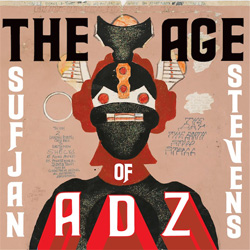
Straight up, the only Sufjan Stevens album I ever listened to was Illinoise and in recent years even that has been reduced pretty much to just the track “Chicago.” For his part, he hasn’t really done a proper followup to that 2005 album, instead releasing lengthy EPs, bizarre experiments and collaborating with other artists (such as an appearance on the latest from The National). But now he’s put out The Age of Adz and called it the legitimate followup to Illinoise. It’s not named after a state, but does that mean Stevens can never achieve greatness again?
Normally it makes sense to talk about an album from the beginning, but I’d like to start discussing The Age of Adz with the last song. Called “Impossible Soul,” the track is 25 minutes long. Normally when you see something like that, it’s because there’s a bunch of silence then a hidden track tacked on. But Stevens has actually put together a little symphony to compliment the rest of his album. With a number of distinct movements, the song features everything from horns to auto-tuned vocals. In the age of playlists and a la carte music purchases, it’s incredibly brave to put something together like “Impossible Soul,” and that is probably the most remarkable feature of this package.
But it’s not just the last song that makes this album great. The whole album seems huge. I don’t know if any of these songs are going to be the next “Chicago,” but I have no doubt anyone could listen to The Age of Adz and find something they love. The way Stevens combines classical and electronic instrumentation is fun to listen to and he often lends emotional credibility to his songs. This has to be heard to be believed.
Like I said, I haven’t been following Sufjan Stevens for the last half decade, I don’t really know what the work he’s been putting out is like. What I do know is that this new album is kind of amazing, and will probably stay in my album rotation for a while. For an album that’s an hour and 15 minutes long, that’s pretty serious.
Favorite Tracks: “Too Much,” “All for Myself,” “Impossible Soul”
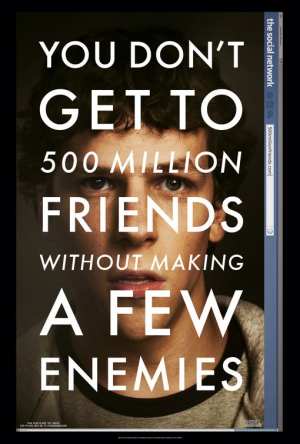
Everyone already knows how big Facebook is today. The website’s addictive nature, privacy problems, massive influence, it is all common knowledge. So the idea of “Facebook: The Movie” did not initially sound like the most interesting project talents like writer Aaron Sorkin and director David Fincher should be investing their time in.
But The Social Network is much more than a movie about a website. Indeed, Facebook itself is hardly seen in the movie. The filmmakers instead focus on the real-life drama that surrounded the website’s development.
Mark Zuckerberg (Jesse Eisenberg) is the genius who co-founded Facebook with the help of fellow Harvard students. He is involved into two legal battles, one with his best friend and one with three other students who say they came up with the idea for Facebook. As the film travels back a few years, it shows how these people got to the point of suing each other.
After his girlfriend dumps him, Zuckerberg gets drunk and starts a website called “FaceMash,” which takes pictures of female students from Harvard dorm face books and lets browsers pick who is the most attractive. The page is quickly shut down, but lasts long enough for Zuckerberg to attract the interest of some other students looking to create an exclusive social network for Harvard students. Zuckerberg starts working for them, but finds himself developing an idea that eventually becomes Facebook.
None of that sounds particularly interesting, but Sorkin’s script is so full of witty banter that it is riveting. Of course this is enhanced by the Fincher’s excellent direction, which always puts the camera exactly where it should be. Even the soundtrack by Nine Inch Nail’s Trent Reznor makes it clear that these are not simply nerds who spend all their time in front of computer screens, but the rock stars of our time.
Despite all his intellect, Zuckerberg ironically has trouble connecting with people. Eisenberg’s performance is wonderful in that it makes Zuckerberg somewhat sympathetic, while also a huge jerk. He handles Sorkin’s dialogue with ease and puts an end to any debate of whether he is the indie Michael Cera.
The rest of the cast, including new Spider-Man Andrew Garfield as Zuckerberg’s best friend Eduardo Saverin, ably performs. Justin Timberlake is great as Sean Parker, the creator of Napster and apparently the coolest guy in the world of Internet entrepreneurialism. Also worth noting is Armie Hammer, who plays the Winklevoss twins, two amusing stereotypical Harvard men.
In some ways, The Social Network is old fashioned. It is a classical tale of a rise to power, full of greed, lust, and betrayal. That it is able to make an interesting, accessible story about subjects as complex as computer programming and depositions is remarkable.
Kevin Lemme, of kevinlemme.com, returns along with Colin’s Internet quality in this latest episode of Da Podcasket. There’s a lot to talk about and da gang aren’t afraid to get into it. The fall TV season, The Social Network and new video games are the focus of serious consternation. Plus, it wouldn’t be Da Podcasket without a hearty helping of baseball talk, in a hit segment that makes you equally sad for the Mariners and happy for the Giants. Enjoy!
The 1980 Seattle Mariners are a strange bunch. We don’t really know much about them, besides cool ones. Alvin Davis, Harold Reynolds, etc. Even Mark Langston seems like a bit of a stretch for people of our generation. We had no emotional connection to these players. They never won anything, they seldom did anything worth personal recognition (with a few exception’s we’ll discover), and they were so bad sometimes they cast a shadow of hatred over themselves that can never be undone. (IE my father’s eternal disdain for Dave Valle). But none the less they are a part of our beloved history as Mariner fans and I feel like we all owe it to ourselves to learn a little about our rich historical tradition.
So without further ado, I give you the greatest Mariners of the 1980’s.
10. Tom Paciorek, LF Since I really don’t have an emotional connection with any of the players I’m about to list, I used cold heartless Wins Above Replacement (WAR) to judge them like robots in cages, fighting to the death. Tom Paciorek was drafted in the 5th round by the Dodgers in 1968 and made is MLB debut a few years later in 1970. After six some odd years playing off the bench for the Dodgers he went to Atlanta, was released after five games, and signed as a free agent with your own Seattle Mariners.
He made this list because of his 1981 season when he led the team with 3.9 WAR. To put that in perspective Ichiro has 3.9 WAR this season. In ’81 Paciorek or Wimpy as some fondly called him batted .326/.379/.509 slugging a legendary team second 14 home runs. I’m sure he’s a great guy.
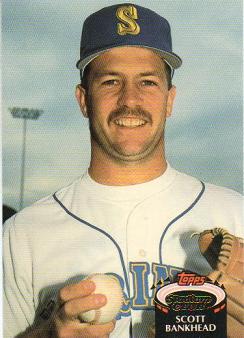
9. Scott Bankhead, P The M’s traded for Bankhead in 1986 for some players you’ve never heard of. He then had a couple okay seasons and then posted a 4.2 WAR in 1989. He threw 210 innings, about 80 more then he previously had thrown in his career. He finished the year 14-6 and was named co-MVP of the team along with Alvin Davis. Good for him.
8. Floyd Bannister, P A local boy hailing from Burien, Wash., Bannister run as a mediocre pitcher for the M’s in the early 80’s. He made the All-Star team in 1982 when he accumulated 4.3 WAR which was good for 6th in the American League. He also lead the league in strike outs that year with 209.
7. Jim Beattie, P Now besides the few stars we’ll get to in a minute, most of the players on this list are pitchers. It’s pretty interesting that the M’s had some decent talent on the mound throughout the 80’s because they’re position players were JUST AWFUL. Terrible. So bad.
Beattie joined the M’s in 1980 after two years being okay to bad for the Yankees. He struggled for a couple years posting 5.21 and 4.85 ERA’s in 1980 and 81, but then posted a 2.97 ERA in 1981. Oh wait, he only started nine games. He really wasn’t that good. Only a 1.6 WAR. But still lead the pitchers for that team in WAR. Man the Mariners were bad.
Anyways, his break out season came in 1984 when he posted a 4.8 WAR just narrowly beating out up and comer Mark Langston who had a 4.4. Being a good pitcher must have really rubbed him the wrong way because he the next year he sucked and the year after that he sucked some more and then he retired. Must have been depressed that in the second year of his career he won a World Series, then went off to rot on one of the worst franchises the baseball world had ever seen.
6. Matt Young, P Young, best known for pitching a no-hitter and losing while with the Red Sox, was drafted by the M’s and spent his first three seasons with the Mariners. His break out year was also his Rookie year as he cracked the top ten in ERA for the American League. It also lead to an All Star appearance and a team leading 4.8 WAR.
5. Mike Moore, P I’m sick of writing about pitchers. Mike Moore was one of the M’s many first pick over all’s, his coming in 1981. He made his debut just a year later, but it wasn’t until 1985 when he posted a 5.6 WAR establishing himself above the rest of the M’s pitching staff. Like well beyond the rest. That was a really bad staff, the closest coming to Moore was Ed Nunez who was only worth 1.6 WAR.
Moore would have a great ’86 season as well leading the league in games started, batters faced, and third in HBP. Is that good?
4. Phil Bradley, LF Bradley led the position players on the Mariners in WAR from 1985-87, which is not really that impressive when you think about his colleagues. But none the less 1985 was a big year for Bradley hitting .300 with a career high 26 home runs, a mark that he would not even come close to the rest of his career.
3. Harold Reynolds, 2B For as much as we adore Harold for his smooth looks and ways with the ladies, he really only had one or two good seasons for the M’s. He of course had his league leading 60 stolen base season in ’87, but he wasn’t much of a threat at the plate. He hit for an okay average, didn’t walk a lot, and hit for zero power. He did win three straight Gold Gloves for the M’s from 1988-1990. I feel like I’m really down on my number three on the list, but looking at these stats, I guess it’s like the current Mariner squad. The standard of good is lowered when you totally suck.
Here’s a sweet video to break up the monotony of this depressing list.
2. Alvin Davis, 1B Finally, Mr. Mariner! I grew up knowing who Alvin Davis was just because of his nickname and my life size growth chart I had to check my height. Davis was if nothing consistent. The big year came his first when he won Rookie of the Year honors with .284/.391/.497 batting line and 27 dingers. He would drop down to 18 homers the next two years but then bounce back with 29 in ’87. He was always good for a decent average, a lot of walks, and a good amount of HR’s. I’m glad to say he’s one of the players on this list who was an actual contributor to the M’s for a long period of time.
1. Mark Langston Now we get to the man who brought us Randy Johnson. Mark Langston was the M’s first true #1 ace. He led the league in strike outs in ’84, ’86, and ’87, as well as a slew of Gold Gloves if that matters. He had four 4+ WAR seasons with the M’s and represented us in the All-Star game twice. Plus he brought us back Randy Johnson in his trade to Montreal making the 80’s worth while for M’s fans in the 90’s.
I really encourage everyone to look for video on these players because there are tons of You Tube slide show tribute songs written but people that think they’re really cool, but I’d be very interested to see some actual video. Everyone knows the Mariners sucked in the 80’s, but they were still Mariners and it’s important to know you’re baseball heritage, ya know?