
| Enslaved: Odyssey to the West |  |
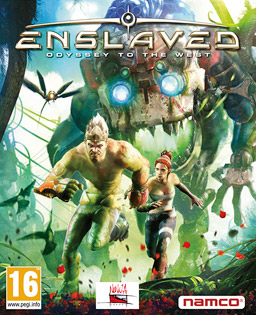
Here’s a review of a game I wish I had played last year. Enslaved is the latest game from developer Ninja Theory, the team behind PS3-exclusive Heavenly Sword and the upcoming Devil May Cry reboot DmC. It is a game that does not break new ground, borrowing its action-adventure gameplay heavily from the likes of Uncharted, Prince of Persia and God of War, but wraps around that solid base a story that is simply one of the most engaging I have played in a while.
Much of what makes this game great is its Hollywood ties. Alex Garland (28 Days Later, Sunshine) wrote the story of Enslaved, based on the Chinese classic Journey to the West, the same novel that inspired Dragon Ball. In the distant future, the modern world is in ruins. The only remnants of our civilization are ancient mechs who still do what they where designed to do: kill humans. The few people that are left face the constant threat of abduction by slavers. As the game begins, Monkey, a muscular wild man and Trip, a brainy lady, manage to escape a slaver transport. Monkey is knocked out, so Trip puts a mind control headband on him, which wounds Monkey if he disobeys her and kills him if she dies. Trip enlists Monkey’s help in getting back to her home some 300 miles away.
Andy Serkis plays Monkey and I imagine he did a lot of mocap for this game as well, just like Heavenly Sword. We’re living in a post-L.A. Noire world, so I can’t say these are the best in-game performances I’ve seen, but they’re close. The interactions between Monkey and Trip are shockingly nuanced and make the story rather touching. It helps that the whole game is beautiful, set in a vibrant, largely desolate world that is so much more colorful than most games these days. There are plenty of cinematics that seamlessly integrate with the gameplay and overall the game feels a little bit like Avatar. Except you can play it.
The combat in Enslaved is your basic heavy attack/light attack fare, with counters, evades and simple combos to keep it interesting. Your only weapon is a staff (the legendary extending staff that Goku also had) which can shoot blasts of plasma that damage or stun enemy mechs too. But getting to enemies is far more interesting that actually destroying them in this game. You often don’t stand at chance at a distance, so you’ll have to maneuver around cover and rely on Trip to distract enemies while you close in on them. It’s simple, but it adds a nice puzzle element to the game. To mix it up further, there are turret sections, races on your hover disc (called your cloud) and plenty of platforming. Platforming in Enslaved is pretty worry-free, as the game straight up won’t let you jump to your death in almost all situations. Instead, you just jump along an obvious linear path, which discourages exploration, but adds to the game’s cinematic quality.
Enslaved was a delight to play and it’s haunting ending will probably make it stick with me for a long time. The poor game sold terribly, probably because it came out in the packed Q4 2010 without much marketing behind it. During these slow summer months, there hasn’t been a lot new to play, which I why I would encourage you to seek this one out. It’s got to be pretty cheap by now and it certainly is worth a look.