



I equate the experience of watching a movie with being told a story so naturally that I often forget that that isn’t essentially what a film has to do. Jacques Tati’s PlayTime is a monumental reminder that cinema can be a game each member of the audience plays by themself. That’s a challenging initial experience, but one I immediately wish to revisit.
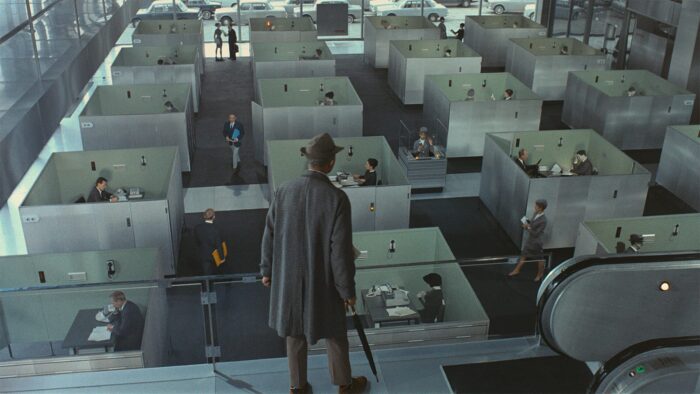
PlayTime is ostensibly Tati’s third film starring his character Monsieur Hulot, a French proto-Mr. Bean. But while Hulot’s debut, Les Vacances de Monsieur Hulot (1953), is recognizably a wholesome comedy, PlayTime is something unique. Here, the camera stays distant and usually is obstructed by walls and windows and crowds, causing it to often wanders away or even loses track of Hulot. Tati makes the audience into observers of this particular slice of life rather than attaching us to Hulot’s perspective. And what he shows us is that this baffling, contemporary Paris is a city of lost souls.
But it’s a comedy! What could be seen as a slick, mid-century modern dystopia is actually just the set-up for endless slapstick gags. People get lost in mazes of cubicles, walk into glass doors, and struggle with massively complicated modern computer systems. And in the background there’s even more going on: one of my favorite gags in the movie is in its very first shot: a janitor looking around helplessly at the airport that is so immaculately clean and sterile all he can do is shrug his shoulders and look around helplessly. There’s surrealist stuff too – Hulot rides an elevator up a bunch of floors only to exit just above where he started, mannequins come to life and people turn into mannequins, and there enough lookalikes wandering about to make you think this is secretly a Where’s Waldo movie. There’s a group of American tourists seen going around throughout the movie, and yet the only glimpses of the real, historical, iconic Paris they – and we – get are in reflections.
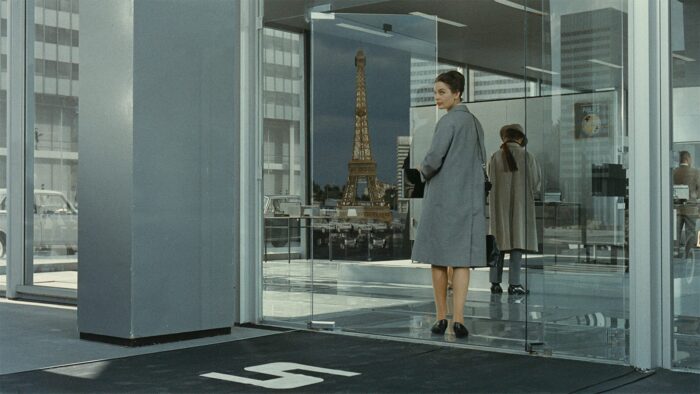
Tati was inspired to make PlayTime by Charles de Gaulle’s Fifth Republic, a period of rapid economic growth in France and Paris more specifically. Over 15 years, much of the old city was knocked down and rebuilt, including the construction of the city of lights’ first high-rise structures (skyscrapers were previously banned as no tall buildings were allowed share the skyline with the Eiffel Tower). Tati, who had lived in Paris most of his life, clearly had some thoughts about his home turning into a maze of glass and steel, like so many cities of the world already had. So he did what any artist would do: build a city set of his own (“Tativille”) and in turn make the most expensive film ever made in France …at that time, I’m going off Wikipedia here.
That budget actually explains Hulot’s presence here – Tati had wanted to retire the character but needed his popularity to boost the chances PlayTime could be commercially viable. But the sets are the star of the movie, to the point that the music is minimal and dialogue is deliberately turned down. Everything went into the glorious 70mm photography, an enormous frame that is nearly always packed with multiple sight gags going off at the same time. There’s so much going on you have to assume no two viewings are exactly the same, and I kinda wanna just put this on in the background anytime I have people hanging out at my house in the future.
Like John’s pick yesterday, PlayTime had been my go-to backup pick for many Criterion Months in a row. I’m happy that I ended up finally watching it on eve of a new Christopher Nolan movie, because with its absurd dedication to real sets, 70mm film, and inaudible dialogue, this feels like what would happen in Nolan made a French comedy in the Sixties. And hey, the chances of that happening are low but never zero!