



You want to know how long we’ve been doing Criterion Month? Since we started Criterion Month, there have been TWO, honest to God, two, Wonder Woman movies. And yet, after nine years of Criterion Month, it took me this long to watch Blow-Up, a fact made fun because it’s been a backup pick for me almost every year since then.
I mean, come on, it’s a moody mod thriller set in swingin’ ’60s London. The score features Herbie Hancock, AND the Yardbirds appear in the film. It’s like that Vince McMahon reaction meme where every new revelation brings a new level of excitement. This is the film that inspired The Conversation, Deep Red, and Blow Out. All films I love.
What took me so goddamn long?
I don’t know. I wish I had a better answer for you. I like to do a lot of theme months, so I’m sure there were times when this Criterion didn’t meet my criteria. Or maybe it was intuition, because now that I’ve watched Michelangelo Antonioni’s English-language debut, I’ve got one word (in English): “Meh.”
I didn’t dislike the film, but with such a juicy premise, I expected so much more. I’m not going to lie, I was worried after I read the short story the film was based on, “Las Babas del Diablo” (“The Devil’s Drool”), written by Julio Cortázar and published in 1959. Worried because, although the short story has a compelling conceit, I found its execution tedious and confusing.

Cortázar’s short story concerns a photographer and translator living in Paris. One day, he notices a teenage boy and an older woman in a park and snaps a photo. The woman demands the photograph, but he refuses. Later, he “blows up” the image and notices a mysterious man sitting in a nearby car. He puts two and two together and comes to suspect the woman was trying to lure the boy into a sexual encounter with the man.
It’s a solid premise, but it’s Cortázar’s approach I can’t get behind. The story jumps between first and third person, making it difficult to follow and draining much of the suspense. Granted, that’s just my reaction, so take it with a grain of salt.
So I finish the story, put on the movie, and am surprised, but not that surprised, to find the film challenged my patience in a similar way. Blow-Up has a great hook, made even hookier by raising the crime from suspected exploitation to suspected murder, but it’s hampered by pacing. I’m sure many would argue the deliberate pace reflects the photographer’s listless day-to-day routine, but did we have to waste such a good idea on such a slow approach?
I don’t know Michelangelo Antonioni. That feels like Colin territory. I’ve read he was a modernist who eschewed conventional narratives. Even knowing that much helps. This ain’t a movie from the Blake Snyder Save the Cat! school of “every beat in a screenplay should have a purpose and every scene should create momentum toward the next beat.” Not that I noticed, anyway. The scenes build on the themes, but I can’t say they build much on the action.
Adapted for the screen by Antonioni and British playwright Edward Bond, Blow-Up follows Thomas (David Hemmings), a London photographer drifting from photo shoot to photo shoot, tired of the sex, drugs, and superficiality surrounding him. We watch Thomas go through the motions before the inciting incident arrives, propelled by none other than the legendary Vanessa Redgrave.
Redgrave plays Jane, a woman Thomas photographs in a park while she’s meeting with a man. Jane desperately tries to recover the roll of film, but Thomas tricks her by handing over a different roll instead. Later, Thomas blows up the photographs and notices a third man lurking in the bushes, a potential assassin. What should Thomas do with the photos? And what role does Jane play in all of this?
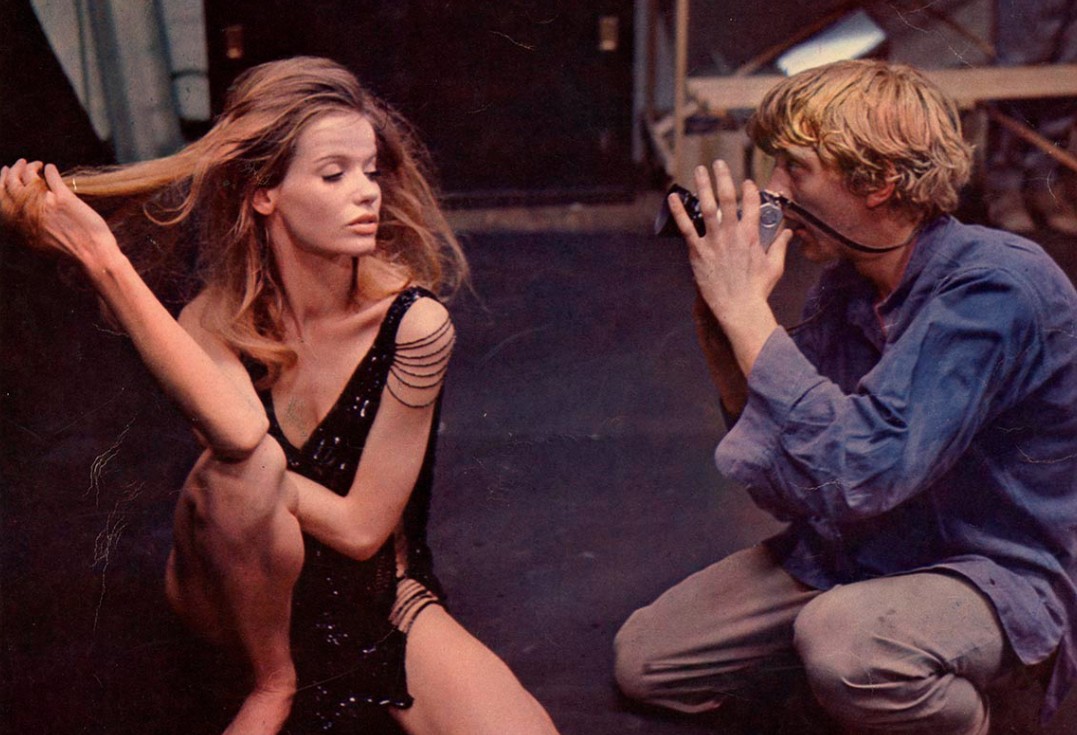
Then I zone out. Jane and Thomas have a series of encounters, he sleeps around, and tries to carry on with his life despite the lingering effect the photographs have on him. This isn’t a cat-and-mouse thriller so much as a cerebral journey for Thomas. Which I appreciate, but I can’t help wondering what this story would have looked like if Alfred Hitchcock had directed it. Oh wait, I can. It’s called Blow Out.
The culminating event, or at least the event most viewers talk about, is when Thomas follows Jane to a Yardbirds concert at the Ricky-Tick Club in Berkshire. The crowd watches like motionless zombies as the ‘Birds rock out to “Stroll On.” If you’re a classic rock fan, this is a cool moment because it captures the brief period when the band featured both Jeff Beck and Jimmy Page on guitar.
Jeff Beck’s amplifier malfunctions, and he responds by smashing his guitar. The crowd suddenly comes alive, swarming over the broken instrument. Thomas grabs the neck and runs off. Cool sequence. No idea what it means. Thomas later goes to a swingin’ party and tries to convince his buddy Ron (Peter Bowles) to accompany him back to the scene of the crime. Ron refuses. Thomas wakes up the next morning and ends up playing invisible tennis with a troupe of traveling mimes.
I’m sure there’s a rich text at work, but it feels like the text is written in another language. With a story like this, I understand the temptation to lean into ambiguity. Paranoia is always an intriguing road to go down. It’s difficult because I’ve seen Blow Out, which tells a more Hollywood version of this story that’s easier for me to engage with and is more entertaining.
Is it weird to wait this long to see a movie only to think it’s okay? Nah, that’s the fun of what we do. You want to be surprised, for better or worse, because it makes the pleasant surprises that much more pleasant. If anything, I feel like I’ve filled out another page in my personal book of cinematic exploration. You know this page has a picture too. As long as it’s blown up.