



One fun thing to be reminded of each year when we do Criterion Month is that film is such a rich, wide-ranging, and diverse medium that there are always new pockets of great filmmaking around the world to discover. Namely, I chose to watch Cairo Station for not much reason other than that it was a film produced in Egypt, a country that I don’t believe has been represented yet in Criterion Month. So after watching the film and doing a little bit of digging into its production, I was surprised to find that Egypt actually had a pretty thriving film industry during the mid-20th century, on par with Bollywood.
From what I learned, it sounds like Egypt’s filmmaking output was also not too far off from that of Bollywood content-wise, with big grand escapism, made to please a mainstream audience. One of the filmmakers who was no stranger to Egypt’s genre filmmaking was Youssef Chahine, who instead turned to something grittier and street-level with Cairo Station, a film that Western audiences have often labeled as his response to Italian Neorealism.
I have not seen this comparison made before, but Cairo Station in a lot of ways reminded me of Do The Right Thing, since it most broadly revolves around a bunch of characters’ lives intertwining around one location over the course of a hot day, all eventually leading toward something tragic. Also, just like that film, we see much of the story through the eyes of a character played by the film’s director, as Youssef Chahine plays Qiwani, a guy who is considered a beggar and is pitied just because he has a bit of a limp. Qiwani is given a job selling newspapers around Cairo Station, and often crosses paths with the two other main characters we follow over the course of their day at this train station.

The first of them is Abu Siri (played by Farid Shawqi), who is a station worker who is trying to unionize the other men working at the train station throughout the film. The other is Hannuma (played by Hind Rostom, often described as “Egypt’s Marilyn Monroe”), who makes a living selling cold drinks around the station, though she seems to be selling them independently, making it unclear how on-the-level her business is. Hannuma is engaged to Abu, but nonetheless, Qiwani is fixated on her, at one point proposing to her. Hannuma’s feelings toward Qiwani is that of empathy, as she does seem to have a soft spot for the guy, even if she’s clearly more enamored with the more traditionally masculine Abu (Shawqi was known to be one of the more beloved leading men of his time in the Middle East).
Over the course of the film, we see that Qiwani is slowly losing it, often just in the simple way that the camera is constantly focusing on his eyes, communicating a kind of sinister vacancy. He eventually buys a large knife at one of the markets around the station, and clearly is plotting to kill Hannuma. However, this plot goes awry when his plan hinges on him being brought a drink bucket by Hannuma, but it is instead brought by one of her friends, so he ends up stabbing her instead. This then leads to a mad dash around the station for the authorities to catch the murderer, even though it turns out that the woman is still alive. This also involves Abu being pinned for the murder by some of his nemeses, who are against him trying to unionize the railroad workers.
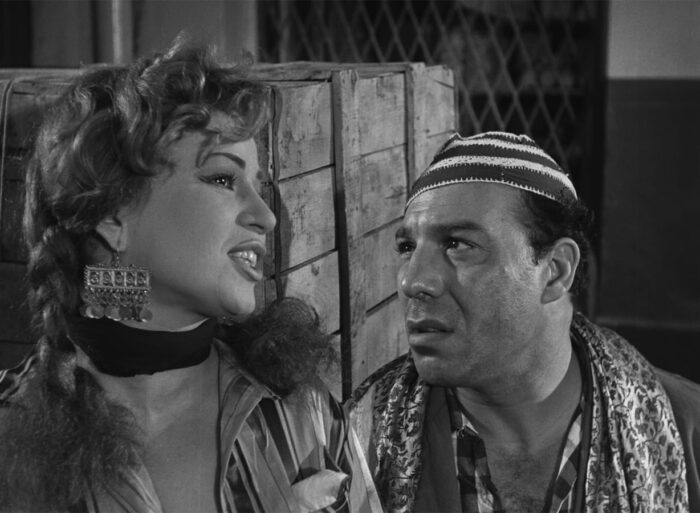
Despite the fact that the plot does ring a little bit of being a murder suspense film, it never entirely feels that way. The joys of Cairo Station are in Chahine’s ability to paint a picture of all the different goings on around the station and of all the different personalities that intersect there. While there is certainly something sinister about Qiwani’s slow mental deterioration, there’s also something infectious about the humanity throughout a lot of the scenes. There’s one that comes to mind where Hannuma boards an incoming train full of passengers as a band is playing on the train, and she treats all the sweaty passengers to refreshments while also dancing and entertaining them.
This is a film that quite simply has a lot of things going for it that I always enjoy in a film: it’s an “all in one day” movie, it’s a bit of a hang out movie, its morality is often complex, and of course it all takes place around a train station, the once bustling epicenters of cities where you could encounter every type of person on the move. There are also plenty of things about it that felt a bit foreign to me, such as the political context in which it was made, as this seemingly was a potent snapshot of Egypt post-Revolution. But overall, it’s a striking, energetic melting pot of styles that somehow turns its somewhat grim subject matter into the best kind of slice of life.