



There are plenty of directors that are closely associated with the film noir genre, from John Huston to Billy Wilder to Edward Dmytryk. However, there was really only one great noir director who found themself completely severed from the country that produced the majority of the great noirs. Jules Dassin first made a name for himself in the genre in Hollywood with fellow Criterion Collection entries 1947’s Brute Force and 1948’s The Naked City, but was blacklisted due to being a former member of several American communist party associations in his younger years. This is how Dassin ended up directing his later films in Europe, such as heist classic Rififi. While Dassin was in the midst of being ousted from Hollywood, he made a sojourn to Britain to direct Night and the City, a film fittingly about a desperate man with more than a few walls closing in on him.
Based on English writer Gerald Kersh’s 1938 novel of the same name (which Dassin admitted to never having read), Night and the City is set in a cold, dark, shadowy version of London that feels like it could only exist in the aftermath of World War II, even if the novel predates this version of the city. Our anti-hero at the center of it is Harry Fabian (played by Richard Widmark), a con man constantly trying to squeeze money out of his exhausted girlfriend (Gene Tierney) and whose greatest frenemy in the underworld is the nightclub owner Phil Nosseross (Francis L. Sullivan) and his equally ambitious wife Hellen (Googie Withers). One night, Harry tries to pull a con at a wrestling match but is quickly thrown out before ass-kissing his way into a friendship with the renowned veteran wrestler Gregorious (played by actual wrestler Stanislaus Zbyszko), who is disgusted with the theatrics of modern wrestling compared to the Greco-Roman tradition.
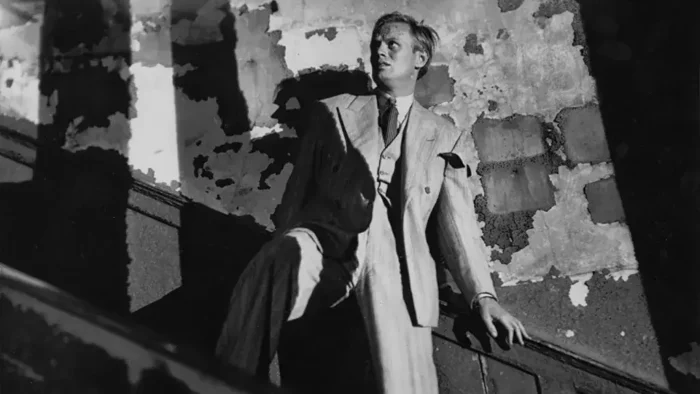
Harry’s scheme is to partner with Gregorious and his up-and-coming wrestler son Nikolas to put on wrestling matches outside of the control of Gregorious’s other son Kristo, who basically owns London’s wrestling world with an iron fist. Harry goes to Nosseross for an investment in his wrestling enterprise, which Nosseross says he’ll front if Harry is able to come up with half of the required investment. After rooting around for such funds, Helen eventually propositions him behind her husband’s back, because she’s willing to give Harry the money if he’s able to get her a license to open up her own nightclub. Of course, Harry is all too happy to oblige, taking the money to get Nosseross to front his investment and getting his wrestling dreams underway.
However, Harry’s scheme quickly goes awry when Kristo finds that Harry has gotten himself knee-deep in family drama by forming a partnership with his dad. Kristo then forms his own devilish partnership with Nosseross (who at this point has suspected Helen and Harry are in cahoots), withdrawing his financial backing of Harry’s endeavors and suggesting that Nikolas wrestle a showier wrestler named the Strangler, thinking it will surely make money (while also knowing it will not go over well with the integrity-obsessed Gregorious). There’s plenty more backstabbing and double-crossing that goes on in the film’s last half that I don’t feel the need to get into, but there’s a particularly brutal wrestling scene that happens between the Strangler and Gregorious of all people, which has disastrous consequences for the already constantly sweaty Harry, which leads him on a doomed chase through the dark corners of war-ravaged London as an insurmountable legion of goons are hot on his trail.
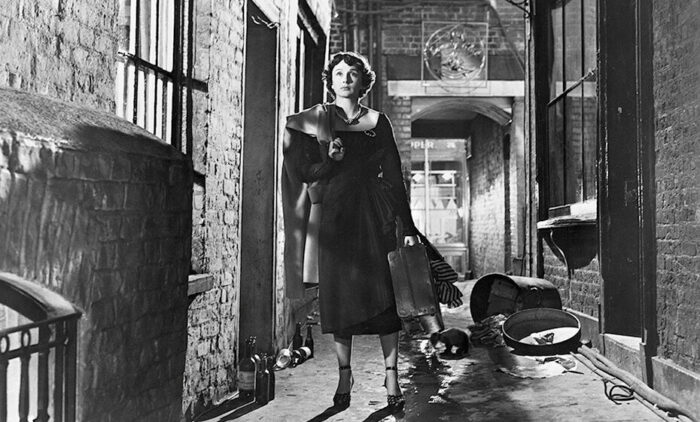
This final chase sequence, as well as much of the film itself, couldn’t help but remind me of a favorite of mine, The Third Man, which came out just a year before Night and the City. Both films have this similar vibe of being about an American stuck in a once great European city that has been bombed to bits and only seems to contain the darkest vestiges of human nature around every corner. However, with the absence of a plucky zither score and the real-life camaraderie of Joseph Cotton and Orson Welles providing a bit of warmth, Night and the City is a much darker film. It seems like every character is in it for themselves, while Richard Widmark’s Harry trumps every other seedy miscreant that shows up in the film in terms of sheer selfishness and recklessness.
As you might expect from a film noir, what’s captivating about Night and the City’s darkness is not just thematic, but also quite literal, as this is one of the most arrestingly shadowy-looking films in a genre filled with them. Cinematographer Max Greene captures every scene with a sharp contrast, while every scene seems to take place in a room that feels more lived-in and ravaged than your average film noir, filmed on pristine Hollywood soundstages. The film uses a lot of shooting on location in post-war London, and along with a camera that’s as constantly on-the-move as Harry is, it gives the film a dynamic, pulsating quality that film noir sometimes lacks.
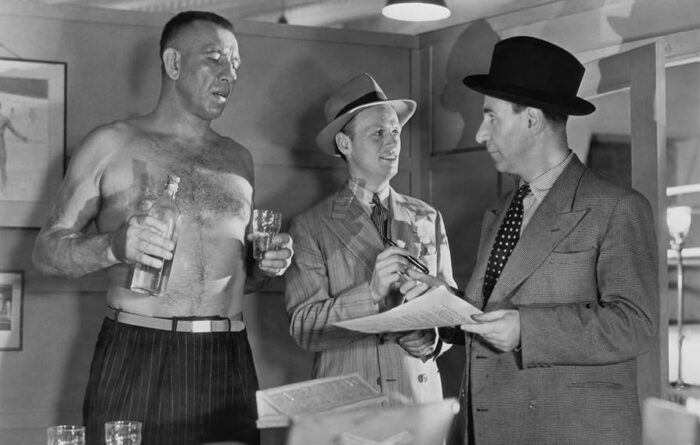
As a longtime fan of Rififi’s methodical, extended heist sequence that serves as the film’s centerpiece, I was struck by Night and the City featuring a somewhat similar sequence that feels unique for its time in the way it really draws things out. This would be the one-on-one wrestling sequence that happens between Gregorious and his younger nemesis, The Strangler. There’s nothing particularly thrilling about the sequence; it’s more just slow and brutal, epitomizing a kind of primal cruelty that lurks beneath a lot of the characters’ motivations in the film; it’s just that everyone else thinks that they’re more sophisticated than these strongmen. But in the end, everybody’s just trying to pin the other fella down.