



It’s always striking to see a film that holds up so well in terms of content and yet is so tied to its time period in terms of aesthetics. I’m hesitant to use the word “dated”, because I think a film like Working Girls is aiming to portray an authentic version of its own reality, even if that reality feels unmistakably born of the 1980s. But the guiding philosophy of Working Girls seems to be that “sex work is work”, a phrase I only remember popping up in the public consciousness in the last decade or so. So to see a film that portrays sex work in terms of labor and workplace politics feels pretty remarkable, even if the hair, make-up, and name brands used in the film feel like relics of the Reagan years.
Working Girls depicts a day in the life of several sex workers who are employed at a brothel in Manhattan, seemingly in some run-of-the-mill office building. We most closely follow Molly (Louise Smith), a Yale graduate, who we see in the early moments of the film waking up next to her girlfriend, eating breakfast, and then heading out to work like it’s any mundane workday. When she gets to work, we are introduced to her colleagues, Dawn (Amanda Goodwin), a college student who has a tendency to be difficult with her co-workers and clients, and Gina (Marusia Zach), a boutique owner who’s more just a solid worker looking to get through the day.

Over the course of the day, we see a revolving door of johns show up at the brothel, and we see in unflinching fashion what happens in the brothel’s bedrooms between the working girls and their johns. We’re later introduced to Lucy (Ellen McElduff), the brothel’s madame, who is out shopping when Molly gets into work, which sets the tone for Lucy being more interested in money and material things than keeping her workers happy. Over the course of the day, Molly’s sexual encounters run the gamut from pleasant to awkward to bordering on violent. It leads to Molly slowly over the course of this day — in which Lucy asks her to work overtime — begin to question whether she wants to continue working there once the day is through.
Director Lizzie Borden had come out of New York’s downtown art scene in the ’70s, and her first two films, Regrouping and Born In Flames were more on the documentary side and released in relative obscurity. Working Girls, however, was released through Miramax and, despite being released without a rating, brought her a bit more mainstream visibility. Her interest in making the film was sparked when doing research for Born In Flames and learning that many of her preconceived notions about sex work didn’t necessarily align with society’s clichéd perceptions. Namely, that it wasn’t all just the kind of street-walking hookers we see as murder victims on cop shows or high-end call girls. There was also this more middle-class version of sex work that Borden observed at this brothel in Manhattan, which felt more like your average workplace, despite the work itself being criminalized and criticized by society.
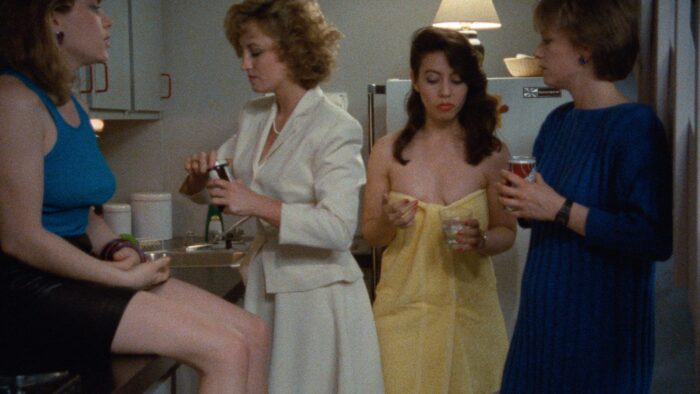
It’s in this unadorned, almost mundane manner that the film is shot that I found the film to be quite singular. There are a lot of conversations between the working girls about how to best handle certain clients, techniques to use for certain sexual preferences, and also how to compartmentalize their profession in relation to their personal relationships outside of work. It felt quite reminiscent of your average water cooler conversations, other than that the work that their day revolves around is sex. The movie almost feels like it could have been the pilot for a groundbreaking HBO workplace dramedy if it had been made 20 years later and toned down the nudity just a bit.
There’s also a unique objective quality in the way the sex scenes are shot. I have a hard time deciding whether the scenes are meant to be titillating or not, but maybe that’s beside the point. Working Girls aims merely to show what sex on-screen looks like when romance is absent, which is a rare thing for a romanticized medium like the movies to show. These are girls going about their jobs, which does require some degree of making their clients feel like they’re being loved, even if that’s not the case. Borden’s camera emphasizes different parts of the human body at different parts of the sexual encounters, as she seems to be more interested in the minutiae of the acts themselves rather than what the characters are feeling during them.
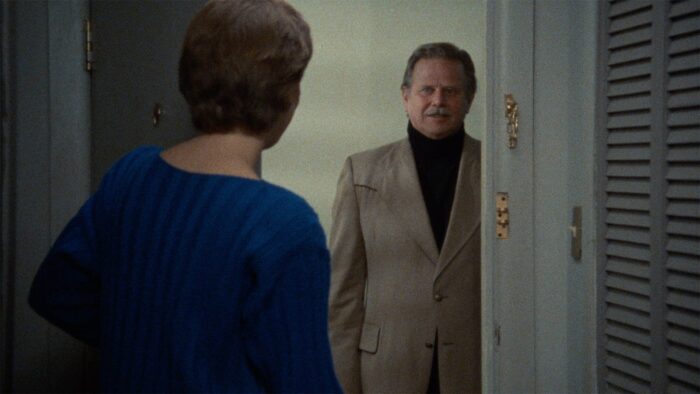
I think the only issue I have with the film as a whole is that it does encounter some limitations of being a low-budget film made during a period when Hollywood did not put many resources into indie film productions. Some of the performances are a little rough around the edges, but Borden has such a knack for pacing and thought-provoking dialogue that it rarely matters. Also, the aforementioned ’80s aesthetics can be a bit distracting, what with the drab office decor and tacky ’80s fashion that keep the film from feeling entirely timeless. But I don’t think that’s a huge problem, since it also makes the film interesting in the context of this capitalism-obsessed decade, and you can see the characters’ motivations for just making a buck as an extension of that.
Anyways, this is a film with a lot of potent ideas located at the intersection of sex, feminism, and capitalism. This is evidenced by the Criterion essay for the film by So Mayer, which is one of the longer and more intellectual ones I can remember Criterion publishing. I can’t claim to be an expert on all the ideas at the heart of the film necessarily, considering I’m not a woman, terribly knowledgeable about sex work, or a Marxist. However, I still found Working Girls to be a fascinating depiction of a long-maligned profession, that I think anyone can relate to on some level, since we’re all just trying to get through each day by whatever means necessary, no matter what our job is.