



Aw man, I was so excited to finally check out Bob Fosse’s next biggest movie (as a director) nearly a decade after doing All That Jazz until today, when I finally had to sit down and watch it. That’s because I realized I didn’t account for two things: 1) writing about biopics is incredibly boring and 2) The Odyssey came out this weekend and it rules and kinda all I wanna do now is read about The Sea Peoples. But worry not friend, Lenny was more than interesting enough to have really woken me up and grabbed my attention against those perilous odds. I mean, what did I expect? It’s Bob Fosse.
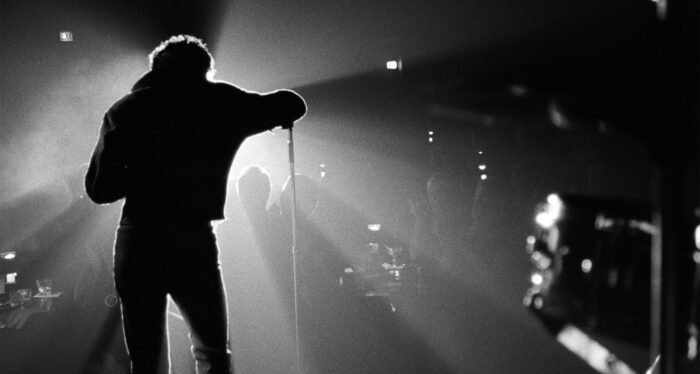
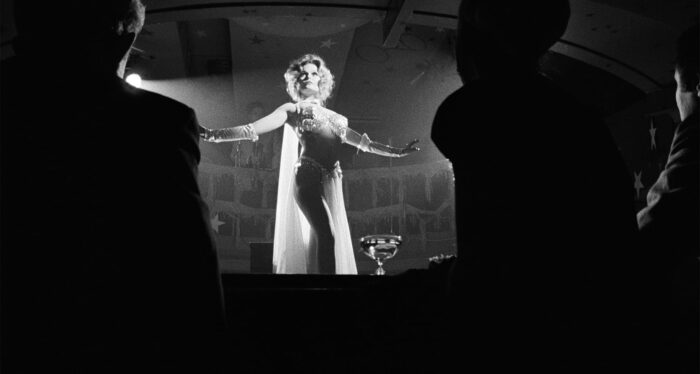
Presented as a sort of non-linear mockumentary, Lenny follows the career of legendary comedian and free speech advocate Lenny Bruce (Dustin Hoffman), from his early struggles as a strip club emcee to his death by overdose at the age of 40. His rise to fame is paralleled by his wife’s, Honey Bruce (Valerie Perrine), a showgirl who eventually performed in a double act with him. As you might expect with a showbiz biopic, both of them struggle with married life, raising their daughter, fame, legal problems, and drugs. The story unfolds in behind the scenes intimate moments which are interspersed with stand-up performances and formal interviews with Honey, Bruce’s mother, comedienne Sally Marr (Jan Miner), and his manager, Artie Silver (Stanley Beck).
Fosse, himself no stranger to the pains of being anything but pure of heart, seemed much more interested in making Lenny about the man, rather than the legacy. So while yes, we do see Bruce’s desperate attempts to fight absurd obscenity laws, we see little of the effect that has on the nation and a lot of the enormous toll it takes on him. I don’t think you’d necessarily walk away from this movie believing Lenny Bruce was all your favorite comedians’ favorite comedian (or at least the one that paved the way for all of them) and maybe that’s a byproduct of when it was made: 1974, only eight years after Bruce’s death and still three decades before Bruce’s pardon by New York Governor George Pataki. But Roger Ebert did write “Unless we go in convinced that Lenny Bruce was an important performer, the movie doesn’t convince us.” I think that’s fine. I think Fosse saw someone who lived a controversial life and wanted to make something that was equally controversial, in both style and substance, rather than reverential. More Raging Bull than The Trial of the Chicago 7.
As a sidenote: why are all the best biopics black and white movies made in the color era? Raging Bull, Ed Hood, Oppenheimer, to name a few…

Lenny was adapted by Julian Barry from his 1971 play of the same name, which makes me wonder how similar they are since this feels so cinematic. The most theatrical aspect of the movie is how much of it rests on the shoulders of its two stars, Dustin Hoffman and Valerie Perrine. Hoffman always seems like such a serious guy, I had a hard time imagining him playing a comedian, but of course Lenny Bruce was a pretty depressed dude who sucked at telling like “joke” jokes and was a genius at using stand up to talk about the issues of the day. In a storied career, I can see why this performance is held in high esteem. And Hoffman is maybe surpassed by Valerie Perrine, who is asked to do a whole lot – everything from burlesque routines to hospital stays to a prison sentence to drugged out mania to the melancholy of remembering Lenny after his death. The were both nominated for Academy Awards that year, and Perrine won Best Actress at Cannes.
Speaking of the Oscar noms, as great as the performances are, the real star of Lenny is cinematographer Bruce Surtees. The movie exudes such a seedy, smoky atmosphere that I had a hard time find a moment to look away to play Wordle or whatever I’d normally do when I have the advantage of watching a movie in the English language. Kudos to the production design too, and to editor Alan Heim. One of the cringiest scenes is Lenny performing a set absolutely loaded, wearing a raincoat and one sock and yelling at the unperceptive audience, and Fosse and Heim let the short set play out in its entirety in one long, stationary shot. Absolutely brutal. And, in conclusion, I’d be remiss if I didn’t shout out for the Johns of the world: there’s lots of shots of boobs and butts that look great too.