



A lot of fairy tales are pretty weird, even despite the fact that they’re an inseparable part of most people’s childhoods. Filled with eating children and killing grannies and creepy little weirdos with unpronounceable names, there are a lot of strange things in these stories that get passed down to each generation. And yet, we as children take them at face value because as far as storytelling, they’re all we know at that age. So what does it look like when a director tries to make a film that evokes that childhood purity that one gets being read a fairy tale before going to bed? Well, that’s what Jacques Demy aimed to create with Donkey Skin. However, because it’s a fairy tale that has never been all that popular in English-speaking countries, it’s hard not to be struck by its charming weirdness.
The fairy tale in question is Donkeyskin, written in 1695 by Charles Perrault and one that director Jacques Demy had been familiar with since he was a child. Like the story itself, I’ll just be very upfront and say that what makes this fairy tale weird is that it involves incest. Which, of course, yuck. The film begins by introducing us to the Blue King (Jean Marais), whose wife, the Blue Queen (played by Catherine Deneuve), is quite ill. Fearing that she will die soon, the queen tells the king that after she dies, the king can only marry another woman who is as beautiful and virtuous as she is. After she passes away, the king’s advisers come to him, insisting that he must find a wife so he can produce an heir.
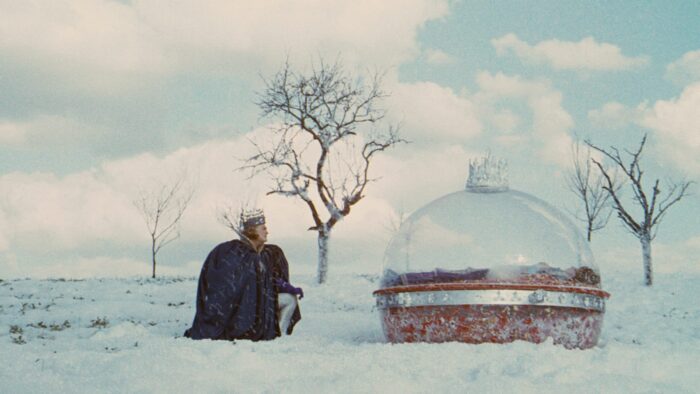
The king’s advisors start bringing the king paintings of princesses near and far, and none of them suit his taste until one painting strikes his fancy. However, it’s then revealed that the painting is of his daughter, the princess. We then see the lonely princess (also played by Deneuve) sing a sad song in the courtyard that will become a recurring musical motif throughout the film. As is often the case with fairy tale princesses, she has a fairy godmother (played by Criterion Month favorite Delphine Seyrig), and after the king proposes marriage to his daughter, the godmother advises against it.
As a way of fending off her creepy dad’s advances, the godmother suggests that the princess make impossible demands in exchange for her hand in marriage, first by demanding he gift her a series of unfathomable dresses. First she asks for a dress that’s the color of the weather, then one that’s the color of the moon, and then finally the color of the sun. However, the king is able produce all three of these dresses, my favorite being the dress the color of the weather, which uses a nifty technique to project clouds onto it. This leads the princess to stoop to the last resort suggested by her godmother: she asks for a dress made of the skin of her father’s prized donkey. Of course, this is no ordinary donkey. This is one that poops out jewels and coins, which seems to be the source of the king’s wealth.
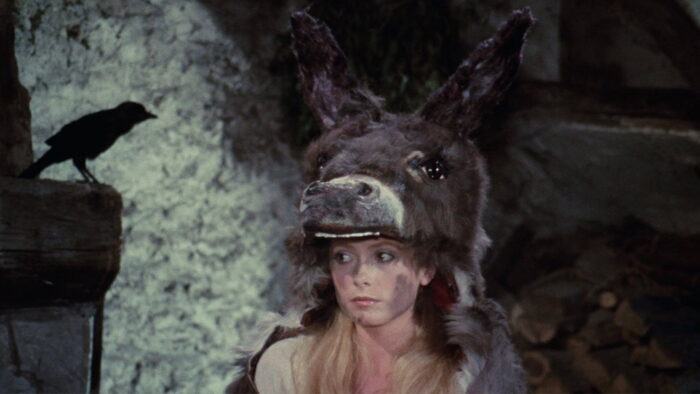
The princess is then shocked when the king comes into her room with a skinned hide of his favorite donkey and offers it to his daughter. This prompts the princess to flee the kingdom with nothing but her donkey skin and the desire to start anew, so she settles down in a small village and starts going by the name “Donkey Skin”. Most of the villagers are repulsed by her, considering the fact that she is never seen without wearing a skinned donkey carcass. She ends up living in a little cabin in the woods, and one day a prince from a kingdom where everyone is red instead of blue (as was predominant in her own kingdom) finds himself spying on her, which leads to the two of them falling in love.
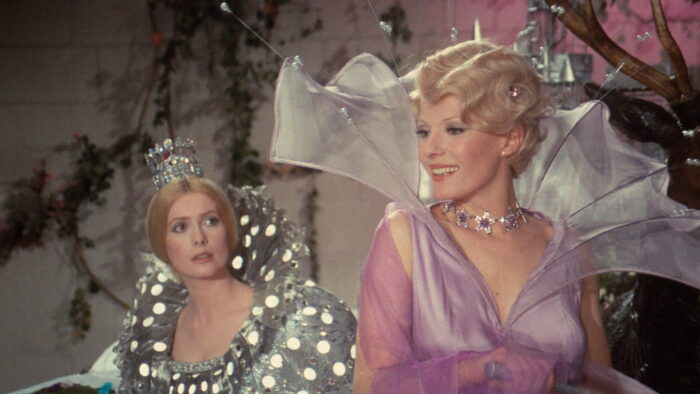
When he returns to his kingdom, he ends up spending a bunch of time lying in bed (I guess he’s just a sleepy boy) and demands from his servants that they have Donkey Skin bake him a cake. When his servants show up at her door, she fulfills his wish and bakes him a cake while literally singing to herself, as she’s now decked in her princess garb while a spirit version of herself rattles off ingredients for the pie. When the cake is returned to the prince, he eats it, delighted, but then finds that there is a ring baked into the cake. In very Cinderella-esque fashion, the prince declares that whatever woman’s finger fits into the ring he’ll marry, which sets off a succession of women lining up to try on the ring, which of course fits Donkey Skin once she finally shows up at the palace.
Recounting the plot of a movie is usually not my favorite part of reviewing one, but I actually did enjoy doing it for this review because it’s so easy to remember and yet so bizarre. And yet, if you grew up in France, it probably would not seem all that strange to you. There is something charming about the way in which Jacques Demy doesn’t try to do too much to change the story for the sake of adaptation (or taste), just letting this weird little story do its thing on screen, even risking alienating the audience in the process.
Demy pointed out in an interview that the strangest part of the story (the idea of a king marrying his daughter) would not seem all that strange to a child, though an adult would of course find it problematic. But it gets at why Oedipus Rex is such an enduring story and also, I suppose why this one is if you’re French. I’m not sure I have much else to dissect about this aspect of the story, since it’s really just the catalyst for the film, but still something that certainly sticks out by today’s standards.
What you get during the rest of the film is a lovingly curated ode to childlike imagination. The costumes are colorful and gaudy in a way that I mostly like, but also had me often questioning whether this was camp or not. Either way, like all of Demy’s films, there’s an emphasis on color and set design meant to stir up big feelings. Here, he also uses a lot of practical effects that perhaps aren’t the most technically impressive, but also do the trick of creating a fantasyland during a time when the main place you saw fairytales brought to the big screen was in Disney’s animated films. This resulted in Demy being heavily inspired by Jean Cocteau’s Beauty And The Beast in terms of bringing a non-animated fairy tale to the screen, even casting that film’s star, Jean Marais, as the king.
Of the films of Jacques Demy I’ve seen, I’m not sure that this is near the top, but it still feels like a very pure distillation of what makes his films delightful. The aforementioned use of color is as present as ever throughout the film, as is the music of consistent collaborator Michel Legrand, as well as the unmistakable presence of another consistent collaborator, Catherine Deneuve. Fairy tales had always been a part of Demy’s approach to storytelling, and so it seems only fitting that Demy finally make a full-on fairy tale, sort of like how it seemed inevitable that Quentin Tarantino finally start making full-on Westerns. While this perhaps doesn’t result in Demy’s best film, it’s still fascinating to see him indulge such pure impulses. Also, at the end of the day, it’s hard to name a lot of films quite like this one.