



I had become more interested in Japanese noir two Criterion Months ago after watching Pale Flower and realizing there must be more there, especially when stumbling onto the reputation that Seijun Suzuki’s Branded To Kill had within the genre. Also, taking into account that I’d seen and liked Suzuki’s earlier Tokyo Drifter, I figured this film would be a fun time. While I’m not sure I understood large portions of what this movie was going for, I can still see some of the allure of this film that seems to have influenced a fair share of filmmakers. But overall, I just found its plot and intentions a little too indecipherable, which was famously what got Suzuki fired from the Nikkatsu film studio, as they declared that he made “movies that make no sense and no money”.
I wish I could tidily sum up the plot of Branded To Kill, but that might involve just copying and pasting what I’ve seen online, since I really have a hard time communicating what this movie is about. That said, there are still enough tangible bits and pieces I could give you. The main thing to know is that the film stars a hitman named Goro Hanada (played by the chipmunk-cheeked Joe Shishido) who is the number 3 killer in the world. Unsurprisingly, over the course of the film, Hanada comes into contact with the other top 5 killers and ends up taking them down with expert marksmanship and a cold, calculating nature.
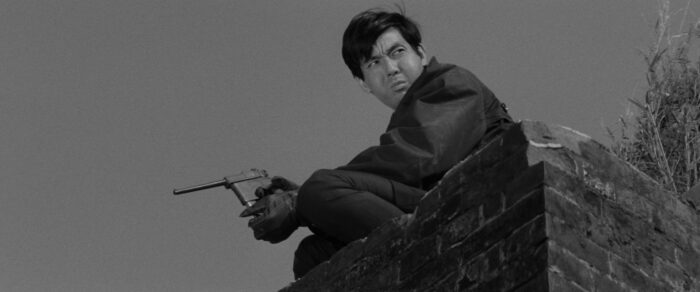
Really the only defining characteristic we get to know about Hanada is that he gets turned on by the smell of boiled rice, which we see in a surprising amount of sex scenes. Otherwise, he is very much your typical hyper-professional killer for hire, first being hired by a Yakuza boss to escort a client from Sagami Beach to Nagano. One night, after one of several gunfights, he’s picked up on the side of the road by a mysterious woman named Misako (Annu Mari) who has an obsession with death. After meeting her, he’s compelled to go back to his apartment and have rough sex with his girlfriend Mami (Mariko Ogawa), which may or may not also be fueled by the smell of rice wafting through the air. After that, Hanada continues to be a target in the underworld after bumping off the wrong man, while he also continues to find himself crossing paths with the mysterious Misako, who has a penchant for keeping a vast collection of butterflies in her apartment.
I think the biggest problem I had with this movie is that I am rarely enamoured with movies that are nothing but an exercise in style. I had basically no connection to these characters at all, and their motivations were made very fuzzy by the film’s scrabbled-together plot. It seems that director Seijun Suzuki had a penchant for spontaneity in his films and would come up with ideas the night before filming. In the case of Branded to Kill, it seemed that these tendencies were combined with the fact that the film went into production while Nikkatsu still had problems with the script, prompting a bunch of last-minute rewrites.
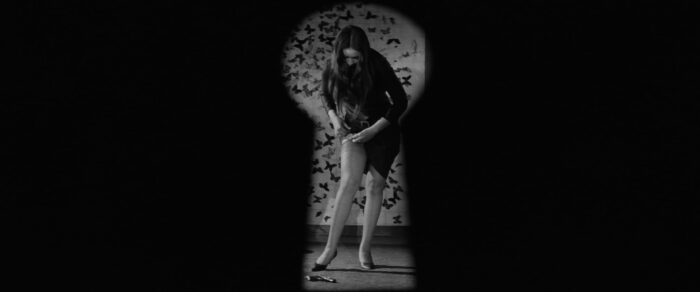
The result is something that is certainly memorable and that you can see influencing everybody from Wong Kar-Wai to Quentin Tarantino to Jim Jarmusch. The film is a true pastiche and send-up of yakuza movie clichés and style, playing by its own rules and throwing all sorts of weird imagery in here and there. It also just looks great, with its black-and-white cinematography creating a moody, expressionistic underworld combined with an off-kilter jazzy score. However, I found myself having a hard time paying attention when there wasn’t all that much to get invested in from an emotional perspective. Also, it always just bums me out when a movie asks all of its leading actresses to perform nude scenes when shit like that is never expected of their male counterparts, not that this was a trope that had much precedence in 1967.
While I had a hard time connecting with Branded To Kill, it’s still a film I could see myself enjoying more in a certain setting, like on a subsequent viewing where I know the plot won’t matter much, or at say, a midnight movie screening where a thirst for weirdness is more welcomed. But watching it on a Saturday afternoon, after having watched a similarly dizzying narrative in Juliet of the Spirits, I just wasn’t in the right headspace for this one. Maybe I’ll try boiling rice beforehand next time.