



Like Brian De Palma, Aussie director Richard Franklin was very much a disciple of Alfred Hitchcock. In fact, Franklin was such a devotee that, while attending USC, he was determined to get Hitchcock’s Rope (1948) screened on campus. This effort led to Hitchcock personally calling the school, and Franklin inviting him to give a lecture, which he did. The two struck up a friendship, and years later, in 1983, Franklin would go on to direct Psycho II.
A glance at Franklin’s filmography paints the picture of a true genre filmmaker. The guy loved horror and suspense, high-concept ideas that practically pitch themselves. Movies that feel Hitchcockian, but updated for modern audiences. Like in 1979, when Franklin landed on the idea: “What if someone made Jaws… but with chimps?”
But it wasn’t until years later, when Ozploitation scribe Everett De Roche (who’d previously collaborated with Richard Franklin on Patrick and Roadgames) shared a National Geographic article about intertribal warfare among chimpanzees, that the idea for Link finally clicked. And it’s a killer premise: a woman stranded in a house in the English countryside with an obsessed ape. Throw in some cigars, and you’ve got yourself a movie.

Link is a unique one, not just because of its unusual setting and tone, but because it casts an orangutan as the antagonist rather than a gorilla or chimp. At the time, most people didn’t realize chimps are actually the most dangerous of the great apes (a fact that became much more widely known after a grisly 2009 incident involving human face-eating). Orangutans, by contrast, have a reputation for being pretty chill, which, in a way, makes the film even more unsettling.
Link (played by Locke the orangutan) is a seemingly well-mannered butler. He’s 45 years old, smokes cigars, wears suits, and used to work in the circus. He’s been around humans his whole life. You’d never expect anything bad from Link, right? WRONG.
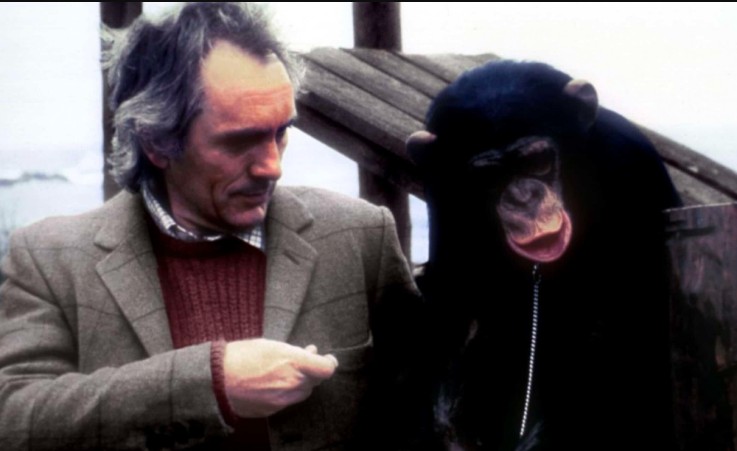
Elizabeth Shue plays Jane Chase, a zoology student studying in London under the eccentric Dr. Steven Phillip (Terrence Stamp with an insane Beethoven haircut). How eccentric is Dr. Phillip? Well, when he’s not in class he’s living in a Victorian Mansion on the English coast with three apes. There’s Imp, a young but naive chimp Dr. Phillip takes to class, Voodoo, an older more aggressive chimp, and Link, Dr. Phillip’s orangutan butler.
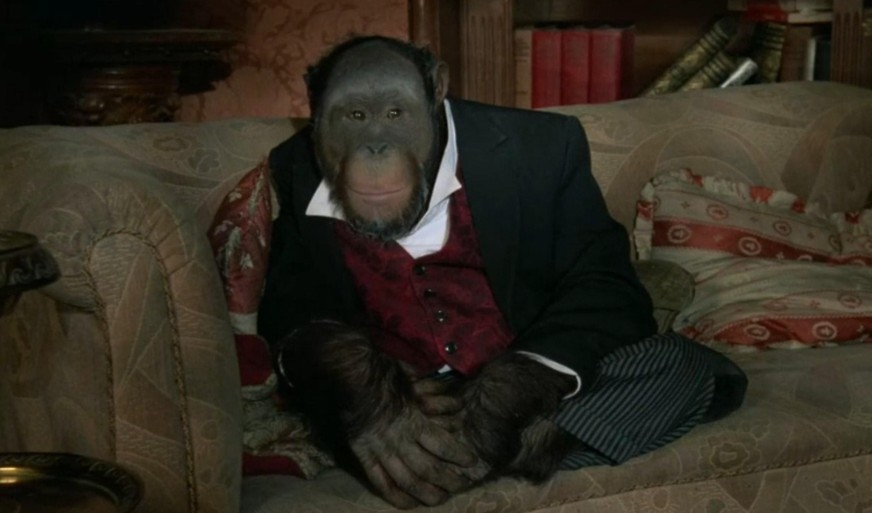
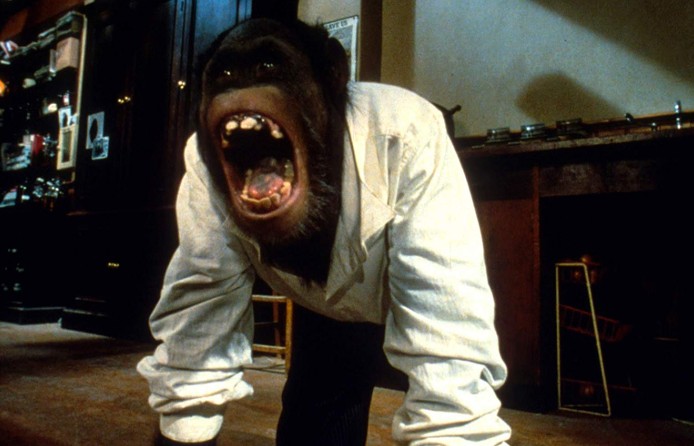
In hopes of furthering her studies, Jane volunteers as Dr. Phillip’s assistant while he trains young apes to solve puzzles and advance their cognitive abilities. The key word here is “young,” because as apes age, they become aggressive, which is why Dr. Phillips has decided to euthanize the aging Link. This, combined with Link’s obsession with Jane, results in a rumble in the jungle (not literally), as Link kills Dr. Phillips and hides the body, leaving Jane to believe he’s stepped out to attend to his regular ol’ monkey business.
What I like is even though it’s obvious Link is behind the disappearance of Dr. Phillips, we’re not shown this right away. You know where it’s going, but not how it’s going to get there, the mark of a good suspense thriller. This, combined with Franklin’s inventive camera angles and zooms, makes Link a thrilling watch.
What hurts the movie for me, and it pains me to say it, is the score. It pains me, particularly my ears, because it was composed by Jerry Goldsmith, one of my all-time favorites. We’re talking about the guy behind the Oscar-winning theme to The Omen, as well as classics like Patton, Alien, Poltergeist, some of the best Star Trek music, and even the original Planet of the Apes. That last credit alone should have made Goldsmith the perfect choice to score a killer ape movie.
Jerry was very hit or miss in the 1980s. He did, as many composers, fall prey to synths and drum machines. The main theme to Link is carried predominantly by an aggressive drum machine with a flutey or organy kind of melody line on top. The feel is similar to Tales from the Crypt, but if it was for kids. I guess that’s what the ABC morning show Tales from the Cryptkeeper was. I think it’s trying to evoke circus music (cuz apes), but the result feels more like the theme to a children’s Halloween special.
It’s funny, because two years earlier, Goldsmith scored Gremlins, which has a similarly offbeat energy powered by an angry mob of synth voices. The difference is Gremlins is a horror-comedy. Link, for the most part, plays things straight. A more traditional score would have added a lot to the film’s tension, instead of sounding like a goofy romp on a Casio.
The film does have goofy moments, but they don’t always feel intentional. Still, there are effective touches. It’s the little things, like when Link stares at Jane as she undresses to take a bath. I bet Alfred Hitchcock would have approved of that scene.
Ray Berwick, best known for training birds for The Birds (of course Franklin used him), served as the animal trainer here, and for the most part, Link and his fellow ape co-stars feel like real characters. They seem to understand they’re in a movie and know exactly what to do. It’s fascinating to watch, especially in an era when all of this would be done digitally. For that alone, it’s worth checking out.
Link doesn’t have much of a cult following, nor has it undergone any cultural reappraisal, but it should. Regardless of the final product, this is an ambitious piece of storytelling that mostly succeeds at what it sets out to do. If anyone should seek it out, it’s Hitchcock devotees: isolation, voyeurism, the vulnerable blonde, it’s all here. You might even say Link is the missing link between Hitchcock and contemporary thrillers. I wouldn’t say that… but you could!