C.A.T: Walk Among Us

Misfits – Walk Among Us (1982)

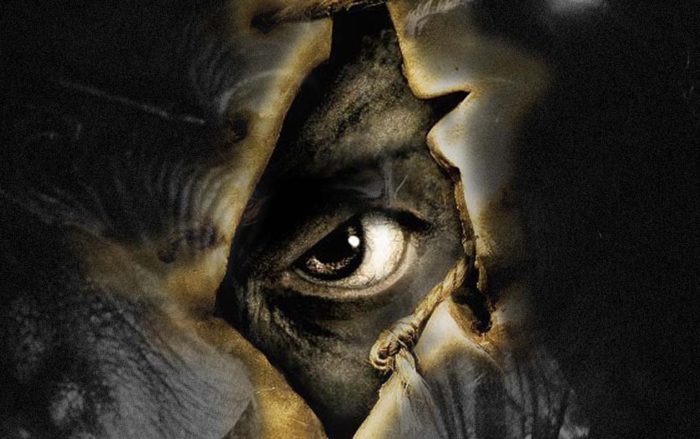
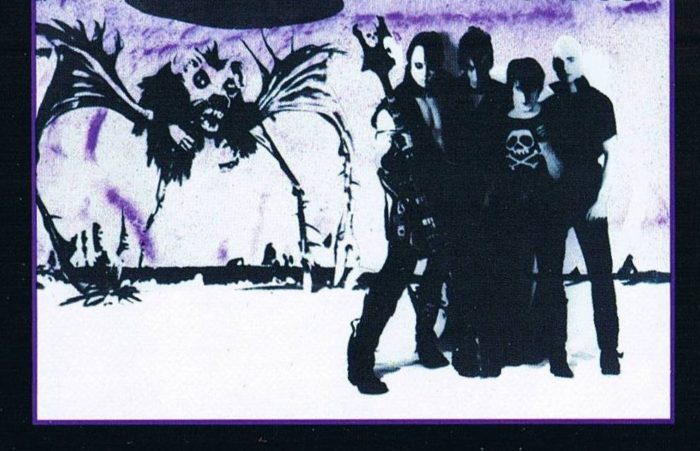
Somewhere between the corporate fuck glam of Kiss and the shock rock of Alice Cooper lies Misfits. A gritty combo of monster makeup and hardcore punk, Misfits brought Horror Punk from the depths of hell and unleashed it upon this mortal coil. Led by Glenn Danzig, a stocky figure so imposing he was once considered by Twentieth Century Fox to play Wolverine, despite no acting experience, Misfits were rock mutants in a league of the own. Beginning their rampage in 1977, 1982’s Walk Among Us was the band’s first full-length release. Stitched together from previous recordings Walk Among Us is a punchy 25 minutes of monster mayhem.

Songs tell tales of Martians, vampires, and Astro-zombies, all while embodying a monster mash party vibe, fueled by the sheer attitude of 60s garage rock. “Woah-Ohs!” and “Yeah! Yeah! Yeahs!” boom behind the brooding croon of Glenn Danzig. Arthur Googy pounds away on drums as brothers, guitarist Doyle Wolfgang von Frankenstein and bassist Jerry Only (originator of the Devil Lock haircut) forge Satan’s favorite soundtrack. It’s hard to think of another band that has so encapsulated horror movies into their music. There’s no political confrontation here, just freaky fun and high voltage power.

Walk Among Us feels surprisingly upbeat considering its grisly wrappings. It just goes to show that you can embody a love for horror without guttural howls about burning through witches. You don’t have to be on 24/7 suicide watch to write horror songs. From its Sci-Fi inspired album cover to it’s kitschy lyrics, Walk Among Us is spooky good fun.

Favorite Tracks: “Astro Zombies,” “Skulls,” “Vampira”

Shocktober: Day 7

Cabin Fever (2002)

Cabin Fever is a fuckin’ mess. It tries to be funny, it tries to be scary, it tries to be political satire, and fails, fails, fails. I’ll give props to the film’s threat: a contagious skin disease that infects a group of teenagers in the backwoods but everything else is tired and uninspired. There’s a lot I could say about Eli Roth’s Cabin Fever; it’s derivative, it’s cliche, it’s gross for the sake of being gross, but why bother when you can just watch this:

You think that seeing the movie would explain that scene, it doesn’t. In the kitchen of horror movies Cabin Fever is just another burnt short stack.

Shocktober: Day 6

Bubba Ho-Tep (2002)

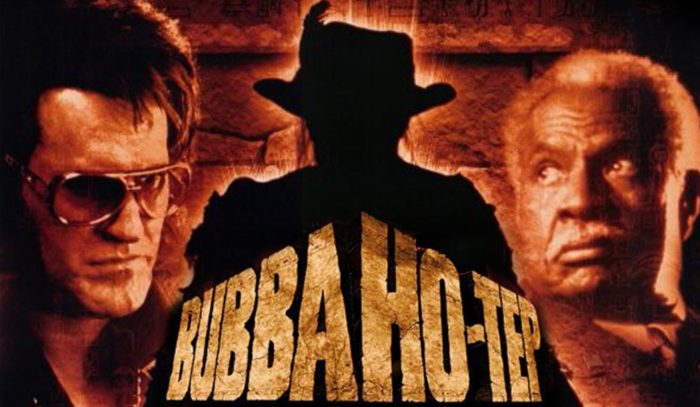
Where does an idea like this come from? An aged Elvis awakens from a twenty year coma to team up with Black JFK against a re-animated Egyptian mummy? Let’s start with the film’s writer: Joe R. Lansdale. Wikipedia describes Lansdale as an American author and martial-arts expert. Who better to write a film about Elvis than a man that shares a passion with the King for the arts and the martial arts? Lansdale is perhaps best known for his darkly comic short stories and for penning several episodes of Batman: the Animated Series. What began life as a novella, Bubba Ho-Tep was picked up by cult filmmaker Don Coscarelli (Phantasm, The Beastmaster) and cast with America’s favorite son: Bruce Campbell.

Bruce Campbell plays “The King”, but if you’re asking the individuals of the Shady Rest Retirement Home, he is the King of Crazy: Sebastian Shaff. According to Shaff (let’s call him Elvis from here on out), in the 70s he escaped the demands of fame by switching names and places with an Elvis impersonator. After a brief retirement, the impersonator died and Elvis became unable to prove his identity after a propane accident destroyed all his documentation. Elvis then fell into a coma after botched hip surgery. He awakens thirty years later and finds himself pitted against an escaped museum mummy invading the retirement home.

I know, I know. This all sounds absolutely ridiculous. Elvis fighting a mummy? It doesn’t sound like it should work but it does. It does because this movie has heart. Most of this heart comes from a warm performance from none other than Ossie Davis. Ossie plays a wheelchair bound resident of Shady Rest who believes he was once John F. Kennedy. According to him, the government dyed his skin black and then dumped him in a retirement home to hide him after his assasination. JFK and Elvis form a quirky relationship and work together to fight evil. Just the idea of people bonding after being forgotten and told they don’t matter. If that doesn’t make you feel bad for putting old people in retirement homes than I don’t know what will.

Naturally, Mr. Campbell brings the machismo but dials it down just enough to match the now dethroned king. The performances are the real draw in this monster mummy shootout. In fact, the movie would have worked without the mummy, he’s just the icing on this kooky cake. Weird to think that in a movie with an aging Elvis, a black JFK, and a western wear adorned mummy, that the mummy is the least absurd. That’s a wrap!… Please… Kill me.

BUBBA_HO_TEP
The boys are back in town!

Shocktober: Day 5

The Devil’s Backbone (2001)

Like precious blood, I’ve been absorbing anything Guillermo Del Toro for the past few months. I’ve been reading the Strain trilogy, re-watching Del Toro’s movies, and eagerly await his upcoming book of artwork and story notes. Revisiting the Del Toro library I watched The Devil’s Backbone for the first time in almost seven years and wow, a film like that only comes once in a blue moon. Where it may not match the whimsy and magic of Pan’s Labyrinth, its emotional core and symbolic imagery may make it Del Toro’s most personal film.

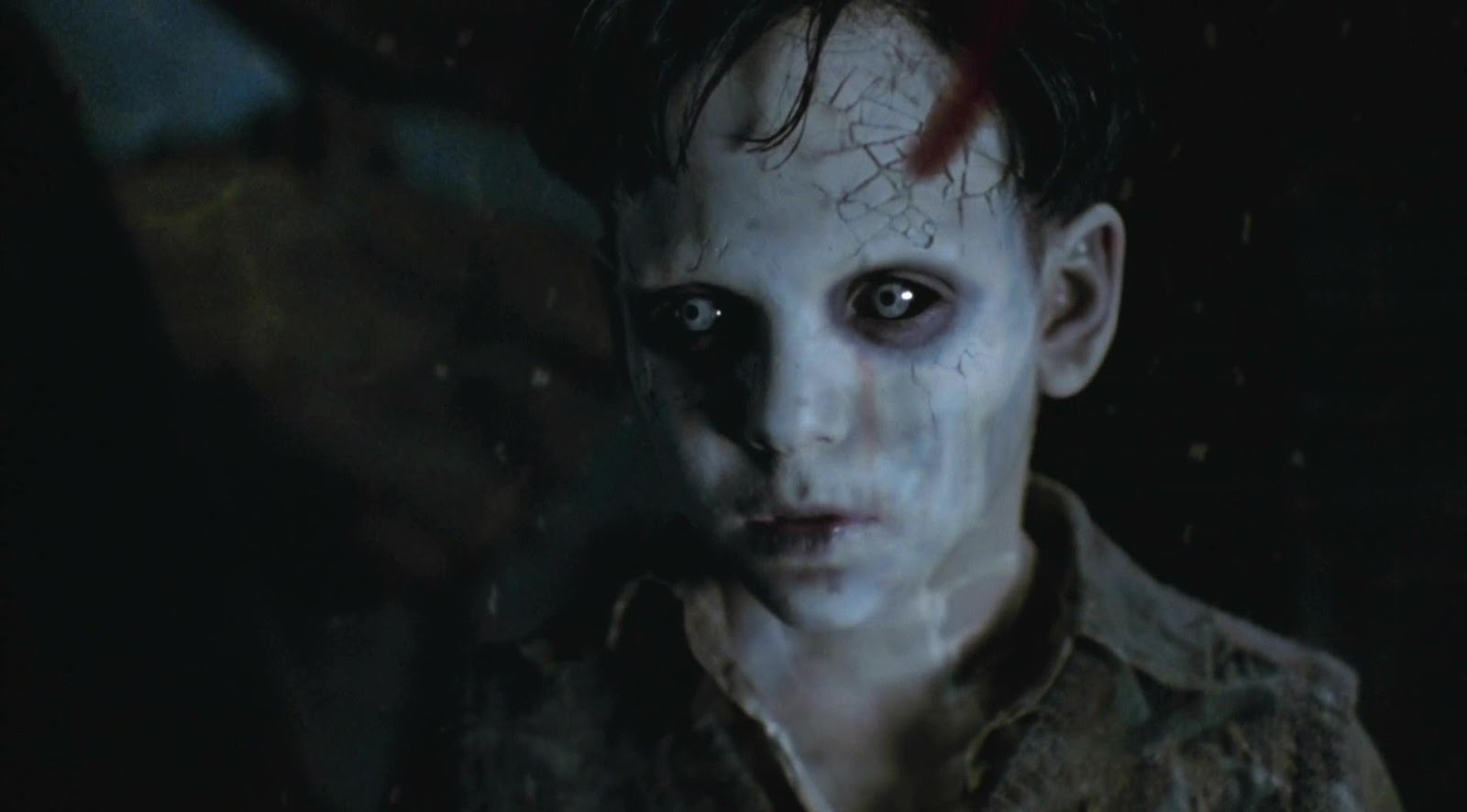
The film is set in Spain, 1939, during the final year of the Spanish Civil War. Fernando Tielve plays Carlos, a young boy who’s been left behind at a reclusive home for orphans. The orphanage is run by Casares (Federico Luppi – a favorite of Del Toro’s) and Carmen (Marisa Paredes), who are aligned with the Republican Loyalists, and are hiding gold for the Republican Treasury. This creates tension between Casares/Carmen and Jacinto (Eduardo Noriega), the orphanage’s greed-driven groundskeeper who wants nothing more than to take the gold. Meanwhile, Carlos must not only adjust to his harsh peers but to a mysterious ghost of a former orphan named Santi, who now haunts the grounds. What happened to Santi? To what heights will Jacinto reach to claim the gold? The stakes are high and always getting higher.

Immediately, The Devil’s Backbone strikes you with its powerful imagery. Many symbols in the film parallel to the idea of being stuck in limbo. A large bomb that was dropped during the war sits center stage on the orphanage grounds, yet has never exploded. There’s a countertop in Casares’ office adorned by fetuses in jars (born with a spinal condition called: The Devil’s Backbone) that represent life that got lost along the way. Even Santi represents a moment of pain forever immortalized as a sorrowful spirit. The film is as touching as it is tragic.

A great deal of Del Toro’s influence comes from his own background as a lapsed Catholic. The fears that we carry forever due to the struggles of life. Much in the way of its sister work, Pan’s Labyrinth, The Devil’s Backbone Shows the hardship of a troubled childhood but also the spirit to overcome that hardship. It gives me nightmares in my mind and in my heart. A must see!

1289122983_45656
AAAAHHH!!!

Lost In Space

Gravity

I think I’ve made it clear that I’m not much of a sci-fi fan, and in particular I’m not really a fan of the kind of special effects-driven sci-fi blockbusters that seem to be more and more prevalent in today’s movie landscape.  And why is this?  Well, I guess it’s mostly because so much of today’s science fiction asks us to be passively entertained by overblown spectacle, and doesn’t invite us to feel any sort of emotion other than “Hey, that’s pretty cool.”  Fortunately Alfonso Cuaron, the writer/director who brought us Children of Men is back, and has given us a film that grabs you by the throat, and forces you to feel a whole wide range of gripping emotions, while also providing some seamless special effects that are, well, pretty cool.

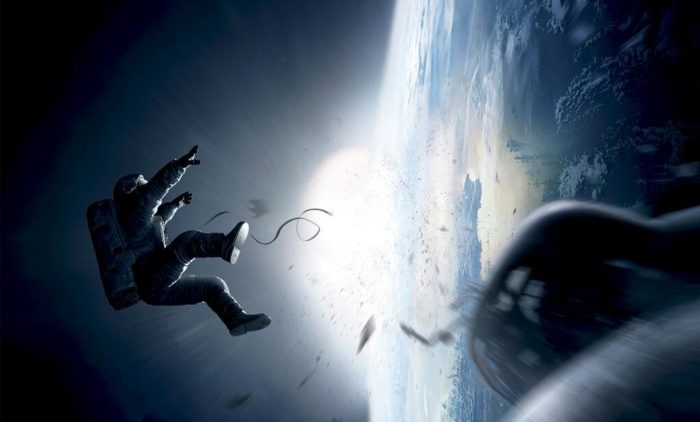
Gravity begins with an extended tracking shot (or perhaps floating shot), that sees astronauts Ryan Stone (Sandra Bullock) and Matt Kowalski (George Clooney) miles above Earth’s atmosphere, in the middle of a routine repair outside of their space station.  They’re then informed that the Russian’s have used a missile to destroy one of their own space stations, and the debris could be headed towards them.  This of course happens, and the two astronauts are sent hurtling through space after a chaotic explosion tears the space station apart.  This then leads to a spaceborne fight for survival as the two free-floating astronauts are forced to find some way of not dying an inevitable space death.

I must admit that I did not see this movie in Imax, nor 3-D.  Which I am now regretting since it seems like every review of Gravity has said something to the effect of “You’re not really seeing this movie unless you see it in 3-D on a giant-ass screen”.  Yet, regardless of that, because of the high amount of craft and care that’s been put into the film on a technical level, I still felt completely immersed in every moment of this film.  And I don’t think that’s a feat to be scoffed at, considering that having a movie set entirely in space doesn’t quite have the same allure as when Kubrick unleashed 2001 on the world all those years ago.

Yet, Gravity somehow manages to evoke the kind of awe and wonder that space travel should evoke.  And at the same time, it also captures the incredible terror of what it’d be like to be stranded out in the unforgiving blackness of outer space, which to me seems like literally the scariest fucking thing a human being could experience.  But that’s what makes this film so exhilarating.  I actually left the theater feeling as though I’d just experienced something that I’d never experienced before.  And how often does that happen?

Now, perhaps not seeing the film through the tint of 3-D glasses or on an enormous screen did cause me to pick up on a few of Gravity‘s flaws.  Obviously, from a scientific standpoint there are a number of moments that force you to suspend disbelief, and this seems even more apparent after reading articles like this one and this one.  Also, the Sandra Bullock character’s backstory seems a bit undercooked, while some of the dialogue is a bit clunky, though the Cloon-dog’s affable charm remains unflappably intact.  But these quibbles are tiny dots in a film that’s full of huge, awe-inspiring moments that also feel oddly intimate and human at the same time.  Honestly, I hardly ever see movies more than once in theaters, but I think I’ve got to plunk down the money to see how awesome this thing looks in 3-D and on a giant-ass screen.

Shocktober: Day 4

Jeeper’s Creepers (2001)

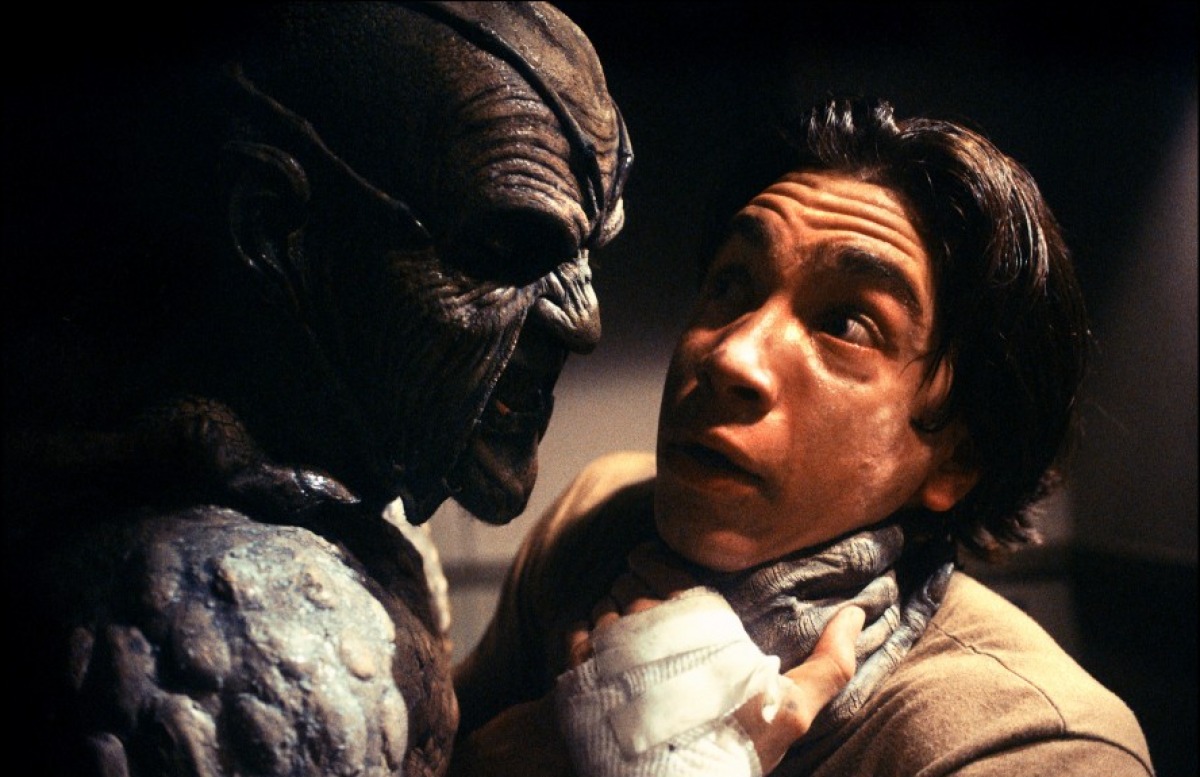
It’s always tiring when a horror franchise decides to milk the same character up to the point of double-digit sequels. Does Freddy Krueger need to kill teenagers over the course of three decades? Is it really worth the effort to send Jason Vorhees or Leprechaun to space? That’s why it’s always refreshing when someone decides to make a new monster with a new mythology. Jeepers Creepers has received mixed opinions for mixed reasons. It doesn’t help that it was helmed by the highly controversial Victor Salva (more on that later), but you have to give it props for being original. “The Creeper” can hang with the baddest of the bad, from Leatherface to Michael Myers… Do I smell a spinoff?

Trish (Gina Philips) and her older brother Darry (Justin Long) are driving home for spring break through the Florida countryside. What appears to be a seemingly mundane road trip is soon interrupted by a mysterious driver that tries to the run the siblings off the road. Letting the vehicle pass, Trish and Darry seem to be in the clear, whoo, that could’ve been bad. Except that later they see the same truck pulled off near a shack where a man in black is chucking a wrapped body into a large sewer pipe. Channeling their inner Scooby Doo, Trish and Darry investigate only to a find hundreds of bodies sewn together in a chapel, missing certain parts. They flee the scene and ask around town until they meet a woman named Jezelle (Patricia Belcher) who knows the secret. It turns out that this mysterious driver is an immortal creature dubbed: “The Creeper”, who every twenty-third spring hunts for twenty-three days. It does this in order to harvest organs so that it can continue to survive. Ay yi yi!

The shocker moments are big and the creeper is a uniquely creepy adversary. Sadly, there’s an even creepier story behind the filmmaker. Victor Salva began his career producing the 1986 low budget horror film Something in the Basement which attracted the attention of Francis Ford Coppola. In turn, Coppola funded Salva’s next film Clownhouse (1989). The controversy comes in when it was discovered that Salva had sex with one of his actors, a 12 year old boy. Salva pled guilty and served 15 months in prison. You think that would kill a director’s career but with persistence and the help of Coppola, Salva found his way back in to the industry. Yuck, if there was ever a case of trying to separate the artist from their art. I still like the film but it’s not easy to say that. It’s disturbing sometimes how much more terrifying the real world can be than make believe.

Jeepers-Creepers-2001-justin-long-31149166-1200-777

When will PC’s and Macs get along?

T3: The Breaking Bad Special

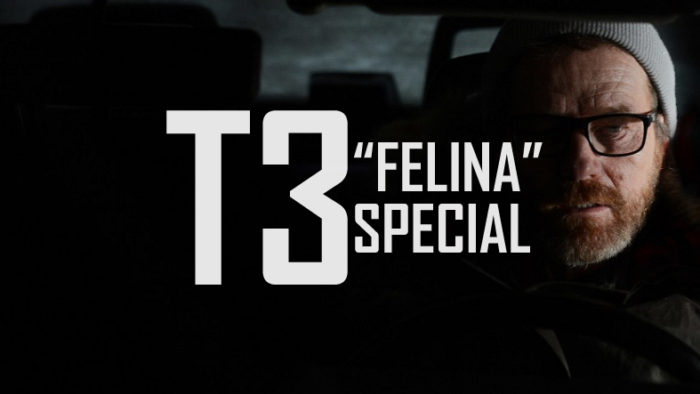
As implied by my Dexter finale review, “Felina,” Breaking Bad‘s final episode, was actually not disappointing somehow. And while sure, you could argue the merits of focusing criticism on one episode of a serialized story like this, we felt it was meaty enough to talk about for 45 minutes or so. After all, something like 10 million people watched this episode, more than any before it. Which makes me wonder, how many marathoned the whole series? Isn’t it weird this show became a big deal in it’s last few weeks?

Top Ways to Listen:
[iTunes] Subscribe to T3 on iTunes
[RSS] Subscribe to the T3 RSS feed
[MP3] Download the MP3