T3 43: Top 10 TV Shows of 2012

We go back from whence we came and do another best TV shows of the year list. A lot has changed in the year since we did in the first episode of this podcast, the top 10 shows of 2011. On NBC alone, Community went from cult phenomenon to a point of concern and longtime darlings 30 Rock and The Office began their final seasons. We all started watching new shows, some of them we really enjoyed, some of them we are ashed to like. I guess what I’m getting at is that this list isn’t necessarily just a rehash of what we talked about last year. At least, not entirely.

Top Ways to Listen:
[iTunes] Subscribe to T3 on iTunes
[RSS] Subscribe to the T3 RSS feed
[MP3] Download the MP3

Continue reading

Sean’s Top 10 Albums of 2012

I had a really hard time making my list and now I’m at the point where I’m not even really sure if 2012 was a really good year for music or a really solid year for music. Up until, well, now, I had 20 albums I felt were worthy of being called my favorites of the year. On one hand, that’s really exciting that I had so many I didn’t want to leave off. On the other hand, that means I didn’t have the handful of truly outstanding albums that I absolutely needed to have on my list. Maybe it’s because this was my first year as an Rdio subscriber, which resulted in me listening to well over 80 albums, significantly more than I had in one year before. Anyway, here’s the 10 I ended up on, in an order that is more arbitrary than you might think.

Continue reading

John’s Top Ten Albums of 2012

In 2012, I listened to as many albums as years Bradley Cooper has been alive. Finding good music never gets any easier but it’s out there. This year wasn’t much different than last year, or the year before. There was stuff I liked, stuff I didn’t (cough, cough, Beach Boys’ reunion album) and a helluva lot in-between. Here’s what made me tap my toes in 2012.

Continue reading

Colin’s Top Ten Albums of 2012

I was pretty disappointed when Sean pointed out that my total post count for the year was a measly 20 posts.  But I guess it makes sense considering I had a fairly busy year compared to most, and yet I still managed to find enough time to listen to 40 albums, a new record for me.  I guess it helped that I bought a car this year, and thus listened to music pretty frequently during those drives.  Here are a few albums that served as more than just good road music.

Continue reading

The Vault: Manuary

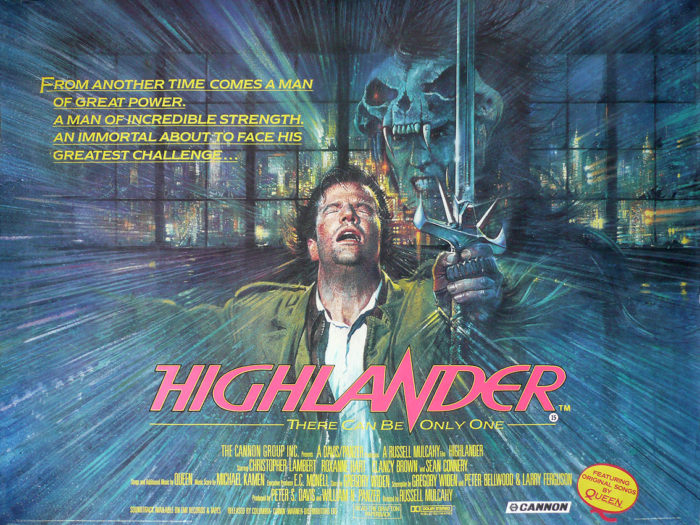
Highlander (1986)

Manuary begins with the testosterone-fueled winner of the Academy Award for “Best Movie Ever Made.” Highlander is the legendary tale of Connor Macleod (Christopher Lambert) an immortal warrior who’s story spans from 14th century Scotland to 1980s New York. Connor is part of a rare breed of immortals that fight other immortals to achieve a power called “The Quickening”. The only way immortals can kill other immortals is by decapitation (awesome). The more immortals you kill the more powerful you become until the last immortal receives “The Prize’ which is assumed to be ultimate ass-kicking power.

What I didn’t know going in is that these immortals are not in fact called “Highlanders”. Connor is a Highlander because he was once a warrior from the Scottish Highlands. During this time he did battle against “The Kurgan” (Clancy Brown) a rival clan leader who is also immortal. After barely escaping battle from The Kurgan, Connor meets Juan Sanchez Villa-Lobos Ramirez (Sean Connery) an Egyptian immortal who teaches Connor the ways of combat. Connor trains and hones his skills for centuries until he is reunited with his enemy The Kurgan (now Victor Kruger) in the 1980s. What follows are scenes of Connor’s journey through the ages while Kruger gets closer and closer to becoming the most powerful of the immortals.

Relative newcomer Christopher Lambert plays the stone-faced Connor in a mostly disappointing performance. To start, his accent is incomprehensible. Reportedly, the French-speaking Lambert worked to develop an accent that sounded like an amalgamation of many accents. The result is a voice that is so bad you wish Lambert would’ve played the part mute. Lambert doesn’t do any better when performing a Scottish accent. Let’s not forget Sean Connery is playing an Egyptian. I’m not sure if Scotland ever recovered from this movie.

On the other end of the spectrum, you have Clancy Brown as the emotionless villain. Clancy Brown is a good actor, but you’d never know that from this performance. His character doesn’t say much aside from “There can be only one.” which he says all the f@*king time. Victor Kruger feels like a character that was written with Dolph Lundgren in mind; a tall, menacing, mostly mute killer that has absolutely no interesting qualities. Though I do like it when Kruger gets so mad in an alleyway that everything around him explodes for no reason.

Highlander is a man movie for many reasons. The plot is as simple as “Dudes need to kill other dudes to be more powerful” and there’s not much in the way of female characters. There’s the throwaway love interest, but whatever-her-face often takes a backseat to dudes being decapitated. The opening enough solidifies Highlander’s place as a manly action-movie. Connor is chilling at the most 80s wrestling match ever captured on film, where he then proceeds to the parking lot and chops of some guy’s head with a katana. Highlander may lack a good script and good characters, but it delivers on the action and that’s all I’m looking for this Manuary.

P.S. The Soundtrack is by Queen! It’s not very good but still… Queen!

‘Merican Manhunters

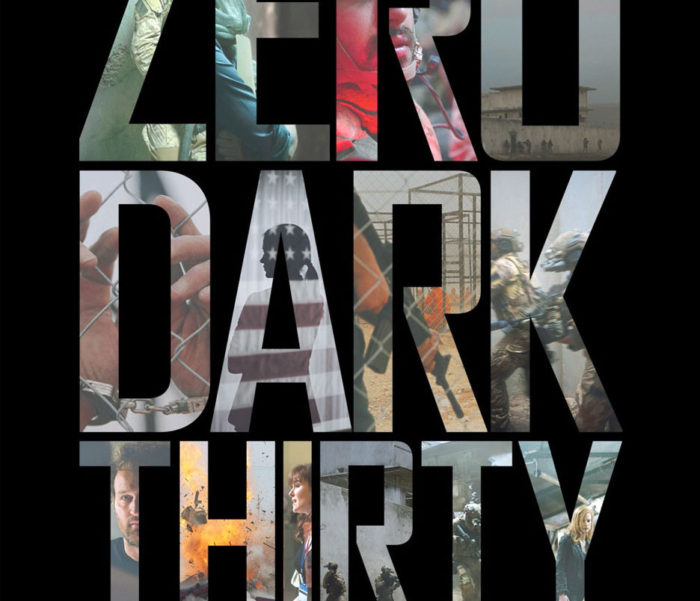
Zero Dark Thirty

And here’s yet another review of a really long movie.  I don’t why this Oscar season has been so rife with movies that seem intent on testing audiences’ patience.  Maybe it’s a reaction to TV’s ever-evolving ability to tell such expansive and complex stories, and this has in many ways felt like a year where Hollywood films have stepped up their game in response to what’s being done on the small screen.  Whatever it is, Zero Dark Thirty rightfully earns it’s 157 minute running time with an approach that recalls the lengthy search for Osama Bin Laden with meticulous detail, and at the same time is uniformly riveting from beginning to end.

The film uses 9/11 as a jumping off point, as this story basically picks up two years later, where we follow Maya (Jessica Chastain), a C.I.A. operative who’s been brought to the Middle East as another able mind with the intention of tracking down the most wanted man in America.  Torture is really the first tactic we see in getting information about bin Laden’s whereabouts, but it’s really just one of many ways in which these characters use every little bit of information or intelligence to scrounge together a lead in the hopes of finding the man.  As the manhunt continues for another eight years, we see C.I.A. members come and go, people whose lives are lost, and an overall feeling of hopelessness, despite Maya’s unwillingness to deter from her single-minded objective.  Of course, eventually she stumbles upon the compound at which bin Laden is hiding in 2011 (which isn’t really explained how, because I guess some information is just too classified) and the rest, as they say is history.

I think some stories are so fascinating that they don’t need a great deal of inflection or filmmaking pizazz to make that story enthralling.  Another film that brilliantly chronicles a fascinating moment in American history with a very straightforward approach is All The President’s Men, which I couldn’t help but think of while watching Zero Dark Thirty.  Unlike All The President’s Men, I can’t really be sure how much of Zero Dark Thirty is based in truth since the C.I.A. obviously wasn’t going to be careless in what details it revealed to screenwriter Mark Boal and director Kathryn Bigelow.  But this feels like a film that strives to do justice to the truth, and because of that it feels like a hard-hitting reminder of what it was like to live through that turbulent decade in the aftermath of 9/11.

I found the tone and morally ambiguities of the film to be about pitch perfect.  There’s been a lot made of the fact that the film glorifies torture, which it does not at all.  In fact it explicitly acknowledges the questionable nature in which torture was used, and yet how the American people where sometimes led to believe that America was too good to get itself involved in that kind of brutality.  But those were the crazy times we were living in, and desperate times often call for desperate measures.  There really aren’t any cut-and-dry answers at the heart of Zero Dark Thirty, as it’s all a mish-mash of conflicted feelings in the wake of the underlying question of “We killed bin Laden, but at what cost?”.  And even after a superbly tense reenactment of Seal Team 6’s infiltration of the compound, we’re still left with that lingering question, in a brilliant last shot that sums up the film’s conflicted nature.

The only real complaint I can make about Zero Dark Thirty is that I couldn’t help but think that Jessica Chastain might have been miscast as the film’s strongwilled heroin.  It was mainly just in the first half of the movie that I had a hard time believing her as this badass C.I.A. agent, but by the end she had basically won me over in believing that this character would go through this kind of transformation.  Also, it’s nice to see James Gandolfini, Kyle Chandler, and Mark Strong sink their teeth into some juicy roles, when that’s not always the case for character actors of their kind.  But honestly, I can’t really think of much more praise I can heap on this film, let alone knocks against it, because for me this a film that more or less gets everything right, and in the process reminds us that movies still have the power to be a vital document of these crazy times in which we live.

“I Had a Dreaaaaaaam!”

Les Misérables

Les Misérables was my most mixed film-going experience of the year. Pretentious, melodramatic, and overlong, were all preconceived fears that quickly became truths in my viewing experience of this film. Concurently, the film tells such a grand story that’s presented in such a grand package. I greatly admire the ambition of scope, but I despise the film’s refusal to give the audience any breathing room in all of it’s 158 minute running time.

Based on the 1980’s musical adaptation of Victor Hugo’s 1862 novel, Les Misérables is an epic tale of guilt and redemption. The film begins with ex-con Jean Valjean’s (Hugh Jackman) parole for a petty crime. Jean struggles with life on the outside and eventually breaks his parole, leading to police officer Jalvert’s (Russell Crowe) undying pursuit of him. Years pass and Jean assumes a new identity as a successful businessman/mayor. Jean uses his status to aid the struggling Fantine (Anne Hathaway) and promises to support her illegitimate daughter Cosette (Isabella Allen and later Amanda Seyfried) no matter what happens. As the story continues, Javert continues his pursuit and Jean raises Cosette all along the backdrop of the French Revolution. Les Misérables is most definitely an epic story but often falters as an epic film.

I like musicals as much as the next guy, or at least guys that like musicals, but Les Misérables is a musical that doesn’t fit the mold of a movie. There’s something so awkward about characters that sing directly into a camera. There’s no dancing here and not much to look at it. Most numbers revolve around a character sitting or bent over lamenting in song. That’s not to say that some of these songs aren’t great, but there’s nothing to visually complement the performances. Anne Hathaway’s Fantine is the only character who’s vocal performances are truly memorable. “I Dreamed a Dream” as seen in the trailers is the film’s breakout moment. Hugh Jackman has a unique tenor delivery, but it becomes grating after ninetysomething minutes. Russell Crowe isn’t right for this film at all. He can sing but it’s the wrong kind of singing. While Anne Hathaway and Hugh Jackman sound like true stage singers, Russell Crowe sounds like he’s trying to do David Bowie.

I liked the majority of the songs, but one thing I couldn’t stand was something I call “Talk-Singing”. This is when two characters for no apparent reason sing all of their dialogue with no discernible melody. You have to give the audience some time to breathe in-between songs. Instead, Les Misérables is a relentless assault of never ending singing. After awhile I felt the movie getting repetitive and dull. Not only that, but so many of the songs convey the same themes. I get that Jean is tortured by guilt and that Javert has a mournful dedication to his duties. Do we really need more than one scene of Russell Crowe overlooking the Paris skyline and belting out his responsibilities as an officer?

It’s hard for me to bash Les Misérables when it’s clear that so much love and and hard work went into bringing this story to life. There’s some outstanding set pieces here and the production, costumes, and sets are all of the highest caliber. I think the problem is Les Misérables as a musical doesn’t translate well to film. I would have much rather seen Tom Hooper approach the story as a non-musical, period-piece drama. The film is by no means terrible, but far from what I come to expect during Oscar season. The fact that this will be an Oscar contender is completely undeserving.

P.S. Why does everyone in France speak with a Cockney accent?