



Exit 8 is the most faithful video game adaptation ever made. Move over, Mario! Get lost, Lara Croft! Sayonara, Silent Hill: Revelation 3D. There’s a new video-game-adaptation sheriff in town, and it’s based on a walking simulator from indie game studio Kotake Create. I played the game last year, as I like to keep my fingers in many horror-media-flavored pies. The whole experience took me about 40 minutes, which is why I was shocked when I heard it was becoming a movie. How many video game movies are longer than the games they’re based on? And does this work against the movie or in its favor?
The premise of the game is simple. You enter a sterile white passageway in a Japanese metro station. You see a yellow sign with an arrow and the number zero. Next to it is another sign with the following instructions:
1. Don’t overlook any anomalies.
2. If you find anomalies, turn around immediately.
3. If you don’t find anomalies, do not turn back.
4. To go out from Exit 8.
Simply put, you investigate the passageway, the posters on the walls, a Walking Man who passes by carrying a briefcase, and other details as you try to progress through the game. If you find no anomalies, the next passageway will start with a yellow sign that reads 1, then 2, then 3, and so forth. If you fail to notice an anomaly, you start over. What kind of anomalies? Moving eyes on posters, the Walking Man running at you, or a pair of creepy-ass twins that follow you. If you spot an anomaly, turn back, and the passageway in the opposite direction becomes your new path forward.
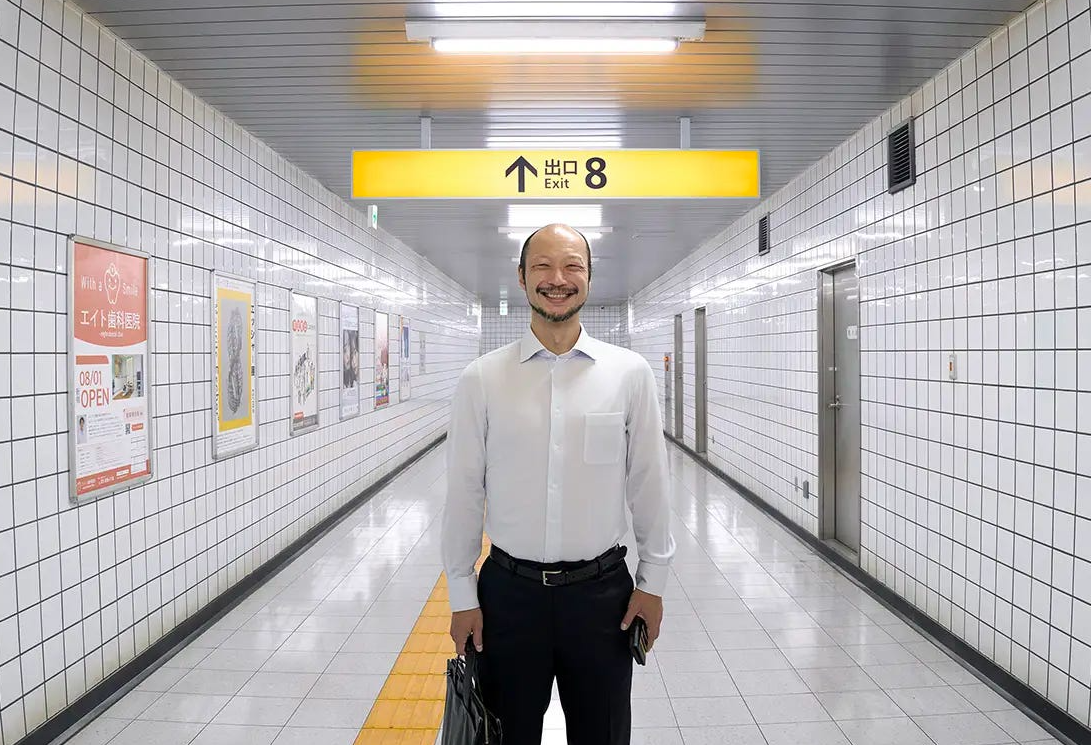
The premise is inherently cinematic, using tone and setting to establish dread and mystery. It’s a killer idea for a short film. A feature-length film, on the other hand? Well, I’ve got thoughts about that.
The film follows the “Lost Man” (Kazunari Ninomiya), who’s riding the subway and struggling to process a call from his ex-girlfriend telling him she’s pregnant with his child. As he wrestles with fatherhood, the Lost Man finds himself facing an even bigger obstacle when he gets trapped in a seemingly endless passageway. He encounters spooky shit and later meets a lost child. Is the child a metaphor? Is he even real? Adulting is hard!
Exit 8 is great for about 40 minutes. The protagonist and premise are established succinctly, and the pacing and scares are effective, particularly those involving the Walking Man. Yet, after the Lost Man fails a few times, I get restless. “Just solve it already,” I grumble to myself. We do get a cutaway sequence showing how the Walking Man became trapped, but even that feels like more of the same.
The trouble is the appeal of the game lies in its isolation. You truly feel like you’re on your own, trapped in this passageway with nothing but your wits and determination. The movie introduces other characters, and whether they’re real or manifestations doesn’t change the fact they alter the experience. It’s a solid experience, but it doesn’t scratch the same itch as the game.

Regardless, the film is beautifully shot and scored, with a good sense of tone. It knows when to be funny and when to be scary, remaining as consistent as a long, winding corridor. I’m not familiar with the film’s co-writer and director, Genki Kawamura, beyond his involvement in producing numerous animated films, but he has a dynamic eye. Take the opening, which is shot from the Lost Man’s POV. There’s a real sense we, the audience, are trapped with him in a place that appears normal on the surface but is anything but.
It’s no easy task to expand upon a game you can beat in less time than it takes to watch an episode of This Is Us, but Exit 8 succeeds more often than it doesn’t. After all, it is the most faithful video game movie ever made. Put that in your pipe and smoke it, Detective Pikachu.