



So I end my Criterion Month journey in a somewhat unfamiliar place, seeing as animation is not exactly the Criterion Collection’s forté. The only animated film I can remember ever reviewing for Criterion Month is the insane Fantastic Planet, but maybe there have been others. Either way, Flow was one of those rare cases where an international film crosses over to be a worldwide hit just because the amount of care put into it is undeniable. Also, it just has a built-in cross-over appeal because it’s not encumbered by a language barrier, seeing as all of the dialogue in the film comes in the form of meows, woofs, and squawks.
Describing the plot of this movie is probably going to sound a bit like describing a children’s book, but here it goes: Flow is seen through the eyes of a small grey cat, who like most cats, is a little bit scared and a little bit curious about everything. The cat seems to inhabit a post-apocalyptic world, since we first see it resting in an empty bed that must have belonged to a human. When the cat roams the forested area it lives in, there still aren’t any humans to be seen, but it runs into a pack of dogs who all seem to be a bit rowdy except for one nice golden labrador. The cat tries to steal a fish from dogs, but is foiled when the dogs chase after the cat. After escaping, the cat notices a stampede of deer hurtling towards it, then noticing that right behind the deer is a massive tidal wave that all of a sudden engulfs the cat and everything in the forest.
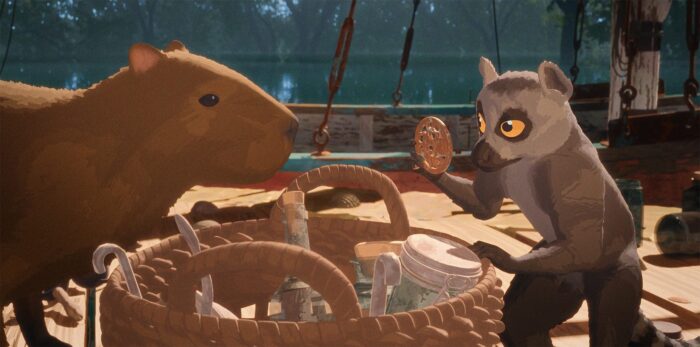
The water just keeps rising and engulfing everything until the forest has become an ocean, possibly the result of some sort of ecological disaster, though the film never reveals its origins. This, of course, is a cat’s worst nightmare, as our little furry friend first has to find high ground and avoid being engulfed in water and then must find a boat of some sort. This happens in the form of a sailboat being manned by a capybara, whose demeanor is a bit more composed than the constantly terrified kitty cat. While sailing around, the cat also encounters a majestic secretarybird, a scrounging lemur, and the labrador that we saw earlier, who all join this ominous seafaring journey.
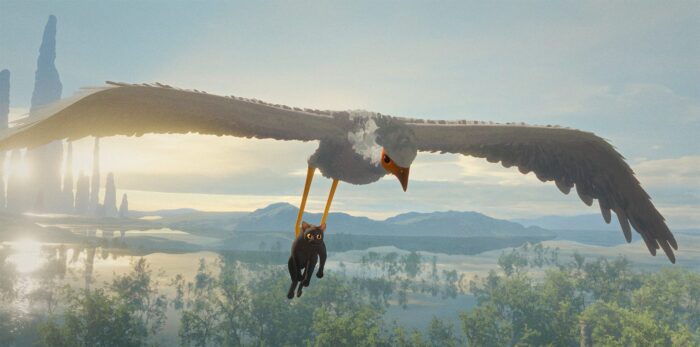
This animal crew continues sailing on and eventually finds an abandoned ancient city that is near these giant stone pillars that we’ve been seeing off in the distance throughout the movie. During a grueling storm, the cat gets swept into the water, but eventually makes it ashore, in the shadows of the giant pillars. There’s this odd, ethereal sequence where the cat gets lifted upward by some sort of cosmic force, and the bird ascends upward and is never seen again. The cat then goes back to find his furry friends, but is separated from them when a giant cavern opens up in the earth, swallowing the water and finally returning nature to its neutral state, but still leaving the cat wanting to see his buddies one last time.
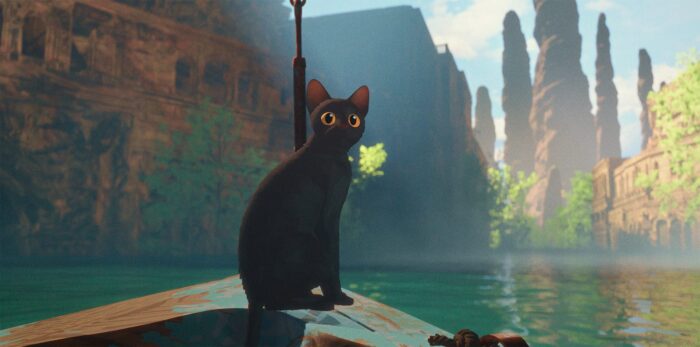
Flow was the brainchild of Latvian animator Gints Zilbalodis, who made the film over the course of five years and made it all with a free software called Blender. This results in animation that certainly lacks the fine detail of a Pixar or Illumination, but there’s still something about the care put into it, the simple storytelling, and the immaculate vibe that the film has that’s pretty much irresistible. Despite this lack of fine detail in the animation, the greenery and water and animals that the film presents are somehow striking nonetheless. Even if the animation is a little abstract, you really feel like you’re in the forest with these animals, perhaps because of the sound design, but also because the “camera” in the film has this very handheld, on-the-ground feel to it.
Another aspect of the film that feels unique is how believable these animals are. We’re so used to animated films in which animals talk and act like people, but here’s a film where all of the animals more or less act like animals, which makes them strangely even easier to empathize with, especially if you’re an animal lover. You can tell that the animators spent a lot of time studying the behavior of the animals in the film and the fact that they used real animal voices is kind of a no-brainer, but they sure got some good performances out of these critters.
Another thing that really holds this minimalist movie together is the score, which was done by Zilbalodis and Rihards Zaļupe. Its atmospheric tone, which often alternates between serene and chaotic, really carries the emotional weight of the film when the sounds these animals are making can’t quite do all of the heavy lifting. It often reminded me of the immaculate vibe of the recent Legend of Zelda games, but it seems like the most prominent influences on Zilbalodis was the anime Future Boy Conan and the films of our boy, Jacques Tati. While we just barely missed reviewing any movies from the silent era this year for Criterion Month, Flow was a nice little reminder that the age-old practice of telling a story without words can be just as captivating as ever. Meow.