



In terms of discovering classic foreign films as a budding teenage cinephile, Fellini was certainly one of my gateway directors. That said, I gobbled up a bunch of his movies in high school and early college and probably have not watched one of his films since we were still renting DVDs in the mail from Netflix. So since Criterion Month always presents plenty of opportunities for a dip into Fellini-land, I’ve always been curious to see how I feel about the director now, since he’s certainly not namechecked by filmmakers nearly as much as he was 20 or 30 years ago. However, in watching 1965’s Juliet of the Spirits, it’s easy to see how Fellini’s influence on cinema is still quite present, while a latter film like this still has the ability to challenge and disorient.
In a lot of ways, Juliet of the Spirits feels like a companion piece to Fellini’s previous film, 8 1/2. Like that film, there are a lot of flashbacks and dream sequences and warping of realities as we focus on the inner life of one particular character going through one particular identity crisis. This character, Juliet (played by Fellini’s wife and muse Giulietta Masina) has begun to suspect that her husband is having an affair with another woman. This all begins when she has a bunch of friends over one night, and they hold a séance in which a variety of spirits talk to Juliet. In the middle of it, she also notices a phone call that comes to her house that is picked up by one of the party guests, but a voice never responds on the other end.

Over the course of film, Juliet wonders if the anonymous phone calls coming to her house also have something to do with the fact that her husband Giorgio (Mario Pisu) is always away at work while leaving very few details as to his whereabouts. This leaves Juliet at home pondering her place in the world while encountering a variety of colorful characters, some in her current consciousness and some in her memories and dreams. Some of these are mystics, some are relatives, and some are friends and neighbors. Perhaps the most memorable is Suzy (Sandra Milo), her next-door neighbor, who lives a life of sexual freedom and encourages Juliet to do so as well.
However, Juliet is haunted by Catholic guilt, constantly having flashbacks to her upbringing and a young friend who killed herself when they were children. She also is haunted by images of her grandparents, priests, headmasters, and a guy with a bright red beard that I have to assume is Satan? Anyways, trying to explain the plot of this movie is a bit of a tall task, as it takes you on a journey through one person’s subconscious and conscious at the same time while taking a lot of detours and throwing in a lot of imagery that I’m not sure you’re meant to fully understand.
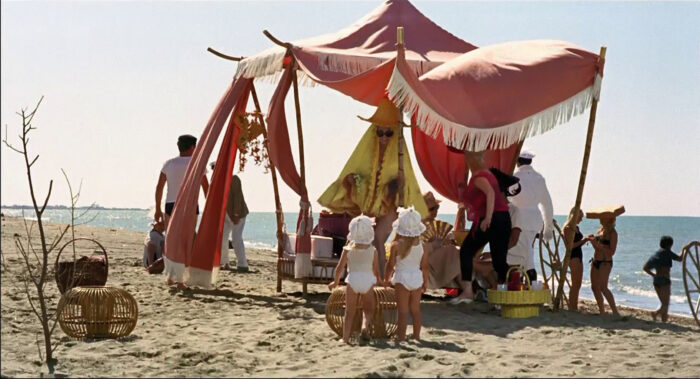
Apparently, in the late ’50s and ’60s, Fellini got very into Carl Jung and LSD, and from watching this film, you can certainly tell. Dreams became a source of constant fascination and inspiration for Fellini, and 8 1/2 seemed to be the turning point in that regard, as that film and Juliet are clear departures stylistically from the earlier, neo-realism-adjacent films like La Strada and Nights of Cabiria that first brought him and Giulietta Masina to fame. While I didn’t find myself quite as mesmerized with Juliet of the Spirits as I was with 8 1/2, there is still something wild and fascinating about watching him try to paint with a kind of surrealistic paintbrush that hadn’t been used much in film before.
Also, the one big thing this film has over 8 1/2 is that it was Fellini’s first full-length feature filmed in color, and he really makes the most of it. Fellini is a director that would be very at home in the ’60s, and the kaleidoscopic, proto-psychedelic nature of the film feels like a perfect fit for that decade, even though the box office failure of Juliet would make it so he wouldn’t direct another film until the decade was over. Regardless, it’s still a film that I can see a lot of filmmakers being influenced by, as the more nightmarish bits of the film reek of David Lynch, while the plot, concerning a middle-aged woman’s identity crisis while wearing plenty of fabulously colorful outfits, feels right out of an Almodóvar movie.
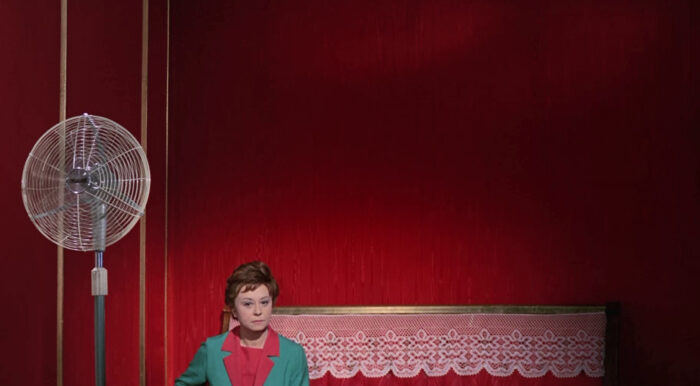
Of course, for all the film’s flights of fancy, what really keeps the film grounded is Giulietta Masina, in a role that Fellini wrote specifically for her after her career had stalled a bit. Masina has one of the best faces of any actor in cinema as far as I’m concerned. She’s able to express so much with her eyes, and in this film she mostly downplays each scene even though the character is clearly going through a whole wide range of emotions. Now, there are all sorts of biographical threads you could pull loose from this film’s content, since despite the fact that Fellini and Masina remained married until their deaths, it seemed that their relationship could sometimes be rocky. But the two of them clearly tapped into something as creative partners, and Juliet of the Spirits showed how Masina as an actress could complement Fellini, even if he was taking the audience on a supremely wild ride.