



Did you know right now there’s a chimp civil war happening in Uganda? The once-strong Ngogo chimpanzee community in Kibale National Park, one of the largest ever studied, with around 200 apes at its peak, has splintered over the past several years in a bloody power struggle for ape supremacy. It’s wild, because it sounds like a story ripped straight from a Michael Crichton novel.
Congo, published in 1980, tells the story of ERTS (Earth Resources Technology Services), a fictional tech corporation leading an expedition deep into the African Congo in search of the lost city of Zinj, hoping to recover rare Type IIb blue diamonds for use in semiconductors.
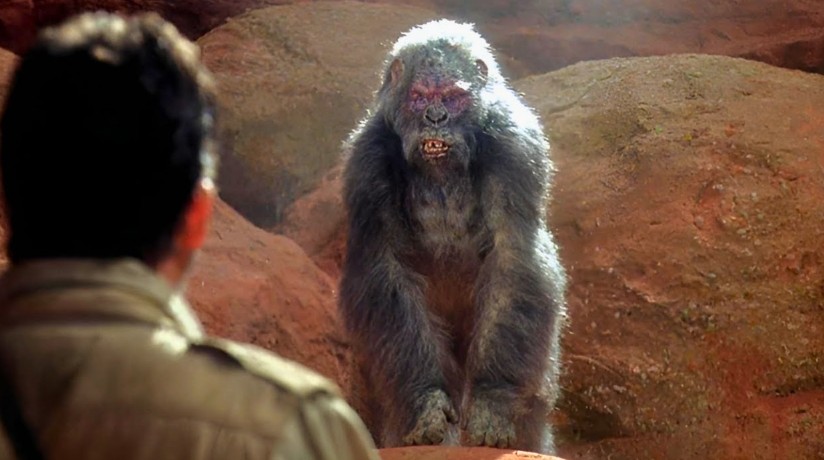
Once the group arrives in Zinj, they’re met by an undiscovered race of gray gorillas who protect the diamonds like a battalion of hyper-aggressive ape warriors. It’s pretty sweet.
The characters are geologist and team leader Karen Ross, notorious mercenary Charles Munro, and Peter Elliott, a primatologist who cares for Amy, a mountain gorilla trained in sign language who has dreams of the lost city of Zinj. Michael Crichton set out to write a jungle adventure in the style of H. Rider Haggard’s King Solomon’s Mines (1881), and the book became an instant bestseller. It was adapted 15 years later into a successful, though critically panned, blockbuster from Frank Marshall.
So why did I pick Frank Marshall’s Congo for this month’s Ape-ril? What was I trying to get out of a third viewing of Congo? Well, before this viewing, I decided to read the book. Which in a way, made it feel like I was watching the movie for the first time.
Congo is a good book. Not a great book. It’s no Jurassic Park or The Andromeda Strain. It’s a solid jungle adventure story, which is exactly what Crichton set out to write. The problem is reading Congo and then watching Congo in a post-Jurassic Park world. Jurassic Park captured the imagination of a generation with its heady ideas about playing God and its deep dive into cloning technology. It’s set in a theme park. Also, it has dinosaurs. It’s every childhood fantasy rolled into one.
Congo doesn’t have any of that. It has a hidden city full of ornery apes. Now, that’s not nothing, but it’s also not that exciting. The Lost City of Zinj could have been built up as an Atlantis-like civilization, advanced, mysterious, lost to time and kept alive through legend. But it isn’t. It’s just a place that happened to be rich in rare diamonds, where everyone died because they bred super-aggressive apes.
The apes, or “gray gorillas” (my favorite Legends of the Hidden Temple team), never get the deep dive they deserve. The book hints they may be the result of humans breeding apes with chimps, possibly even introducing human DNA, but they never feel like anything more than mad monkeys.
Ironically, the most interesting piece of science fiction in Congo, for me, is that Crichton predicted the use of portable satellite tech and early computer mapping for navigation. Which makes it easy to understand why Congo failed to capture imaginations when its most revolutionary idea is… GPS.
Congo probably would have worked better as a mid-tier ’80s action movie starring James Brolin. Not the next Jurassic Park. But man, Paramount really wanted you to believe it was. The marketing push was massive, there were toys, video games, even an exclusive watch at Taco Bell. All of it built around a trailer promising a thrilling creature feature.
The problem is, the gray gorillas are just one piece of the book Congo. It’s also about political unrest in Central Africa, the history of exploring the Congo, corporate greed, and survival. In the book, those elements feel balanced. The movie, on the other hand, goes a little too hard on: “These apes are cool, right? As cool as dinosaurs? RIGHT? MAYBE? Please tell us they are!!!”
Michael Crichton has always been what I like to call a “screenplay-ready” novelist. The way he writes and plots his novels is inherently cinematic. He’s a lot like Stephen King in that regard, with the key difference being Crichton directed a handful of films (seven, to be exact), while King has only directed once, the ’80s cocaine-fueled mess Maximum Overdrive.
Crichton very much wrote Congo with the idea it could be adapted into a film. He even wrote an early version of the screenplay for Sean Connery, the star of Crichton’s film The Great Train Robbery (also based on his novel). Connery was set to play mercenary Charles Munro, aka “the great white hunter.”
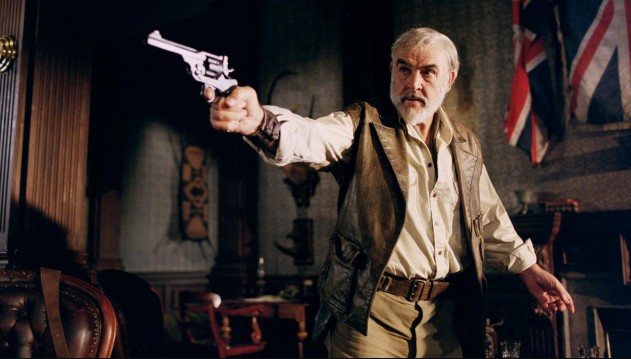
Despite the fact Munro is described as half-Indian in the book, I like this casting. Crichton saw Connery as an Allan Quatermain type, the protagonist of H. Rider Haggard’s King Solomon’s Mines and its follow-up, Allan Quatermain. It’s funny, because in 2003, Connery finally played Quatermain in The League of Extraordinary Gentlemen.
20th Century Fox was on board with this version of the film until they told Crichton he couldn’t use a real gorilla to portray Amy. Crichton bailed, and the project floated around Hollywood for the next 15 years. John Carpenter and Steven Spielberg were both offered the project before Frank Marshall eventually took the reins in a post-Jurassic Park era, with no involvement from Crichton.
Writer John Patrick Shanley (Moonstruck, Joe Versus the Volcano, Doubt) was brought in to write the new screenplay. It’s unclear how much of Crichton’s original script he used. The film was shot in Costa Rica, along with soundstage work and second-unit footage filmed in Uganda, Kenya, and Tanzania.
I was curious whether reading the book would shift my perspective on Marshall’s seven-time Razzie-nominated dud, and you know what? It did. For the better.
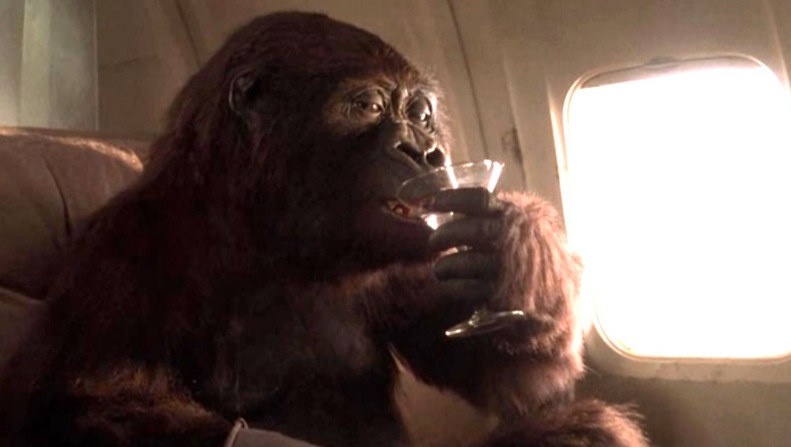
There’s a lot of fat in Crichton’s book. You get the full history of white explorers in the Congo, flashbacks to Peter training Amy the gorilla, and extended backstories for characters like Charles Munro. All of this is wisely condensed into a solid-enough action-adventure film with a few laughs, spectacular makeup effects, and Ernie Hudson skydiving with a gorilla.
I also like Shanley’s additions, including Amy’s high-tech glove she uses to translate her sign language into computerized speech, and the introduction of the over-the-top, diamond-obsessed Romanian financier Herkermer Homolka, played beautifully by a fully dialed-in Tim Curry.
But there’s still one glaring problem with this film: the soundstages. The material shot in the Costa Rican jungle looks solid, but every time our heroes face off against a killer hippo or a troop of gray gorillas, the film retreats to a phoney set. The gray gorilla scenes are the worst, because Stan Winston’s makeup is incredible, but shoot anything in flat lighting like Marshall does, and suddenly it looks like Laura Linney is fighting for her life inside a Spirit Halloween.
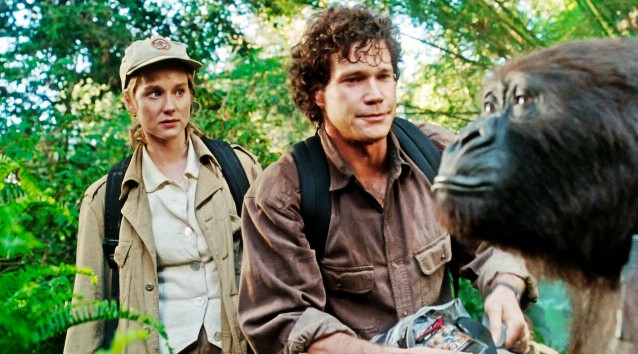
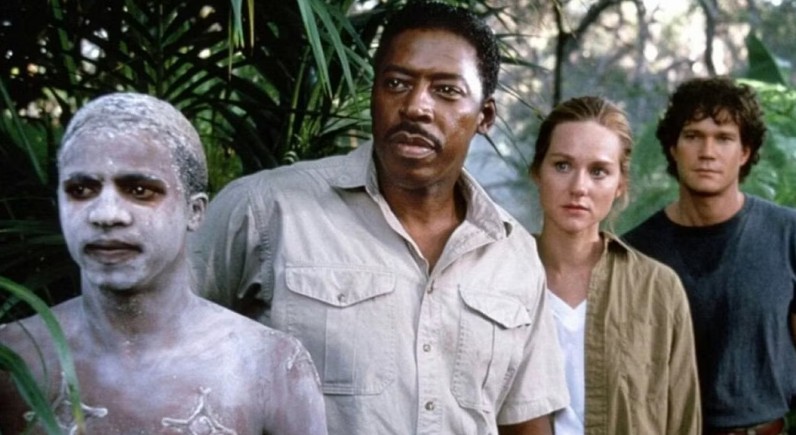
The cast is serviceable. Laura Linney and Dylan Walsh feel close enough to the characters they’re playing. But the real star of the show is Ernie Hudson. His Charles Munro is cool as a cucumber and a total badass. I prefer this version of Munro to the one in the novel. And I respect that the movie is willing to kill off characters, the book has few deaths outside of unnamed porters, so the stakes never feel as high.
Congo still isn’t a great movie. It drags in places, has cheesy effects, and lacks the sophistication of the novel, but it’s a decent ride. What’s an okay-but-not-great ride at Disneyland? Dumbo? Congo is like the Dumbo ride.
So if you haven’t watched Congo in thirty-ish years, or at all, you could do a lot worse. If nothing else, it’ll make you appreciate the fine art of shooting a man in an ape costume with a diamond-powered laser beam. Sometimes it’s the little things in life worth cherishing.