



A group of men must band together in order to complete a job that will hopefully save their lives. It’s a simple premise that has gotten used plenty over the years in various films and one that is at the heart of 1965’s The Flight of the Phoenix. Somehow, this film was not a huge hit when it came out, despite the fact that it feels like a real crowd-pleaser and has an amazing cast (though the box office vitality of a bunch of character actors and an aging Jimmy Stewart may have proved faulty). It’s a little hard to believe also because it fits so nicely along “team of dudes” movies from this era like The Magnificent Seven, The Great Escape, or director Robert Aldrich’s next film, The Dirty Dozen. But maybe the film was too ahead of its time, as it also brings to mind the disaster movies of the 70s as well as one of that decade’s biggest hits, Jaws.

Once the men get off the plane, they find themselves in a seemingly endless desert with no way of making radio communication and only enough water and enough barrels of pitted dates to last them a week or so. We see a few men go searching in the desert for help while some of the men slowly start to lose their minds, while others just become unimaginably sunburned. However, Heinrich Dorfmann (Hardy Krüger), a German aeronautical engineer, believes that he can salvage the plane and make it fly again in the hopes of getting everyone out of this mess. Towns ultimately believes in Dorfmann, but increasingly becomes agitated by his cold, calculating nature and disregard for his fellow men’s needs, which leads them to butting heads repeatedly. However, even as crazy as Dorfmann’s plan seems and as dire as the situation becomes, everyone still holds out hope that they can make this bird fly.
Apart from Stewart, Attenborough, and Krüger, other actors in this spiffy cast include Peter Finch, George Kennedy, and Ernest Borgnine, though inexplicably, the actor who received an Oscar nom was Ian Brennan as Crow, a lively Scotsman who keeps saying racist things. I feel like all of these actors are well-fitted to a film of this type, since many of them had been in epic ensemble movies of this ilk or would go on to be in many of them after this. I also like that the film doesn’t try to make them form some sort of familial bond under the circumstances, since they are after all, strangers from different parts of the world who are all feeling more than a little agitated by the heat and lack of water. So the men who knew each other previously tend to side with each other, while the others end up fending for themselves or trying to forge alliances that are convenient for their own survival.

Filmed in the deserts of California and Arizona subbing in for Northern Africa, The Flight of the Phoenix is a film of both thrilling beauty and punishing reality. The constant images of sand dunes and pure blue skies combined with the equally pure blue eyes of Jimmy Stewart (and several of the film’s other actors) create this kind of grand escapism. And yet, as the film goes on, the faces of these men become more and more ragged, as we see them all grow shaggy beards while the unrelenting sun creates blisters on their chapped faces. This physical manifestation of their suffering just makes the film’s exhilarating conclusion all the more satisfying, as we finally get to see these guys who have been pondering their own deaths finally crack a smile.
Robert Aldrich is not a director I’m thoroughly familiar with, but I have liked all of his films that I’ve seem, which typically have the kind of masculine toughness of The Flight of the Phoenix as well as a propensity for putting his characters in unfortunate circumstances. You could see Phoenix as Aldrich’s transition toward making tough guy movies in the final act of his career, after having invented the psycho-biddy genre with Whatever Happened To Baby Jane? and Hush…Hush, Sweet Charlotte. Considering Aldrich had been working on movies since the early 1940s and wouldn’t stop until the 80s, he’s the kind of guy where filmmaking was in his blood. So it’s easy to draw some parallels between a bunch of guys with a different set of skills going out in the desert and trying to construct something from nothing as a metaphor for making a film. And this is the kind of film where you have to have the kind of crazy vision that Krüger (and Aldrich) had to see that the whole thing will take flight.
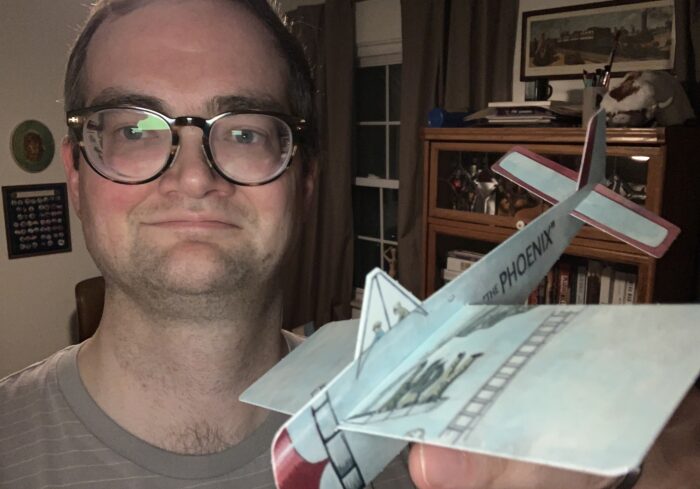 Also, because it was suggested on the draft podcast, here’s a photo of me with the model plane that came with my Criterion blu ray.