



There’s nothing quite like a potent debut film that seemingly comes out of nowhere, filled with possibilities and creativity and passion, but lacking in polish and movie stars. Then there’s a whole other level where it’s a student film – the work of someone literally figuring things out on screen but having the clear talent to express themselves with precision. 1978’s Killer of Sheep is one of those films, as director Charles Burnett started shooting the film in 1972 and eventually submitted it at UCLA film school as his thesis film in 1977, not really getting a proper theatrical release until 2007, and didn’t get its deserved Criterion treatment until a couple of months ago.
I feel like my last few movies have been in this mode of lacking straightforward plots or narrative structure, and I would say Killer of Sheep is somewhat in that vein. There’s not a ton of traditional drama or character development in the film, but at the same, its plot is so bare bones that it’s pretty easy to follow. There are a few different characters that Burnett focuses his wandering camera on, but we spend the most time with Stan (played by Henry G. Sanders), who lives in the Watts area of Los Angeles with his wife (Kaycee Moore) and their kids. Surrounded by seedier characters in his neighborhood, Stan just wants to live an honest life, going to his job working in a slaughterhouse (hence the film’s title) and being able to provide enough for his family.
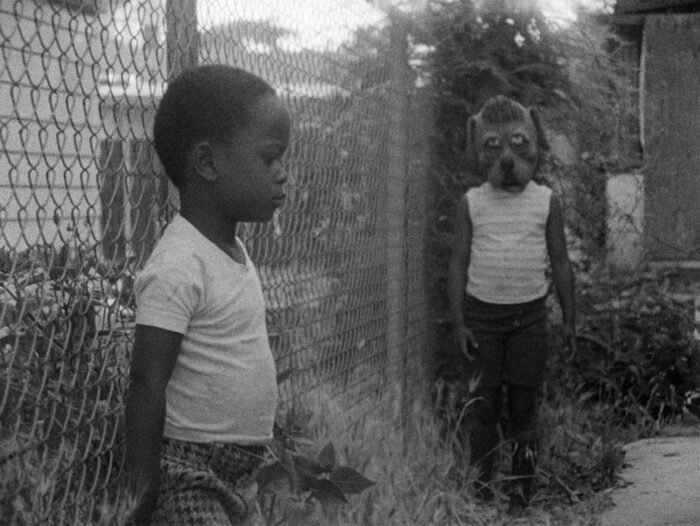
We see Stan get involved in a few different activities outside of his somewhat brutal work, such as trying to transport a car engine in his truck for some extra scratch or striking up a conversation with a liquor store manager who offers him a job that he turns down. As we see Stan interacting with the various people in his corner of the world, the camera often turns its attention to various children inhabiting his neighborhood. This includes his own children (one of whom brandishes a creepy dog mask in one scene) as well as this unidentified gang of youths having fun running around, most strikingly in the rooftop jumping sequence that appears not only on the film’s Criterion cover, but also on the cover of Mos Def’s 2009 album The Ecstatic.
The most arresting thing about Killer of Sheep is just how lived-in it feels, to the point where it often feels more like a documentary than a narrative film. The lack of plot and forward momentum in the film makes it feel like you’re just a fly on the wall, watching these characters go about their lives, which is also supported by the fact that many of the actors here are amateurs. The film’s realness is also bolstered by this location of Watts, which is such a specific working-class corner of the world to see depicted on screen (even in the world of ’70s Black filmmaking) that you feel like you’re getting a truly intimate look into a world that Hollywood, just a few miles away, would never consider putting on film.
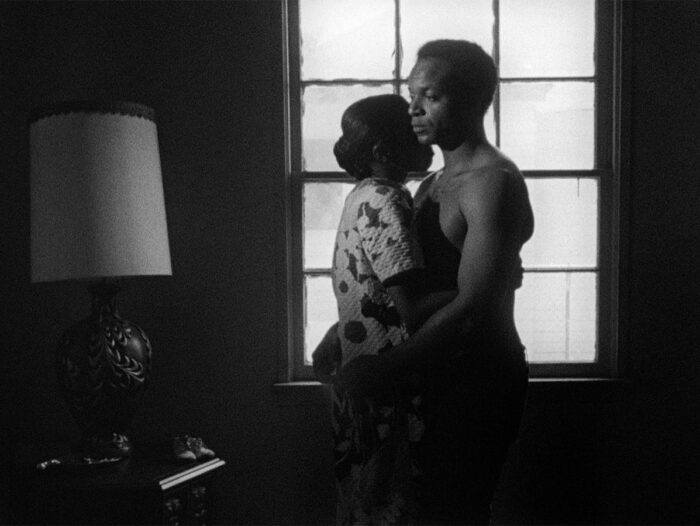
Yet, for as much as Killer of Sheep sometimes feels like a documentary, you also see images in it that are just a little too poetic to ever be at home in a doc. The other time I reviewed a Charles Burnett movie here, I mentioned how the by-the-numbers camerawork of To Sleep With Anger was my only issue with it, but that’s not the case at all here, which goes to show Burnett did himself a favor by serving as the D.P. on the film. The stark black and white photography makes these humdrum moments feel somehow infused with beauty, while the moments involving the kids playing have this kind of innocent magic to them.
There are a lot of reasons Killer of Sheep probably took so long to get a proper release, from it being a student film to a general mainstream aversion to Black art, but the most common sense one is its music rights. For such a minimalist film, it has a surprisingly distinct soundtrack, using everything from Paul Robeson to Louis Armstrong to Earth, Wind, and Fire. I’m honestly not sure what to make of the music, but I like it. It adds a kind of poignancy to the simple work that Stan goes through day after day just to make it through life, and the idea that sometimes that’s enough.