Use Your Interface

In the earliest days, when people thought of computers they thought of massive room-filling machines capable of some fundamental logic-based computation. As time went on, that image shrank down to the classic screen and keyboard setup. Apple revolutionized that by designing the world’s first Graphical User Interface (GUI) and creating a companion for the keyboard: the mouse. Since then computers have gotten considerably more powerful and compact. We have the Internet now, which has totally changed the way we use computers. Technology is rapidly evolving, CPU keep getting faster, graphic cards more powerful, memory more vast. And yet we remain stagnantly attached to the mouse and keyboard.

Don’t get me wrong, the mouse and keyboard are a pretty good set up. We are so familiar with this set up that many of us can type quickly without looking at the screen and orchestrate complex works of art with the mouse. And the idea of change is scary. When I just tried to use a different keyboard layout (Dvorak) I found it so frustratingly slow I gave up after just a couple days. Change is too hard, I thought. But now I’m not so sure that is the case. Maybe what I really found out was that keyboards and mice are not an intuitive way of interacting with computers, but we just accept them anyway. Maybe it’s time we move away to a new form of input. Which is why the work that some people are doing right now is so exciting.

Personally, 10/GUI is the most exciting new UI currently in development because it seems so practical. Since the iPhone, we have all fallen in love with multi-touch. Which we should have, it’s great technology. But I refuse to believe that people actually want to spend all their time dragging their fingers all over their nice monitor at home. That’s tiring and people don’t like seeing all the finger prints when the screen turns off. 10/GUI makes a strong case for itself, logically allowing users to utilize all the power of multi-touch while keeping them comfortable and even leaving the keyboard for text editing.

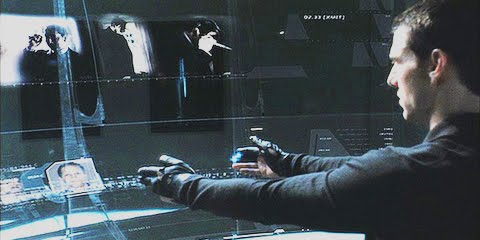
But what about going farther into the future? To modern minds something like 10/GUI seems plausible, but what about a UI that is a little more science fiction? Something a little more Minority Report? Well, funny story. That fancy computer interface you saw in Minority Report was designed by the folks over at MIT to resemble what they thought computers could be like in 2050 or whenever that movie was set. And even though it’s only 2010, MIT is closer to producing a similar UI than you might expect.

As you can see, gesture-based computing is approaching reality. But, besides being really cool, what is the appeal of this? After all, standing up and making sweeping gestures is a lot more exhausting than the borderline nothing computer users do today. You won’t want to jerk it in fancy gloves with cameras watching you. And it seems that text editing would take a hit, since you would be forced to use a slower on screen keyboard or actually dictate everything you want written. And yet this is definitely the direction technology is going in.

The Wii kind of got movement back in the picture a few years back. Later this year, movement will be pushed into further prominence when Microsoft comes out with Kinect (formerly Project Natal) and Sony comes out with PlayStation Move. Both use cameras to track the player in a 3D space. Move uses a Wiimote-esque controller with a magical ball on the top of it that lights up that the camera can very accurately track. Kinect thinks even that is too much, so it just straight up tracks your body. Neither of these technologies are available to the public yet, but it will be exciting to see what they do for the future of gaming. But the future of UI has to be bigger than just gaming consoles. Hell, it has to be bigger than computers as we know them.

Sixth Sense is amazing if it actually works. Being able to enjoy the best aspects of a computer wherever you go is something everyone can enjoy. Obviously there are problems with projector strength and battery life, but that Sixth Sense technology is about as exciting an approach to computing I’ve seen in the real world.

But does it replace the keyboard? I’m not convinced. Despite all the new, exciting UI technology that is currently in development, I don’t see any better method of alpha numeric input than the keyboard. And sometimes you just want to sit back and relax when you play a game or browse the Internet. I think gestures are a bit too much for that all the time. But the wonderful thing about our powerful modern machines is that you don’t need to choose one or the other. You can have both. It’s all about making the experience better for us. And that’s what is most exciting of all.
SIFF Part 3: Little Big Soldier

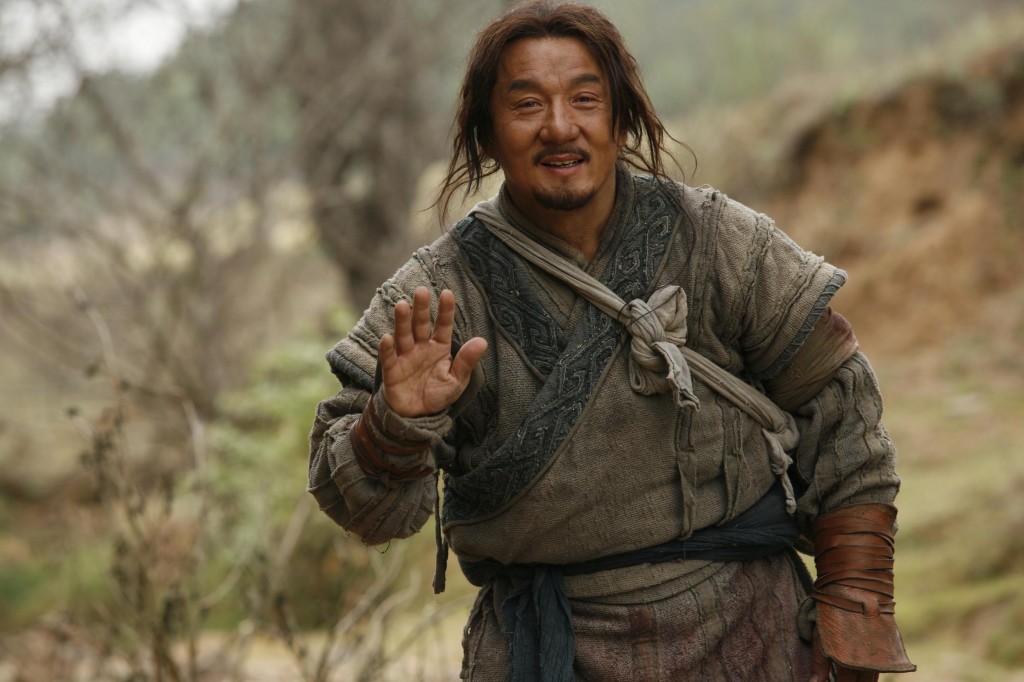
The final chapter of our Seattle Film Festival shenanigans ends with the chinese buddy picture known as Little Big Soldier starring Jackie Chan. The only foreign language film we saw, which we were obviously drawn to because of the Chan man. Known as the Buster Keaton of Kung Fu cinema, Jackie completely delivers with plenty of charm and style in this humorous and even thrilling period piece.

Before I jump in let me paint a picture of our exploit, as I often do. So we (Sean, Colin and I) saw this one at some Regal theater in Seattle. It was one of those fancy shmancy two story theaters that seemed like a surprising venue for a SIFF film. Going in it was the same old SIFF routine. An organizer talks about voting for your favorite film before the film starts and yadda yadda, whatever. I guess none of this important but I’m trying to follow the format of the other SIFF reviews, so just bare with me.

So yeah the film, “Little Big Soldier” either a nod to the film Little Big Man or a fragmented translation? I don’t know but it seems to sum up the film quite well. Jackie plays a Liang soldier during the Chinese warring states period. A simple farmer with little interest in fighting, he’ll often fake being dead to avoid conflict. Though shit gets real when encountering a Wei General (played by Wang Lee-Horn whom Wikipedia describes as “An American-Singer Songwriter”) in a moment of weakness. One thing leads to another and the General then becomes the farmer’s hostage. Planning to turn him into Liang forces for a reward hilarity and action ensue on their journey. Really that’s just a brief summarization of the premise as there’s so much going on here and it truly is a beautifully acted film with some excellent stunt work.

As a matter of fact it’s definitely one of the best films I’ve seen of 2010 thus far and it’s a must see for Chan fans. Anyhow I’ve lost the will to write so I’ll wrap it up here. “SIFF 2010” an intriguing experience that I’d like to follow again sometime. It’s tough finding the right films to see but I’d say it’s a venture worth taking, so that’s my two cents see ya around the blog-o-sphere.

Billy Don’t Be a Hero


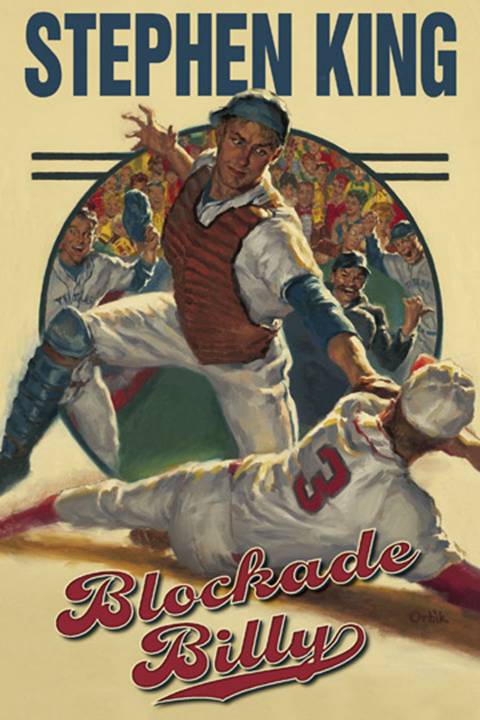
Blockade Billy
by Stephen King


There’s not enough book reviews on this blog though who has the time right? I don’t want people to think I don’t read I just never feel the need to review any of it, because it’s never anything recent. This came out last April coinciding with baseball opening day and being that I enjoy both baseball and the Master of the Macabre, I figured it was one not to be missed.

For those who don’t know, Stephen King is a big fan of the American Pastime, in particular the Boston Red Sox. He can often be seen attending both home and away games and has often incorporated nods to his Beantown boys in his novels. So there’s plenty of references of Boston in his latest novella but this work is based around a fictional team, with one very mysterious player.

Told from the perspective of an elderly former third base coach/equipment manager, Blockade Billy depicts the New Jersey Titans in their 1957 season following the acquiring of their new catcher William “Blockade” Billy a seemingly soft spoken simpleton but with immense skills behind the plate offensively and of course defensively, aggressively blocking home from opposing runners. Though as time goes on and the team begins to suffer certain highs and lows, word soon starts to surface that there is something off about that Billy, something dark.

What I enjoyed about this short, maybe even a little too short tale is that it is pure baseball. Most of if not all of the novel takes place during game-time and King excels at making these moments exciting and suspenseful. He obviously has much love for the sport and has a lot to say about it. The downside is actually the conclusion, in that this big mystery is built up and then answered with only a mildly satisfying finale. All I’ll say is that it’s not supernatural, just kind of dark.

After the story is an additional short story called “Morality” though it’s nothing to rave about and was probably something rotting away in one of King’s jam packed file cabinets somewhere. So Blockade Billy is a mildly enjoyable novel but hardly as compelling when compared to most of his work. Though it has got me back into King, I think I’ll finally check out “The Girl Who Loved Tom Gordon” another story with some baseball tie-ins. Anyways I’ll catch you on the flip side, Otteni out.

C.A.T: Back in Black

AC/DC – Back in Black (1980)
When you think of AC/DC, chances are you’re probably thinking of a track off of Back in Black. From the epic “Hells Bells” to Iron Man favorites “Shoot to Thrill” and the eponymous “Back in Black,” each and every track on this legendary album lives today in infamy.

AC/DC had just released megahit Highway to Hell and started working on this album when lead singer Bon Scott died after a night of partying too hard. With the future of the Australian group in danger, it seemed Back in Black was not to be. But the band decided to persevere, bringing in new lead singer Brian Johnson. They picked up where Scott left off, creating a new album that is both a tribute to their fallen brother and a statement of the group’s rebirth.

Everybody knows the songs on Back in Black. They are the essentials of hard rock. They dominate radio stations even today, and frequently appear in commercials, TV shows and movies. Even though this site tends to shy away from hard rock, I think we’d all agree that these are songs everyone can enjoy. The album kicks off with “Hells Bells,” as good as first song as there has ever been. Then it continues with hits like “Shoot to Thrill,” “You Shook Me All Night Long,” “Have a Drink on Me” and ultimately ends on the tremendous “Rock and Roll ain’t Noise Pollution.”

If you ever feel like you need to rock, Back in Black is about as good a soundtrack as you could ask for. The only problem you might have is that you’ve listened to it too many times.

Favorite Tracks: “Back in Black,” “Shoot to Thrill,” “You Shook Me All Night Long”

SIFF Part 2: Leaves of Grass

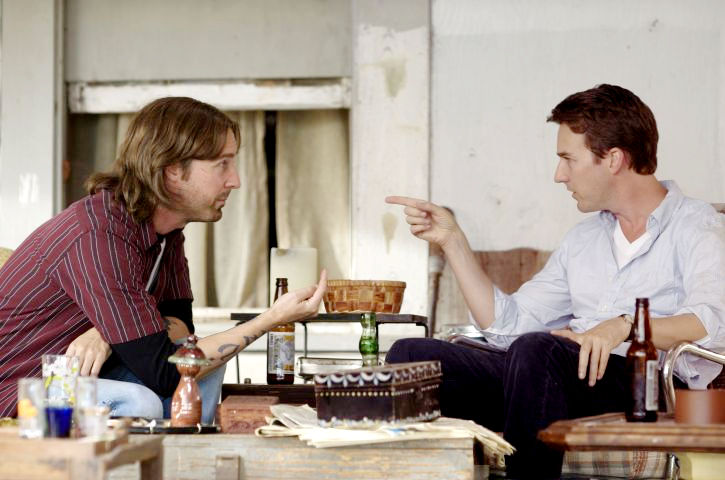
For today we have a play-by-play breakdown of day two of Da Morgue’s Seattle Film Festival Exploits. On our plate this fine afternoon was Tim Blake Nelson’s dark comedy Leaves of Grass starring Edward Norton. One of the few films I’d heard of before the festival this was one I was so excited about I bought tickets in advance. I’d liked the trailer and what I’d read beforehand but what really sweetened the deal was the promise of an Edward Norton appearance afterwards. Wow Edward Norton! Maybe I could ask him what the first rule of FIght Club is? I bet no one ever asks him about Fight Club but we’ll get to that later.

We headed out at about noonish with Sean behind the wheel. As usual him and Colin argued over GPS gobbledygook as Paul and I talked about the worst questions we could ask Edward Norton if we got the chance. We arrived about an hour before showtime and waited in a long but casual line outside the Egyptian theatre in Seattle’s Capitol Hill District. We killed time as Sean once again regaled us with his idea for a graphic novel called Choice: The World of Shadows about people with shadow powers defending themselves from these guys sent from god. Naturally it would be made into a movie starring Jesse Eisenberg as the hero and Will Arnett as the villain. Seemed like a good project to pitch to Edward Norton, maybe he’d be interested in providing some financial backing?

By the time we got inside most of the good seats had been taken. Sean and Colin found decent seats further back but Paul and I wanted to be close for Edward Norton’s appearance. We sat in the front row right next to the steps leading to the stage. So the film began and turned out to be an easily enjoyable experience for all, at least I hope. A dark comedy where Edward Norton played twin brothers, one a renowned philosophy professor, the other a drug dealing hick. Of course Norton played both continuing his fascination with duality. Writer/director Tim Blake Nelson co-starred as the hick brother’s blue collar best friend and what followed was a few hours of off-the-wall dark humor, violence and sweet Edward Norton x2 action.

The audience appeared to eat it up, I mean the lady next to me laughed so loud I practically went deaf. I definitely enjoyed it, not like it was amazing or anything but it was different and humorous. Though it would of been a lot better if I could hear more of the dialogue covered in rowdy audience laughter.

As the film came to a close the big moment was soon to come… And midway through the ending credits they called him up, “Ladies and gentleman, Edward Norton.” He came out and literally walked right in front of me to get on stage. As a matter of fact I had to scoot back my feet to clear a path. To think I could of tripped a two time Oscar nominee if I had it in me… That could of been on the news. It was a typical Q & A and really no one had any really great questions. They went something like this and I’m serious, these are the questions verbatim.

– “Edward Norton, why are you so awesome?”
– “What’s been your most challenging role?”
– “What advice do you have for aspiring actors?”
– “In the movie which brother did you enjoy playing more? And can I have your autograph?”

Those are what I can remember and he answered them with pretty modest answers, except that one chick didn’t get an autograph. For the most part he just seemed like a normal guy but it was still a surreal experience. It couldn’t of lasted more than ten minutes before he thanked everyone and made his exit through an outside door. Afterwards we went to Dick’s and the rest is history, overall a good film, a good day and an unfortunate missed chance to trip a celebrity.

SIFF Part 1: Ondine

I don’t know why it’s taken me so long to check out the Seattle International Film Festival. I mean every year from late May to early June there are literally hundreds of independent film’s playing just a few minutes away. So finally Colin and I took in our first SIFF film yesterday and plan to see all that we can in the remaining week of the festival.

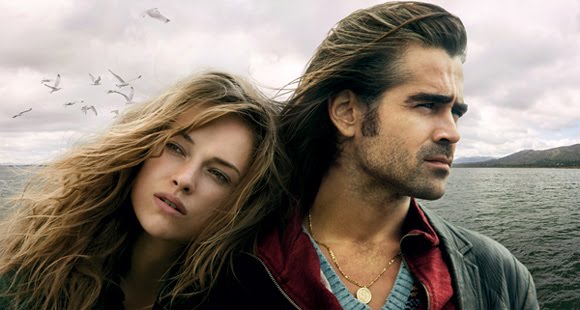
Step one is finding a movie you’re actually interested in. A documentary about the holocaust? A hard hitting drama about Bulgarian refugees? What to do? So we played it safe on our first outing picking an english language film with a familiar star and director. The film was Ondine about a struggling Irish fisherman named Syracuse (Colin Farrell) who one day discovers a beautiful woman Ondine (Alicja Bachleda) in the water, who his ill daughter believes to be a selkie (a mythological sea creature.) It’s a fairly light drama from writer/director Neil Jordan (The Crying Game, Interview with the Vampire) but before I go on let me tell you about this whole indie film going experience.

Being that the film was playing at the Kirkland Performance Center (and we are Kirkland residents) travel was a breeze. We cruised down at about six (an hour before showtime) and tickets for students were dirt cheap at 6 bucks, so if you like going to cheap movies maybe that’s a good incentive to stay in college for as long as you can, like Van Wilder. Concessions were also cheap and offered a few items I was surprised to see at a theater. This included wine, sparkling ciders and brewskis. Colin bought a three dollar pale ale (I just had Dr. Pepper) but had to wait for about ten minutes for popcorn. They ended up bringing it in to him into the theater.

The place wasn’t really built for movies but I didn’t really mind considering it was so cheap. As the film began it looked almost like it was a dvd copy of some film print, I mean it actually started with some weird menu. There were a few audio problems, most notably a few seconds where there was none but aside from that it worked well enough.

What did I think of the movie? Well it was fine just fine. I had some trouble understanding Colin Farrell’s thick Irish accent but I don’t think I missed out on much dialogue. The film was shot in some amazingly picturesque settings which was definitely a highlight. The story was nothing to rave about but it worked out well enough and wrapped up in a satisfying fashion. I’m always a fan of indie Colin Farrell so he was probably my favorite part of the film.

So it was a good film, somewhere around 3 or 3 1/2 stars out of five. I enjoyed the cheap tickets and concessions but don’t feel too desperate to rush back there for more movies (though it might be the easiest way to see SIFF films.) Anyhow check back soon for part II detailing Sean, Colin, my brother Paul and I’s experience checking out the film Leaves of Grass.

Grand Theft Horse

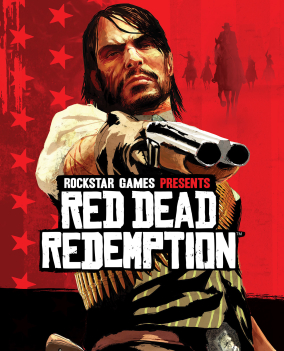
Red Dead Redemption

I like Westerns. There are very few video games that have capitalized on that. Perhaps that is because historically accurate depictions of that era in U.S. history don’t exactly sound fun – lots of racism, hard work, and shitty weapons that are more likely to blow your hand off than your enemy away. But that reality didn’t stop the cowboys of cinema, so why couldn’t a game take the same liberties? There have been attempts, Call of Juarez, Neversoft’s Gun and Rockstar’s Red Dead Revolver tried to deliver quality Western experiences and had mild success, but the genre never had a truly great game. Until now.

Red Dead Redemption is not a linear action game like its spiritual predecessor. It is very much a Grand Theft Auto game set in 1911. Just like the GTA series, Redemption is all about the sprawling sandbox that you are free to explore. But the GTA games were all about wreaking havoc, filling a bustling metropolis with as much destruction as you could before ultimately succumbing to an onslaught of police gunfire. This is a game about enjoying a vast landscape and the strangers that occupy it. The game gives you a huge piece of land, from the U.S. to Mexico, from deserts to forests, mountains to plains. You will spend a lot of time riding around this land on horseback, and while it eventually does get boring, you never fail to appreciate the beauty of this digital world.

And there is a lot to do. You can visit various towns, engaging in games of horseshoes, blackjack and liar’s dice. You can hunt down bounties or actual game. Strangers will ask you for help and take advantage of you. You can search for a new horse to tame. If you stumble upon a gang hideout, it will be up to you to get rid of those criminals. There are even flowers to gather. Everything has a purpose and propels you toward some sort of reward. The developers did a wonderful job of filling this world with life. When someone waves you down, you never know if they actually need help or are about to open fire. And the cougars. Oh those damned cougars.

There is a main story at the center of the game, starring what has to be one of the most compelling main characters I’ve played, John Marsten. When the story begins, Marsten is being pressured into hunting down a member of his old gang by some government agents. The poor guy just wants to leave his old life behind, as the whole gunslinger lifestyle is dissolving around him. In traditional Rockstar fashion, the story is offered to you in tiny chunks, asking you to explore the world at the end of each chapter. Also just like other Rockstar games, you find yourself doing some kind of messed up stuff for really messed up people a lot of the time. But if you make it to the end, I believe you will agree that Marsten’s lengthy story was a pleasure to see unfold.

The game plays a lot like GTAIV, with mostly identical controls. They’ve added a radial menu on the left bumper to change buttons, which is nice but still a little clunky. There are three aiming modes with different amounts of aim assist, I preferred the middle option which lets you aim Modern Warfare-style, automatically aiming at the chest of the enemy you’re looking out when you pull the left trigger. You can also do a mark-and-execute style maneuver by tapping the right analogue stick, which is neat. Most important are the equestrian controls, which take a little getting used to before you understand how they work. But when mastered, it becomes a lot of fun to ride around, which is important since most of the game is spent on horseback.

On top of all this great single player content is an interesting multiplayer mode. The whole world is available for you and your buddies to posse up in, and there is plenty to do there too. There are also competitive multiplayer modes to play, which offer interesting takes on the traditional game types you’d expect from a shooter. Honestly, it all sounds great, but I haven’t really spent much time with it.

Red Dead Redemption is the first Rockstar game I have actually been able to finish. For all that I enjoyed GTA IV‘s story, I did stall out towards the end. I could have probably completed that game in a sitting, but I was done. I was sick of driving around a depressing city, running errands for jerks and constantly appeasing my ever-calling buddies. Redemption was different. The story was so good I couldn’t wait to find out what crazy character I would meet next. The world is vast and beautiful. There is always something fun to do. This is certainly a game worth owning. If you like the west, cowboys or sandbox games, I implore you check it out. Despite a few bugs, this is one of the best games I’ve played.