Sean Lemme

I started blogging as a way to lazily pass my high school senior project and somehow I've kept doing it for more than half my life

How I Had My Cake and Ate It Too

How I Met Your Mother Season 9

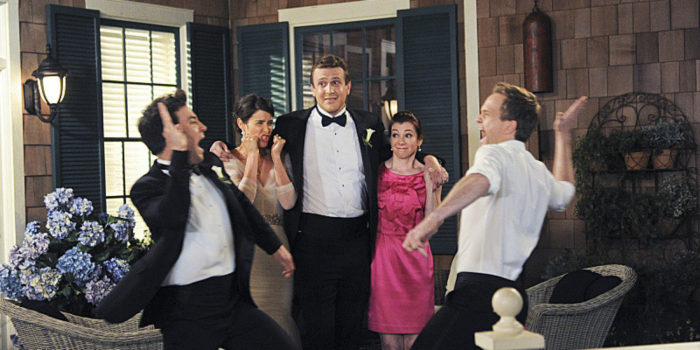
HIMYM ended on a beautiful moment (set to a Walkmen song, the series always could pull a great song when it needed it) that provided the series with symmetry and closure the likes of which are rarely seen in a sitcom. And I hated it.

Let’s back up. This was a show that was well past its prime, even the creatives behind the show didn’t plan on it making it this long. At seemingly the last moment during season eight, a ninth and final season was green-lit to let the writers expand the long-awaited wedding of Robin and Barney into a full season event. At the time that news broke, I was well beyond my frustration with the show’s formula, and my attitude was that they had to either put up or shut up. There were some missteps, but actually I was pretty impressed with most of the final season.
Continue reading

T3 76: Top 10 TV Shows That Lasted Too Long

This week on Top Ten Thursdays Sean learns he cares too much about the shows he spends his time watching, John finally opens up about what it’s like to still care about The Simpsons, Colin has a bone to pick with Everybody Loves Raymond, and Matt makes his triumphant return! It’s a jam-packed episode that guarantees not to disappoint by ignoring what it’s been for the past nine years just to give its ending some unearned symmetry! CHECK IT.

Top Ways to Listen:
[iTunes] Subscribe to T3 on iTunes
[RSS] Subscribe to the T3 RSS feed
[MP3] Download the MP3

Continue reading

The Bluest Skies You’ve Ever Seen

inFAMOUS: Second Son

It was the first inFAMOUS game that sold me on the PS3. Uncharted made it tempting, but the idea of an open world super hero game is one that I can’t resist – why else would I have spent so much time with the PS2-era Spider-Man games? So in retrospect, maybe it’s not a surprise that I became an early adopter of the PlayStation 4 basically so I could get the third inFAMOUS game. Especially since this entry was abandoning the franchise’s tradition of using stand in cities (“Empire City” in the first game was basically New York, “New Marais” was essentially Now Orleans) and was actually set in Seattle, a place I have considerable fondness for. It’s not the Nineties anymore, we don’t get a lot of stuff set over here!

Actually I ended up wishing they hadn’t actually called this city Seattle, because it’s not quite close enough for me. Some parts of the city feel really abridged – like how the Space Needle is basically in the Science Center – while others feel fairly alien, like the “Lantern District,” which didn’t really remind me of the International District at all. There are great touches here and there (I was particularly happy to find the Toe Truck and Elephant Car Wash) but it never felt exactly like Seattle. Especially since inFAMOUS: Second Son‘s set in the future and years after super powered conduits first appeared and starting wrecking places, I’m not sure this could have really been Seattle anyway. I did appreciate the 12th Man jersey I unlocked for my character though.

Delsin Rowe steps in as the series’ new protagonist, since it would be weird for Cole to come back given the way the second game ended. Since then, a government organization called the DUP was formed to capture and intern conduits. A trio of conduits escape from a DUP transport and accidentally reveal that Delsin is a conduit too – one with the unique ability to copy powers from others. With his first power in hand, Delsin and his cop brother head off to Seattle to find the conduits and stop the DUP from doing some nefarious shit.

inFAMOUS: Second Son takes the series already fairly black-and-white approach to moral dilemmas to even simpler heights. While a case could be made for the pivotal choices in the first two games, here I have no doubt that the “good” choice will be considered canon. Basically you chose between being a reasonable person and a terrible monster. Which is a shame, given the game’s early aspirations to deal with complex prejudices and the nanny state. You won’t find yourself torn between loyalties, humans vs. conduits, any of that stuff. Straight up it will be like “do you want to kill the bad guy or kill a bunch of innocent people for no reason?” But that’s OK since you the real incentive to choose bad karma is still there: sweet, sweet evil versions of your powers.

Between story missions, you can work at liberating districts of Seattle. You’ll want to do this, since it nets you blast shards, the currency you use for upgrading powers. Most powers in the game have upgrades, and some require you have a certain amount of good or evil karma. Generally, good karma powers make you better at disabling and detaining enemies, while evil karma increases your destructive potential. So a good karma player will upgrade one blast to be able to zoom in on enemies and shoot them in the feet to disable them, while an evil karma player will unlock the ability to make people dissolve when shot in the head. Karma even extends into combat, with good or evil actions giving you the power to do massive attacks that wipe out all the enemies in an area.

This is the best power fantasy this side of Saints Row IV. Each of the powers Delsin gets feels and looks different from the last, and none of them are exactly like Cole’s lightning powers. Gone are the days of skating on powerlines, now you can, for example, turn into a puff of smoke and get sucked through vents, blasting you to the tops of buildings. Despite whatever other reservations I had, this game just feels great to play. It helps that it’s one of the prettiest games around too, making it a great showcase for this sweet new console I’ve totally had for three months already.

It took me maybe a dozen hours to beat inFAMOUS: Second Son the first time, which isn’t a lot of an open world game. But this game does not match the last games’ enemy and side quest variety, so I’m OK with it. There are only a few side quest types, and most of them only take a minute or so to complete. Basically, I felt I was given enough time to really enjoy each power without overstaying its welcome. Plus, I kind of want to play it again with good karma, because what I’ve seen of that so far makes Delsin seem like a way better person.

After the disappointments of Knack and Killzone: Shadow Fall, as well as the delay of DriveClub, PS4 owners have been looking for a win. inFAMOUS: Second Son is the first game on the system I would say is good enough to motivate a console purchase – if you’re into the series or super hero games in general. It’s kind of shallow to say, but this game’s gorgeous and fun, and when you’re in the early days of a system, that’s about anyone’s looking for.

T3 75: Bottom 10 One-Hit Wonders of the 2000s

I had intended this to be our triumphant return to form, but some unforeseen technical difficulties and foreseen better things to do has led to this comeback being more a whimper than a bang. But don’t take that as any indicator of the quality of this episode to which you’re about to listen! Sure, it’s been a while, but now we’re back and doing something that’s right in our wheelhouse: hating on irrelevant pop culture. This week, we take aim at the biggest hits of the noughts that just rubbed us the wrong way. We’re got our eyes on you, Chad Kroeger.

Top Ways to Listen:
[iTunes] Subscribe to T3 on iTunes
[RSS] Subscribe to the T3 RSS feed
[MP3] Download the MP3

Continue reading

They Truly are the Detectives of Detectives

True Detective Season 1

For a couple months there, everybody was talking about HBO’s hot new show, True Detective. Then it ended a little more than a week ago and the conversations have basically stopped. Which is a shame, since this is definitely one of the those shows that benefitted from rampant speculation and debate; one that I’m not sure will be quite as fun as a rerun. But Colin has expressed interest in reviving the TV review on the blog this year, and if we’re going to do that, then we should probably start with the year’s first must-see TV event.

True Detective is the brainchild of author Nic Pizzolatto, who created the show and wrote every episode, and Cary Fukunaga, who directed the whole thing. The idea is that the show will be an anthology that delves into pulpy crime drama – think American Horror Story but with detectives. The first season follows Rust Cohle (Matthew McConaughey) and Marty Hart (Woody Harrelson), two Louisiana detectives on their 17-year quest to capture a serial killer. Over the course of the season’s eight episodes they find, of course, that there is an evil at the center of this mystery much greater than a lone man.

Like many mysteries, I found True Detective most engaging when it was asking questions, rather than giving answers. For me, the first two thirds of the show were significantly stronger than its conclusion, especially because, for a time, it seemed the show was going in a much more unbelievable direction than it actually did. One of the early joys of True Detective is listening to Rust philosophize about the world and life, and the show lends some credence to his hypotheses. That meant that, after the second or third episode, people saying the show, so clearly inspired by Lovecraft, could end with the likes of Cthulhu didn’t sound totally insane. And that made the show pretty damn engaging.

True Detective‘s bread and butter is the juxtapositions of Rust and Marty; not just the differences between each other, but the differences between who they were, who they are, and who they think they are. The first half of the story is told in two different timelines: In 1997, when Rust and Marty first start working the case, and in 2012, when they are called in by two new detectives who reveal the killer might still be out there. When things in 1997 start going differently from the way they tell it in 2012, it throws even more confusion into this already convoluted mystery.

There are many actors who you’ll recognize doing great work on True Detective, but this Matthew McConaughey’s show. His is the juiciest part in the whole series, and the man absolutely guzzles it down. Much of Rust’s dialogue could have sounded disastrously pretentious or nonsensical coming from a lesser actor, but McConaughey lends enough weariness and gravitas to the role that it works. It’s weird to think how far this guy has come in just the last year or two, one of the most incredible career turnarounds in the history of the industry.

Woody Harrelson has come a long way himself, although I’d contend he’s been a respectable actor for a while now. The part of Marty is less glamorous and the character is intentionally harder to root for, but Woody is no slouch. He does terrific work elevating some of the more traditional aspects of the story, and does bring a fair amount of heart to Hart. There are just a few moments later on in the show that I think were either written weird or Woody played strangely, which had me thinking things that I don’t believe I was supposed to think.

And that’s what I took away from True Detective – it was a smart show that gave me a lot to think about. The ending was really different from what I was expecting, but any reservations I had were alleviated by that spectacular last scene. Where does it go from here, I wonder? Will the creators focus on this same conspiracy? Will we even still be in Louisiana next season? The potential, like the darkness, is infinite.

Remember the Titans

Titanfall

The two biggest games of the first quarter of the year, Titanfall and Dark Souls II, came out on the same day, but that’s about all they have in common. The latter is a punishing, largely singleplayer quest that pits you against crushing challenges that are so intense, they create almost as Stockholm syndrome-esque sense of joy when they are overcome. Titanfall, on the other hand, is multiplayer-only and it just wants you to feel awesome as often as possible. That’s kind of a refreshing change of pace in this day and age.

The modern online multiplayer FPS is all about progression; whether it’s gun upgrades and perks in Call of Duty or cooler looking armor in Halo, you’re always playing for more than just winning the match. Titanfall has that aspect to it too, but it’s extremely scaled back compared to those games. There aren’t too many weapons, attachments, and perks to unlock. A battle in this game isn’t a means to an end, at least not that end. No, here you’re playing for the pure satisfaction of all the cool things you can do right off that bat – like drop a giant mech on someone’s head from space.

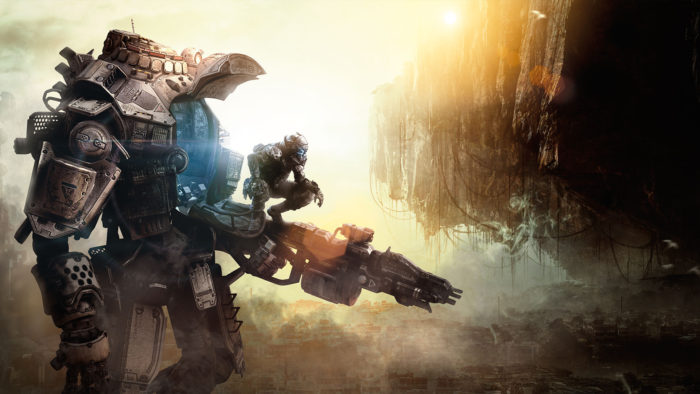
Like so many next gen experiences, Titanfall‘s about the asymmetry. You play as a pilot and will spend your time split between running around on foot and within your titan, the massive mech that is your one and only friend. As a pilot you are extremely agile, you can run on and up walls gracefully and easily. In a titan you are lumbering and slow, but capable of bursts of speed and, you know, crushing people with your feet. It’s a great, delicately balanced approach to gameplay that gives you enough options to change your approach, but never feel outgunned. A pilot is capable of taking down or avoiding a titan, and I wouldn’t be surprised to find out that many people actually prefer letting their titan fend for itself.

AI is a bigger part of Titanfall than any other online FPS this side of Left 4 Dead. For one, when you call your titan down from space (the titanfall) you don’t have to get in it. Instead, you can tell it to follow you around or guard a specific location, which it will with gusto. This comes in handy, because although the game is just six-on-six, each map is also full of AI controlled enemies. These bots serve essentially the same function as creeps in a MOBA game; they’re fodder for you to kill to rack up points. I love this idea, as it makes the battlefield seem more chaotic and it provides something to focus on if you’re just getting dominated by the other team. Plus, they run around yelling about how great and dangerous pilots are. Like I said, this game wants you to feel good.

That carries over to pilot loadouts as well. One of the first guns you get is a smart pistol, a gun that locks onto enemies. It’s great for taking out packs of grunts, but requires a few seconds to get a bead on other players. That means anyone who takes the smart pistol is free to run around mowing down bots, but only the really skilled will be able to use it effectively against humans. Every other gun in this game feels just as carefully balanced, with enough advantages and tradeoffs that I am actively using all five pilot and titan custom loadouts when I play. There isn’t a lot to choose from, with basically just one of each type of gun and only three titan chassises, but that’s less limiting when everything seems useful.

Honestly, my biggest disappointment with Titanfall is the campaign, which is probably just because of my own unfair expectations. I didn’t know much about it going in, only that it would be part of the multiplayer and this was the long-in-development game from the a bunch of the people who brought us Call of Duty 4: Modern Warfare, a game with a wonderful, memorable campaign. As it turns out, the campaign is little more than some multiplayer matches with contextual voiceovers. The story plays out the same way regardless of winning each match, which is the most troubling aspect of this venture. In a game that is so much about empowering the player, here I was left feeling powerless. The whole mode ended up seeming like a vestige of older game design.

Outside of the campaign, there are two team death match modes, one which gives you points for killing anything, another which only rewards pilot kills. There’s a domination mode and capture the flag for those who like objectives. And then there’s Last Titan Standing, a mode in which every player gets one titan and one life, and teams compete to destroy each others’ titans. None of it is groundbreaking, but it feels different and exciting thanks to the simple fact that there haven’t been other games that focused on man-on-machine combat. With 15 maps and the promise of future DLC, this seems like a great package for the Call of Duty crowd.

But what about the outsiders? Personally, I’ve never really, really gotten into an online competitive FPS. I dabbled in Battlefield 1942 and a few of the Halos, but never really committed to a game like a lot of people do. I’ve had a lot of fun with Titanfall over the last week, and I want to keep playing it. The matchmaking seems kind of shitty right now, but that will get fixed. Will this be the FPS that finally gets me? I hope so. If not, I’ll still be optimistic about Titanfall 2.

Morning Glory

Beck – Morning Phase

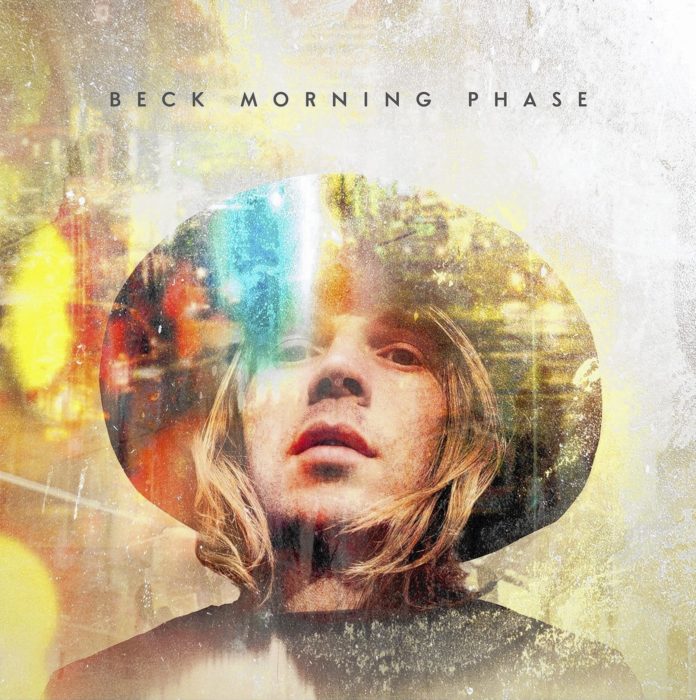
As Mildly Pleased’s resident Beck fan and someone who has gone on the record that Sea Change is one of Beck’s best albums, it’s pretty difficult to contain the glee I have for Beck’s first album in six years. I knew it was coming, I had a sense of the vibe he was going for because of all the singles that he’s put out in the interim since Modern Guilt, but I was a little concerned that Beck maybe didn’t have any more albums in him. After all, his last major release was a songbook he intends to never record.

Not that Beck hasn’t done neat things since 2008. I enjoyed his contributions to the video game Sound Shapes, particularly the song “Cities,” which I wish he would actually release as a real song. He also did that “Sound and Vision” cover thing last year, which is either awesome or extremely pretentious, I’m not quite sure. And then there are all the singles that have popped up in my Rdio feed since 2013, a few of which didn’t even make it onto Morning Phase. I liked those too. Basically, Beck’s done enough to keep people like me interested over a gap long enough that some fans probably did lose interest.

But this album rewards long-time Beck fans. The first track on Morning Phase, “Morning,” is clearly evocative of “Golden Age,” one of the simplest, and best, songs he ever recorded. There are highs and lows as the album continues, but I’ve found it a consistent source of aural entertainment for a couple weeks already. Now into his 40s, Beck’s days of rap rock are long over. Despite the title, I doubt this album is representative of Beck in any sort of a funk like he was on Sea Change – this is no phase. And that’s great, because I like what he’s doing. I just hope he keeps actually, you know, recording it and making it available.

Favorite Tracks: “Morning,” “Blue Moon,” “Waking Light”