


After last year, when I cobbled together a paltry five shows, I’m back in 2025 with a vengeance. Do I believe there is an underlying reason it went down this way? No. TV is weird now. Shows happen when they happen. There is little to no urgency to watch them unless it’s a buzzy show like Stranger Things. Even then, I haven’t watched the new season of Stranger Things. Why? I can always watch it later.
TV is what I put on when I eat dinner, or in the case of Heated Rivalry a cocktail. 😉 It’s background noise. But I’ll tell ya, there was good background noise this year. A few shows I would even consider for the foreground. Key word: consider. Let’s not go nuts.
Fuck it. Let’s do this.
Honorable Mention
I Love L.A.
King of the Hill
The Mortician
The Righteous Gemstones
It: Welcome to Derry
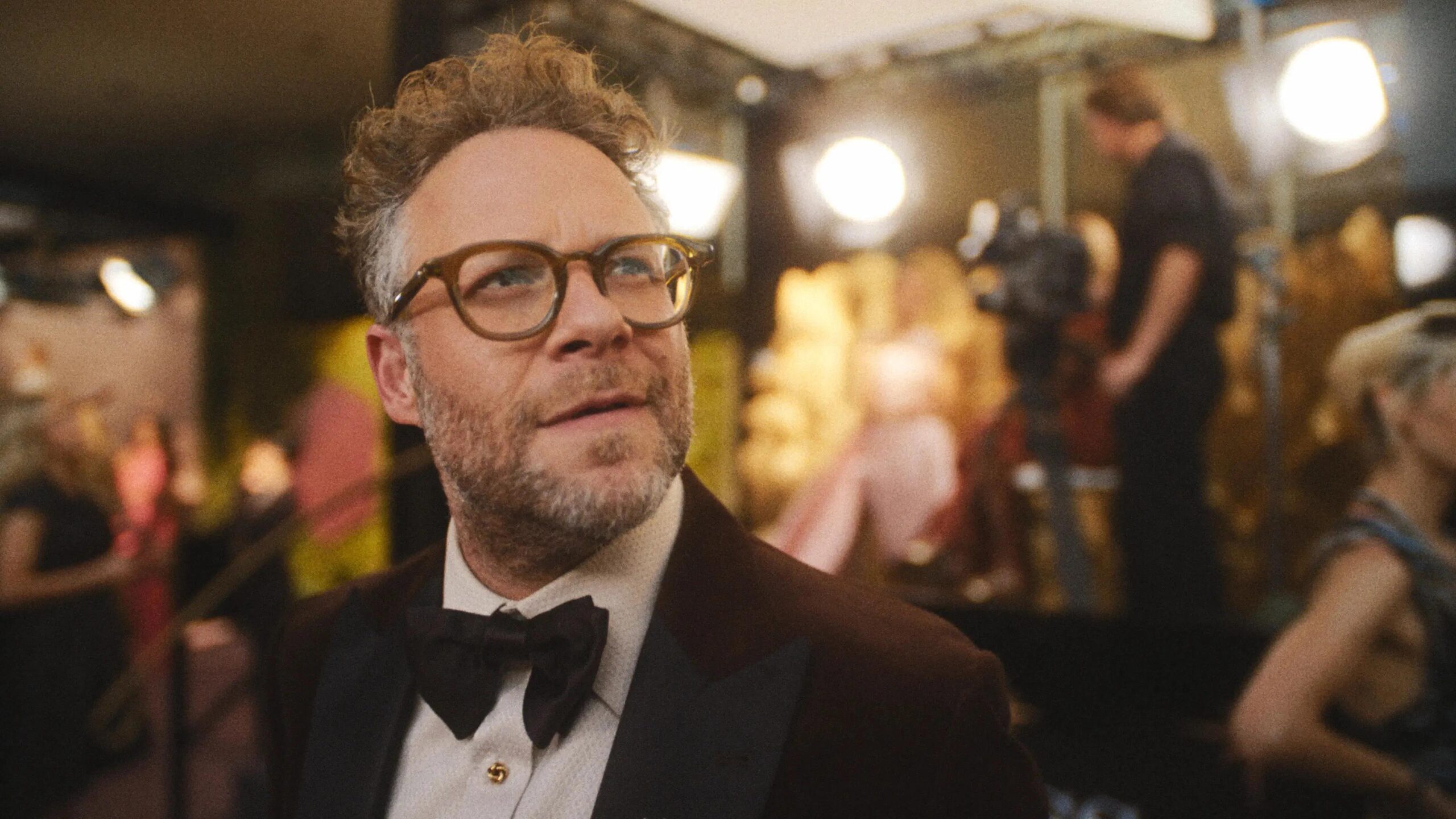
I hadn’t planned on watching The Studio. Then it won every Emmy, and I figured I should give it a shot. I’m not much for TV awards shows. It always feels like one series locks down a category and then wins every year until it ends, even if it sucks. But The Studio stars Seth Rogen, and I like Seth Rogen. He’s like the only member of the OG Apatow crew who hasn’t been canceled or disappeared, which I chalk up to two things: 1) he seems like a good dude, and 2) he loves making movies. So much so he made a show about it.
I don’t know if The Studio is “accurate” to how a movie studio runs (probably not), but it feels authentic in a cheeky, inside-baseball way. I wouldn’t be surprised if a lot of these scenarios were inspired by real experiences from Seth Rogen, Evan Goldberg, and the rest of the writers’ room, stuff like the agony of pulling off a long one-shot, or the delicate art of negotiating with a monster like Ron Howard.
The dilemmas are funny (the Kool-Aid movie controversy was my favorite), but there’s a reason this show lands at my ten spot instead of one. The Studio is TOO stressful. Much like Curb Your Enthusiasm, it’s built around arrogant people who talk too much when all they need to do is shut up. Seth Rogen’s studio head, Matt Remick, is the worst offender. It’s jarring to see Rogen play someone so unlikable and pretentious, but if anyone can pull it off and still make you kind of, sort of, root for him, it’s Seth.
And hey, who doesn’t love a good celebrity cameo? Martin Scorsese being told his movie about Jonestown needs to be called Kool-Aid? That’s gold, Seth. Gold.
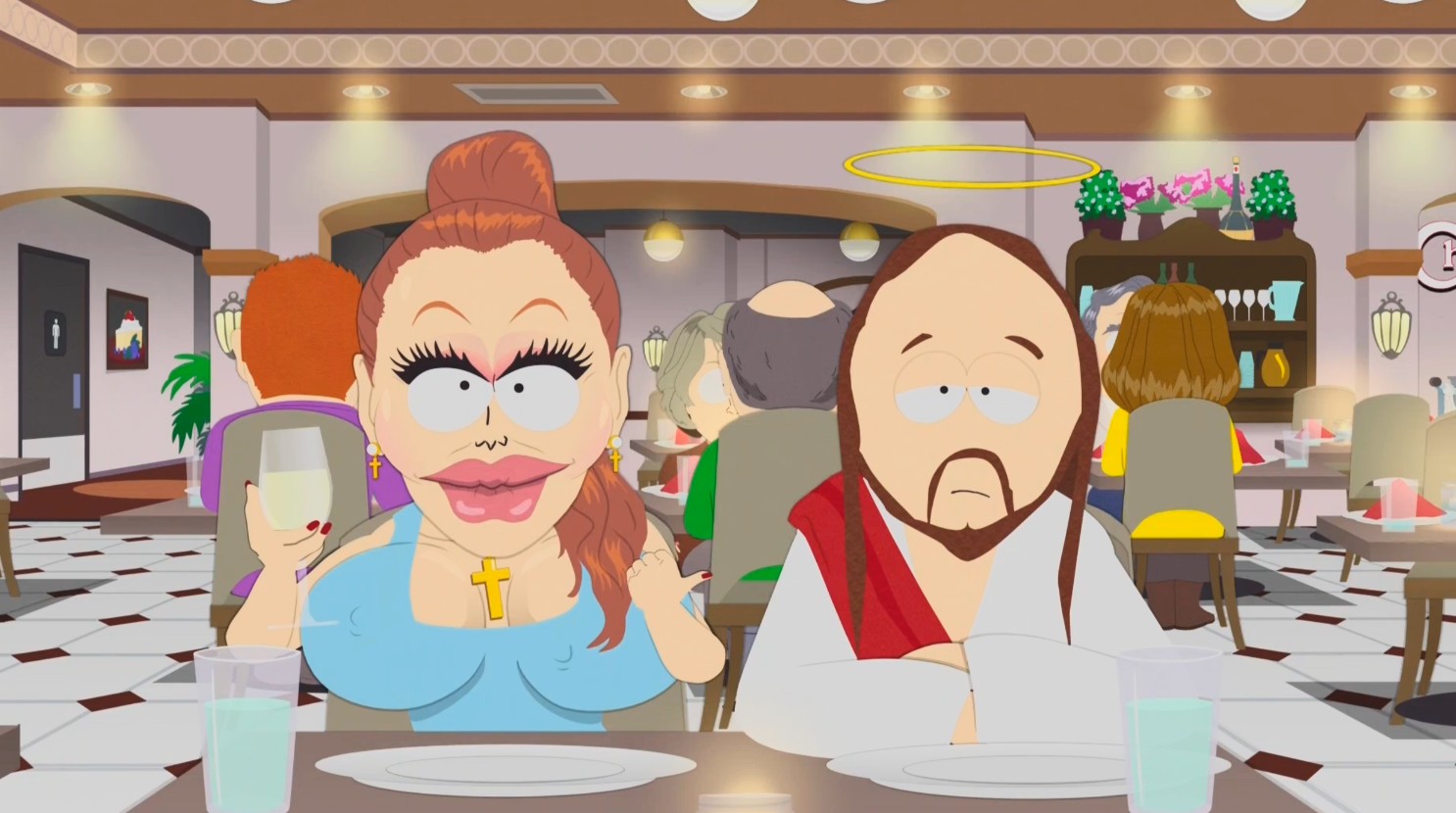
I’m as shocked as you are. Before 2025, I couldn’t tell you the last time I finished a whole season of South Park. It’s not like the show had fallen off a cliff, not to my knowledge, anyway, but it’s hard to keep up with any series for almost thirty years.
What I liked so much about this latest batch of South Park episodes is how Trey Parker and Matt Stone found the perfect way to satirize the Trump administration: by making it just as juvenile as the real thing. Kristi Noem has a melting face and shoots every dog in sight. Pete Hegseth is so gung-ho he attacks a town fun run. Melania is a creepy specter lurking in the halls of the White House, and JD Vance is the Tattoo to Trump’s Mr. Roarke, à la Fantasy Island.
Considering how long the show has been criticized for being “centrist,” it’s wild to see them take such a clear stance against an abusive administration and paint its figures as outright clowns. There’s almost too much material to work with, yet I’m always excited to see the angle they choose.
And I have to give a special shout-out to Jesus’s new girlfriend, Peggy Rockbottom, and her infectious holiday tune, “A Christian Woman Knows Her Place.”
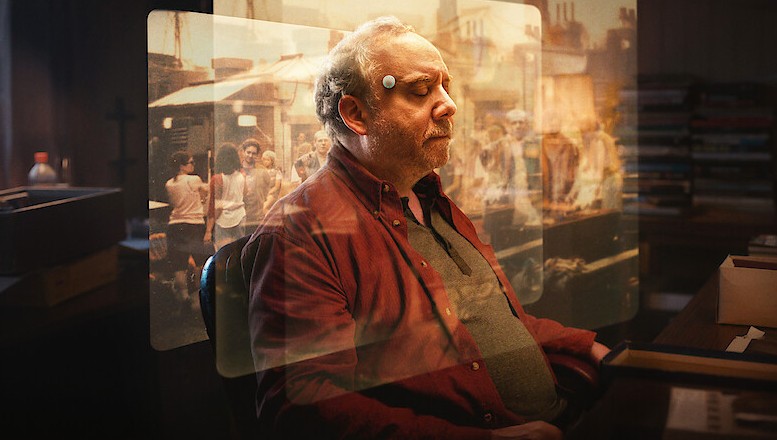
Black Mirror seasons appear so sporadically you may not know they had their seventh season this year. You also may not know they had their best season yet. Part of what makes this run feel so confident is its willingness to look backward as much as forward. Black Mirror has always been an anthology, but season seven leans into sequels, and it isn’t a bad thing per se.
The episode “Plaything,” follows the events of “Bandersnatch”, and there’s also a follow-up to the “USS Callister”. I was skeptical at first, but these new episodes in a way deepen the originals and make the Black Mirror universe feel more connected.
“Plaything” was my personal favorite, a disturbing descent into the obsession of a man who’s become so invested in digital life, he attempts to fuse it with his own reality. On the other end of the emotional spectrum is the Paul Giamatti episode, “Eulogy” about a man stepping into old photographs trying to remember the face of a woman he once loved who has passed on.
As our lives become more mediated by screens and my good pal Al G. Rhythm, the show continues to grow. I don’t see it ever becoming dated either because the show has never been about predicting the future. It’s our modern world reflected into a wacky funhouse mirror. A BLACK mirror.
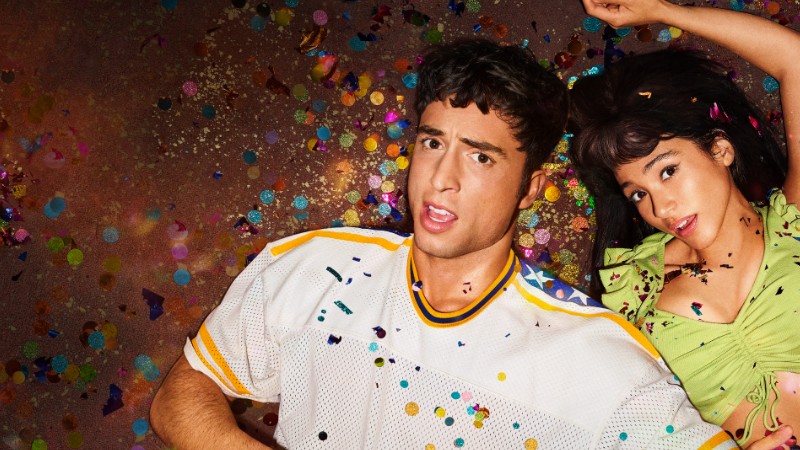
Amazon: “Where shows go to die.” I can’t see any other reason Overcompensating didn’t hit. It’s an A24 show with hot new stars in Benito Skinner and Wally Baram AND Charli XCX guest stars?! Wha happened?
Created, written, and starring Benito Skinner, Overcompensating is Skinner’s semi-autobiographical sitcom about a popular jock named Benny from Idaho struggling to come to terms with his homosexuality while attending college on the East Coast. He tries to date women and act like a macho man by joining a fraternity, but it doesn’t take long for the people around him to notice the cracks.
Also starring is newcomer Wally Baram as the headstrong Carmen, who after a failed attempt to date Benny becomes his best friend. Other stand outs include, Mary Beth Barone as Benny’s apathetic sister and Adam DiMarco (Albie from season 2 of White Lotus) as Peter, a pompous frat leader.
Apart from a sole acting nomination for Wally Baram at the Indie Spirit Awards, Overcompensating hasn’t had much critical success. At least the kind that translates to trophies. But maybe that doesn’t matter. It’s all just a popularity contest anyways.
Hawk Tuah, Man!
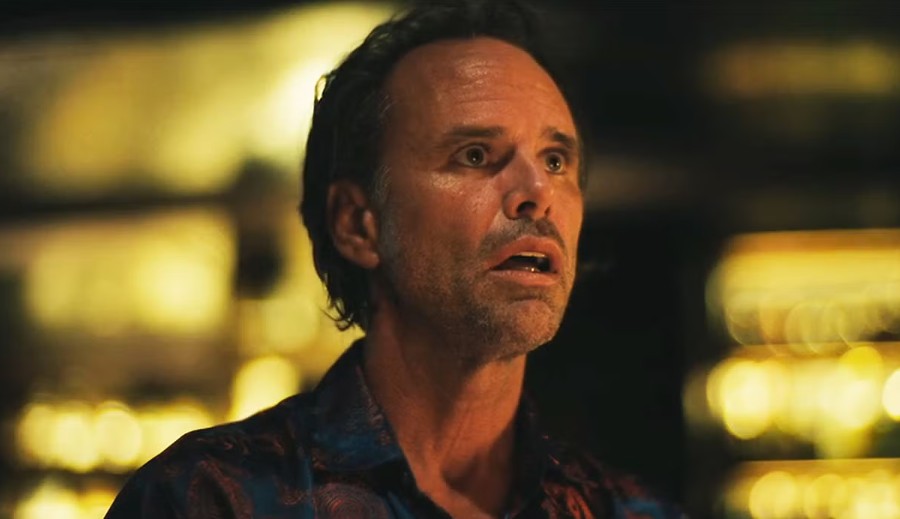
What I like about The White Lotus is every season takes us to a new exotic locale, AND sets a new tone. The first season, set in Maui, felt the most “black comedy” exploiting all of the social discomfort and abuse of privilege between the resort’s snobby clientele. The second season set in Sicily felt sexier, more operatic, dealing with infidelity and the transactional nature of intimacy. And the third season, in Ko Samui, Thailand was the thriller season, with revenge plots, suicide pacts, and of course, monkeys.
Not unlike Breaking Bad, there’s a palpable sense of dread, particularly in Walton Goggin’s subplot. Carrie Coon gives a speech that makes me cry and Jason Isaacs somehow gives the best performance of the season despite playing Foghorn Leghorn if he was suicidal. As long as the ensembles remain strong in future seasons and the theme songs continue to hit, I can’t imagine ever getting tired of this show.
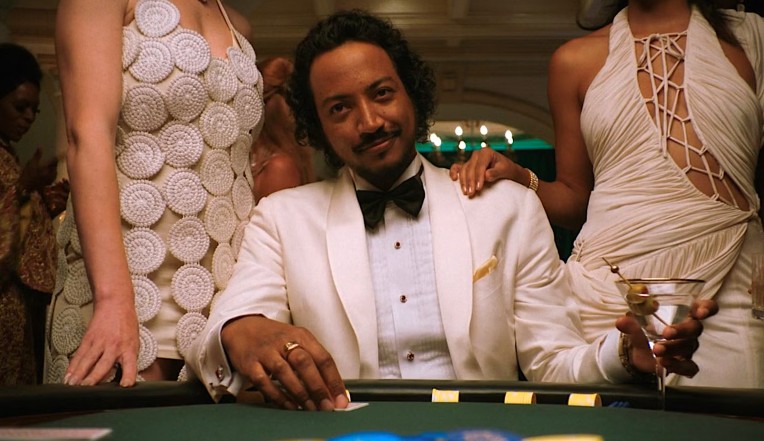
Every year, in the strange, suspended week between Christmas and New Year’s Eve, I fall back into one of my oldest TV obsessions: The Twilight Zone. Part of it is ritual. Christmas is Rod Serling’s birthday, and New Year’s Eve brings the annual Twilight Zone marathon. But it’s also thematic.
New Year’s Eve is about looking ahead into the unknown. The coming year could be one where we come together, or one where we self-destruct. This sense of uncertainty, and the way it’s filtered through social commentary, is why The Twilight Zone has remained relevant for more than sixty years. Its influence is everywhere, including Pluribus.
In an interview with Deadline, Vince Gilligan cited The Twilight Zone and Invasion of the Body Snatchers. as key influences on the show, and the journey of Carol Sturka (Rhea Seehorn) very much feels like someone stepping out of her normal life and into the Twilight Zone.
“What if the most miserable person on Earth must save the world from happiness?” is exactly the kind of ironic, high-concept premise you’d find in the Zone, and Gilligan and company milk it for everything it’s worth. What if aliens catered to your every whim? What would you do, take, or sleep with? How would you regain mankind’s individuality? Is it worth regaining? Pluribus explores all of this and more, anchored by a powerhouse performance from Rhea Seehorn, while always holding back enough cards to keep you curious.
Some viewers may criticize the show’s deliberate pace, but I love its often silent, cold opens, which reveal how events unfold piece by piece. Pluribus boasts the strongest visual storytelling of any show I watched this year. Let’s hope they can guide this one to the finish line, and not get trapped in the Twilight Zone forever.
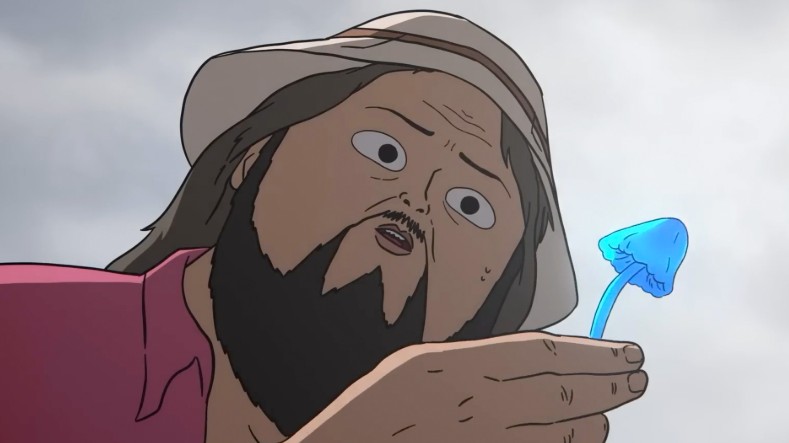
“If a magic cure for all diseases was discovered, would Big Pharma let us have it?” This is the question of the beautifully animated comedy from Scavenger’s Reign creator Joe Bennet and veteran TV writer Steve Hely.
Marshall Cuso (Dave King) is an off-the-grid ethnobotanist who, after discovering a mysterious blue mushroom, discovers it is a miracle cure for all injury and disease. After Marshall reconnects with an old friend from high school, an executive assistant for a pharmaceutical company, Frances Applewhite (Emily Pendergast), the two find themselves in a difficult position reproducing and distributing this miracle drug.
Marshall wants to help people but is fearful of the mushrooms falling into the wrong hands, while Emily wants to find an ethical way of distributing the drug through the struggling company she works for. All this while Marshall is being pursued by the U.S. government in an attempt to destroy the mushroom and halt the damage the mushroom could do against big business.
Common Side Effects is part thriller, part heartfelt character drama, and part psychedelic freakout. If not for the fact every character is animated with big goofy heads and big eyes, I could imagine this show being popular as a live action drama. Yet the show being animated lends so much creativity to the visuals. This show flew under the radar but it’s not flying under this list, man.
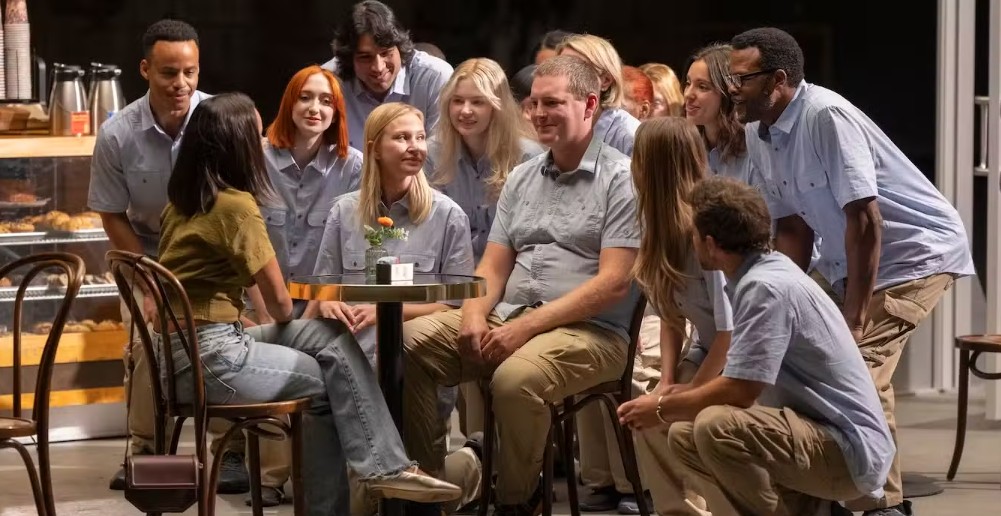
The Rehearsal is the most ambitious show on TV. Nathan Fielder isn’t building fake airports and logging hours in flight simulators for the sake of cringe comedy. Nathan is trying to solve an actual problem. In the case of season 2, this is the communication problem between pilots and co-pilots in times of crisis. I had no idea pilots were under so much pressure to not show any signs of mental health issues and The Rehearsal not only explores that, but figures out how to fix it.
But I never would have expected SPOILER Nathan would become an actual pilot himself to resolve this ongoing problem. The heights at which he’s willing to climb (about 20,000 feet of heights) is beyond admirable. As usual, Nathan Fielder’s latest outing is just as effective as a docudrama as it is a comedy show.
It was my favorite show of 2025 until a little program from up north won me over…
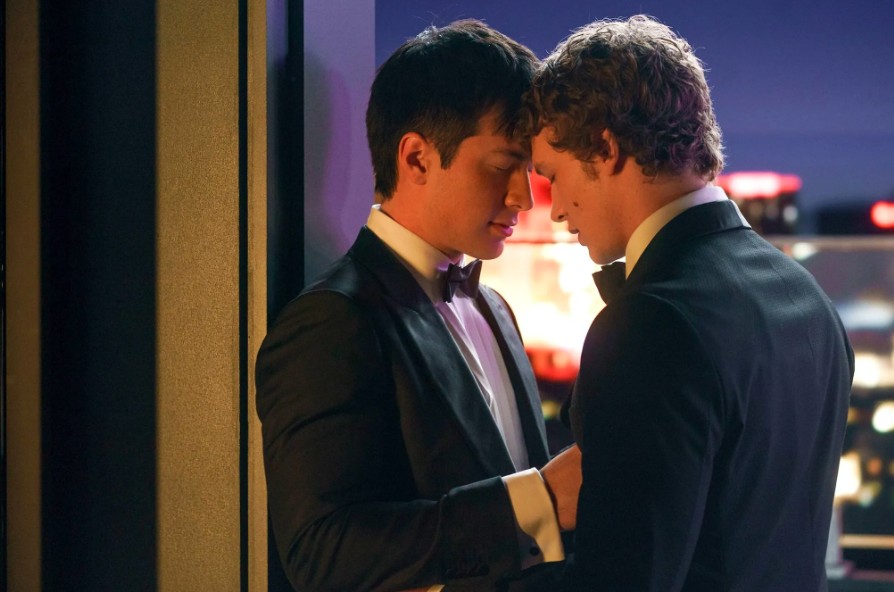
The Rehearsal was the most ambitious show of the year, but few shows, if any, made me pump my fist in the air and cheer. And no, not because of hockey. If I’m two things, I’m 1) a pervert and 2) a romantic, and as far as TV goes, Heated Rivalry checked off both of those boxes.
Based on Rachel Reid’s book series Game Changers and developed for TV by Jacob Tierney (Letterkenny), Heated Rivalry is the story of two pro hockey players: Shane Hollander (Hudson Williams), the soft-spoken Japanese-Canadian leader of the Montreal Metros, and his rival, Russian playboy and captain of the Boston Raiders, Ilya Rozanov (Connor Storrie).
The show follows the two as they rise through the ranks of hockey while facing a years-long rivalry and a years-long love affair.
Yes, YEARS. In one season, Heated Rivalry spanned from our leads’ rookie season in 2008 to their 2016–2017 pro season, with all of their professional and personal struggles emphasized along the way.
What makes the show so successful is how often it uses sex and moments of intimacy to move the story forward rather than hockey. There are few scenes of hockey in the entire show. Heated Rivalry is more interested in the struggles off the ice: what it means to be a closeted person in a profession dominated by hetero-masculinity, and what it means to long for what you fear you can never have.
Unlike most LGBTQIA+ media I’ve consumed, Heated Rivalry doesn’t rely on tragedy, at least not in its first season. Much like sports, this is a show about overcoming adversity to win big. Though instead of a trophy, it’s love. This is best personified in the season’s subplot involving an aging pro, Scott Hunter (François Arnaud) of the New York Admirals, who is also queer, and his burgeoning romance with a charming barista named Kip (Robbie G.K.).
In a year when America’s relationship with its neighbors has been strained by tariffs and fascist nationalism, it feels right to make my favorite show of the year a show made by our more progressive neighbors to the north: Canada. Heated Rivalry is empathetic and sexy in ways American television seems determined to avoid. If all goes right, these stars, and this show, will only get bigger and better in the years ahead.
Oh Canada? More like OHHH Canada… sorry.