



Ever since the creations of Bram Stoker and Mary Shelley were brought to the screen, it’s been hard to keep Hollywood from adapting a great novel about things that go bump in the night. While Shirley Jackson’s The Haunting of Hill House isn’t the most over-adapted example of these by any means, it does seem to get an adaptation once every few decades, most recently with a 2018 Netflix series, which followed a 1999 movie adaptation as well as the one I’ll be reviewing today that are both called simply The Haunting, a title suggested by Jackson herself. Her novel doesn’t necessarily lend itself innately to film, just because it’s fairly subtle in spooky atmosphere, but somehow this first adaptation manages to embody the source material while infusing it with enough thrills and chills to keep you on the edge of your seat.
The Haunting begins with voice-over from the paranormal-curious Dr. John Markway (played by Richard Johnson), who tells us the history of Hill House, which was constructed by Hugh Crain in Massachusetts 90 years ago and was home to many a tragedy of his family and their ancestors. This included several early and mysterious deaths on the house’s grounds, which has led to its reputation as being haunted. Markway puts together a team to spend a few nights in this house to get to the bottom of whether the house is haunted or not, seemingly for no other reason than that he has a fascination with the paranormal. He has invited many people to come visit to house, though the only ones who take him up on the invitation are Luke (Russ Tamblyn), the wisecracking heir to Hill House, Theodora (Claire Bloom), a witchy psychic, and Eleanor (Julie Harris), who supposedly had some encounters with poltergeists when she was a child.
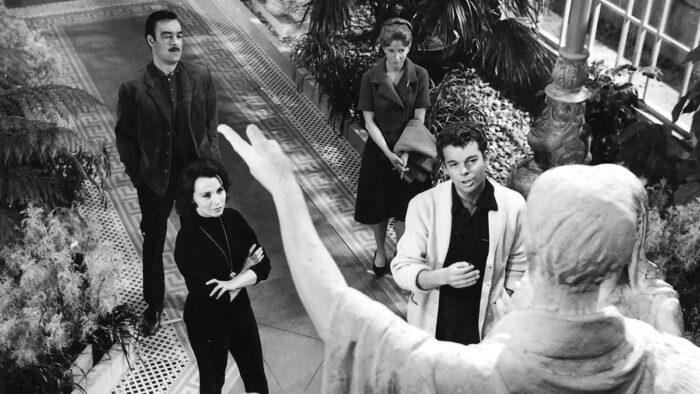
Of these characters, we by far get to know the most about Eleanor, who we see at the beginning of the film is living with her sister and seems on the verge of a nervous breakdown. We eventually learn that she has spent most of her life taking care of her bed-ridden mother and sees Hill House as some sort of escape from her sad life. After everyone arrives, Markway is quick to give everyone a tour of the house and all of its various eccentricities, which the guests quickly start to observe when they hear things pounding in the night. One of the more memorable of these supernatural occurrences is when we see a door to one of the bedrooms being pushed in, with an almost elastic quality, but never breaks.
While the different guests are able to rationalize what’s going on, or in the case of Luke, keep making wisecracks, Eleanor is very personally stricken by how the spirits seemingly haunting the house are talking to her directly. Eleanor forms a bond of sorts with Theodora, but for much of the film, she very much seems on her own plane and affected by the strange occurrences in the house in a way that feels reflective of her own psychological state. This results in a climactic set piece in which she can’t help but walk up a winding spiral staircase that seems destined to come unscrewed from the walls, but Eleanor is determined to find whatever awful thing is waiting for her at the top of the stairs.
Placing more emphasis on Eleanor’s psychological state is one of the slight changes that screenwriter Nelson Gidding made to the novel, and it’s probably the one I’m most mixed on. I do like that it anchors the movie in something more human and tangible when also dealing with these otherworldly beings. But at the same point, I think the movie is perhaps a little too on-the-nose with presenting Eleanor as this woman on the brink, when it maybe could’ve taken a little more of a slow burn approach to watching her unravel, since from the moment we meet her, you can tell there’s something very off about her compared to the other characters. That said, I really like how well-defined each of these characters are, which was a result of the film paring down the number of people trapped in the house and emphasizing their personalities in ways that complete the actors playing them nicely.
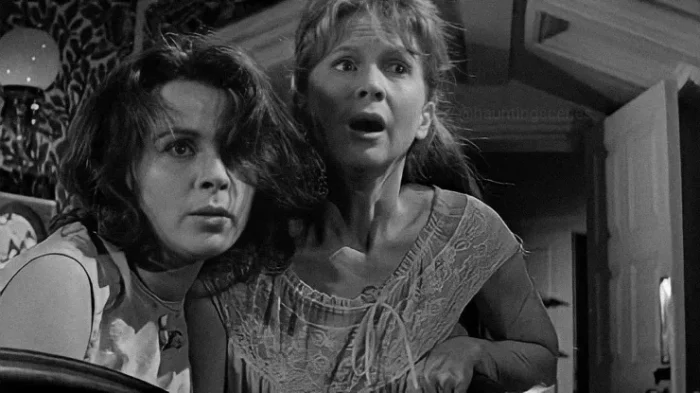
Perhaps the most striking thing about the film is its use of cinematography and set design, and how they combine to make you afraid of the things you can’t see. Director Robert Wise attributed this mentality to producer Val Newton, the 40s horror maverick who gave Wise his first directing job in 1944’s The Curse of the Cat People. The Haunting commits very much to this idea, since you never really see the ghosts in the house, but there are so many strange things that happen in the house that they must surely be there. Wise and cinematographer Davis Boulton create this eery atmostphere by using a variety of wide lenses and moving cameras, but also at the same time, the movie knows when to slow down and let the stillness of the house create just as much unease as when we hear noises in the night.
While watching The Haunting, I had to wonder whether the Hill House was being played by some perfectly ornate house that the filmmakers found and decided to film on location in, though of course, it’s all a set. But that just goes to show you the attention to detail in Elliot Scott’s set design, as it truly feels like you’re in some ornate gothic castle built in the early 1800s. The way the light reflects off the shadows in all the little crevices and woodcarvings throughout the house add to the film’s atmosphere as much as anything. And despite the minimalism of the film’s scope, the look of the house helps make this one of the more visually striking horror films I can remember. Watching this film right after The Dark Old House also reminded me how much the gothic aesthetic had a stranglehold on horror movies for a good 30 years or so, but The Haunting was at the tale end of this era, a few years before the rules of the genre would be rewritten in the 70s.