



Between this and Betty Blue, this has been the hardest stretch of Criterion Month so far, two movies I watched back-to-back with a combined runtime of 356 minutes. But at least Betty Blue looked nice, was funny at times, and straightforward. The Unbearable Lightness of Being (they got the ‘Unbearable’ part right) is a slow crawl through dense political machinations.
This is like a film you watch over a week of school as you struggle to stay awake. It has a lot of sex and nudity with beautiful people like Daniel Day-Lewis, Juliette Binoche, and Lena Olin but the film feels way more preoccupied telling the story of political unrest in 1960s Czechoslovakia. Which I’m sure is a pivotal moment in Czech history, but not in the way Philip Kaufman tells it.
How weird is it that this is a Philip Kaufman film? I don’t know much about the man. I know he’s a seasoned writer director who started in the sixties, worked on westerns in the 70s like The Outlaw Josey Whales (which he wrote) and The Great Northfield Minnesota Raid (which he wrote and directed). He made the beloved Invasion of the Body Snatchers remake, has a story credit on Raiders of the Lost Ark, and made the space race classic The Right Stuff.
But what’s Kaufman’s “Thing”? Is he a journeyman writer/director or is there a “Kaufman signature touch” I’m missing? Even though I didn’t like The Unbearable Lightness of Being it helped me realize Kaufman does have a strong political awareness that rings through most of his work. He’s also not afraid to take his time. Kaufman stories take big events and watch them unfold slowly through the eyes of his characters.

Though these characters aren’t only Kaufman’s characters, this story comes from the 1984 novel-of-the-same-name by Czech author Milan Kundera who was a reformist socialist exiled from Czechoslovakia after the Soviet Union invaded and banned his works. How did an American like Kaufman end up directing this Czech story? 1) He liked the novel and 2) A movie couldn’t be made in Kundera’s home country under Soviet rule.
Set against the backdrop of the 1968 Prague Spring and the subsequent Soviet invasion of Czechoslovakia, The Unbearable Lightness of Being follows Tomas (Daniel Day-Lewis), a charming and commitment-averse Czech surgeon whose carefree lifestyle is upended when he falls for Tereza (Juliette Binoche), a soft-spoken young woman who becomes his wife. Despite their marriage, Tomas continues his many affairs, most notably with the bohemian and independent artist Sabina (Lena Olin). As Soviet tanks roll into Prague and political tensions rise, the trio’s personal entanglements become intertwined with questions of freedom, fidelity, and identity under an oppressive regime.
If that sounds like a lot it is. I’m not gonna lie, my intention for this Criterion Month was to focus on “horny” movies in the Criterion Collection. Now Unbearable Lightness of Being does have a lot of horny scenes; Daniel Day Lewis asking women to get naked, Juliette Binoche envisioning a naked swim class, and Lena Olin and Juliette Binoche having a naked photoshoot, but I would argue all those scenes add up to maybe less than 30% of the film’s runtime.
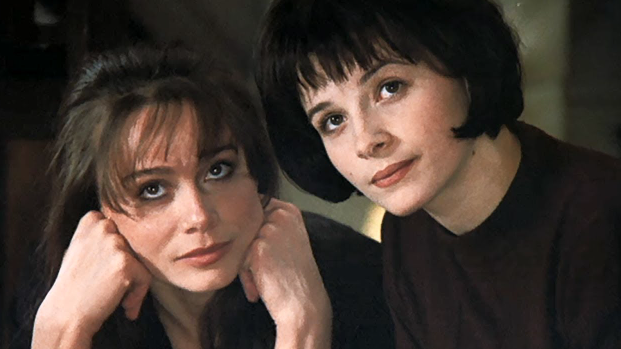
This is a classic case of me not doing my homework. I was not prepared for what kind of movie Kaufman wanted to tell and I had little interest in engaging. Which is a shame because beneath the pace and politics lies a poignant story about Czech resilience, love, and independence during a tumultuous time, one that deserves respect. So it sucks this review is me going, “WAH! I’m bored!” Over and over again.
Sex scenes aside, I will note the other pro I think we can all agree on: the performances. I’m not sure if I’ve ever seen Daniel Day-Lewis this young and even though he looks like Ben Stiller, he still has that magnetic confidence we know him for. Juliette Binoche, who in a way is the “Queen of the Criterion Collection” plays a sweet and innocent character you love to root for, and Lena Olin is sexy and smart giving the best performance of the three. Which is saying a lot when you consider the legacy of her two co-stars.
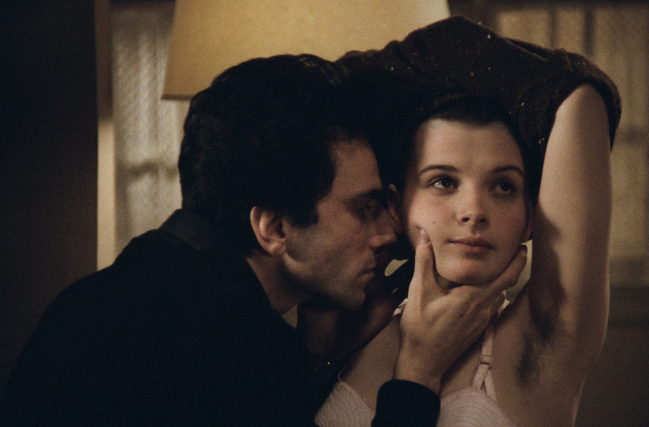
The film was nominated for two Academy Awards for; “Best Adapted Screenplay” and “Best Cinematography” along with being selected as #87 on AFI’s 2002 list, “100 Years… 100 Passions” but otherwise it’s a film I never hear about and I don’t think many have watched or revisited since its original release. A noble effort but a bit of a bore for your resident horny movie critic. This film felt like school and that’s the last place I want to get a boner.