



Ugh, Nazis. I hate those guys. It’s fucking insane that even today those guys have defenders. Why are some people drawn to those fascist dorks? My best guess is that most people hate ambiguity. They want order, with clear rules, a “strong” leader barking commands at them. The problem is they’re willing to overlook the stripping of human rights and murder of others to achieve that “order.”
In The Night Porter, writer/director Liliana Cavani draws a clever parallel between the power dynamic of Nazis and their prisoners and the sexual relationship between a dominant and a submissive. Because we all take solace in familiarity, even when that familiarity is wrapped in trauma.
The year is 1957, and Max (Dirk Bogarde) is a night porter at the Hotel Zur Oper (Hotel by the Opera) in Vienna, Austria. He is polite and professional… he also happens to be a former Nazi SS officer. Max is a complicated “protagonist” because you want to believe he’s moved on from his past, but he still meets with other ex-Nazis to cover up loose ends. So he’s never renounced his crimes.
Max’s lack of accountability becomes more apparent when a former concentration camp prisoner, Lucia (Charlotte Rampling), reemerges in his life. Interned as a teen for her father’s socialist views, Lucia is now the wife of Klaus (Philippe Leroy), an American conductor visiting Vienna to conduct an opera. Shocked to see Max after what she had to endure at the camps, Lucia also feels a weird bond to him.
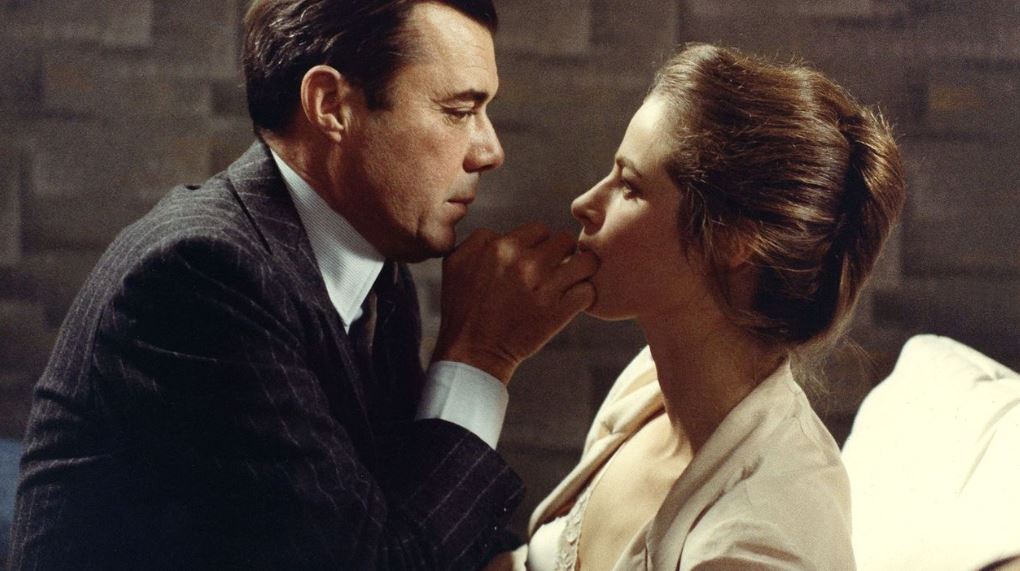
It’s established that, despite the demeaning things Max did to Lucia during the war, i.e., making her sing to the officers in a skimpy SS uniform, it was their sadomasochistic relationship that kept her alive. So in a way, Lucia feels a sense of security in Max’s presence.
Max’s fellow officers discover this relationship and pressure him to perform in a “mock trial,” which would mean Lucia would be forced to stand as the accused and endure a staged interrogation. Anything to ensure no one can rat them out. Fuckin’ Nazis.
But even with the risk, the sexual allure the pair have for each other proves to be too strong, and they fall back into their sadomasochistic routine. Lucia takes orders from Max, performing tasks dressed in uniform and reengaging sexually in the ickiest sub-dom dynamic ever burned into celluloid.
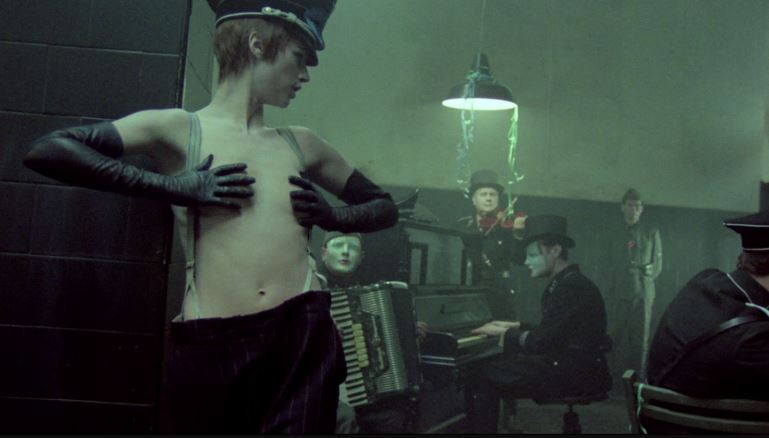
Charlotte Rampling gives a heartbreaking performance in a moody film set in a murky, overcast Vienna. The vibes are chilling, and as with most of the films I’ve covered for Criterion Month thus far, the tension is palpable. Because a taboo romance never ends on a happy note.
Again, I never like to spoil the end to anything I write, but there is no happy end for these two. I mean, there should never be a happy end for a Nazi, but it’s a shame that Lucia has to endure this trauma loop. It’s sad because it’s all she knows. It’s familiar. It’s safe. And in her case, it’s the erotic draw of fascism that has ensnared her. Because fascism never truly dies. Sometimes it just checks into a hotel in Vienna.