



Most years, I start my Criterion Months somewhere in the depths of the golden era of Hollywood’s studio system, and this year is no exception. Though this year I’m starting with one of that era’s genres that sometimes gets overlooked in the grand scheme of film history and serious critical analysis, most likely due to filmmaking’s old friend, sexism. This genre would be the reductively-named “women’s picture”, which were a certain type of melodrama, typically revolving around a female character’s personal journey. One of the great stars of this genre (along with her nemesis Joan Crawford) was Bette Davis, and Now, Voyager has been regarded as one of the best examples of Davis’s work in this genre, which I found to be very much a product of its time, but also felt very unique in its depiction of mental health struggles.
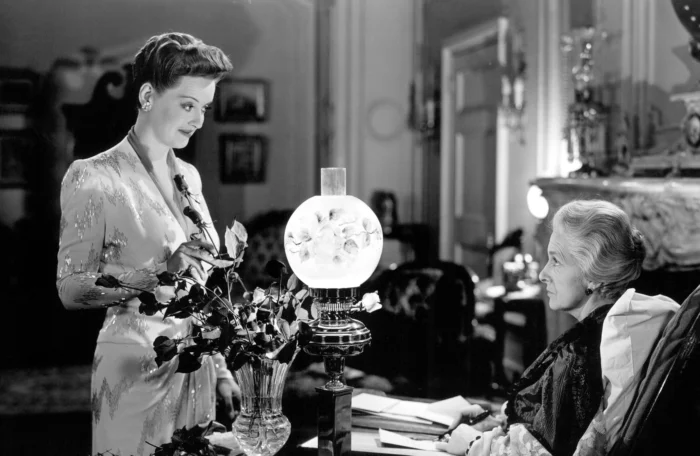
Now, Voyager is based on a novel by Olive Higgins Prouty, which is part of a series she wrote about the Vales, an aristocratic family living in Boston. This entry focuses on Charlotte Vale (Bette Davis), who when we first meet her is unkempt and out of shape, living in seclusion with her demanding mother (Gladys Cooper), who sees Charlotte as the black sheep of the family and also as the one who should be responsible for taking care of her. Having endured her mother’s abuse and seemingly being on the verge of a nervous breakdown, Charlotte’s sister-in-law recommends her to a psychiatrist, Dr. Jaquith (Claude Rains), who recommends Charlotte spend some time at his sanitarium (though its vibe is more of a retreat or commune).
Dr. Jaquith helps Charlotte get her sense of self back and encourages her to go on a cruise before going home to her mother, which Charlotte agrees to embark on. While on the cruise, she meets a married man named Jeremiah (Paul Heinreid), whose life has been hindered a bit by raising his daughter and his unfulfilled architect dreams. They bond when the cruise makes a stop in Rio De Janeiro, where they get lost in the jungle and have to share a hut together. Charlotte eventually finds a way to fly back home and must leave Jeremiah behind, now tasked with confronting her mother, the root of all her problems, while having a new disposition and change in appearance.
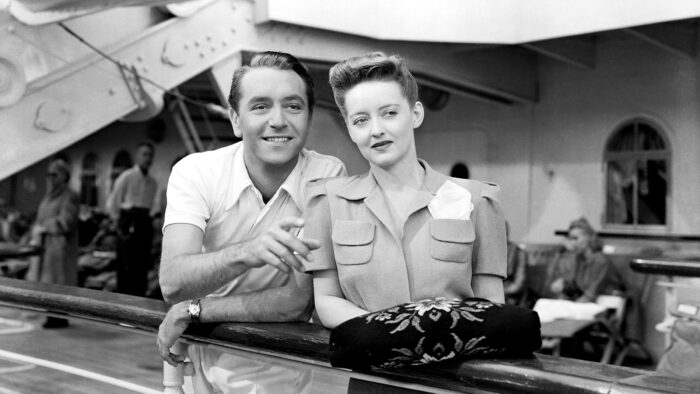
Things between Charlotte and her mother aren’t much better this time around, which eventually lands Charlotte back under Dr. Jaquith’s advisement again. She then eventually marries a widower who seems nice enough but is a little bland, though it isn’t long before Jeremiah comes back into her life when they cross paths at a party. It’s not long after this that Charlotte starts to develop a relationship with Jeremiah’s 12-year-old daughter, who she sees a lot of herself in and who also lands in the hands of Dr. Jaquith. This continues this long-simmering “will they, won’t they” between Charlotte and Jeremiah, who never quite seem like a perfect fit for each other, resulting in the film’s iconic final line, “don’t let’s ask for the moon. We have the stars.”
I first became interested in seeing Now, Voyager after it was recommended by my father-in-law, a retired psychiatrist. It’s not super surprising that he’d recommend it, since it’s one of the more nuanced and positive depictions of psychotherapy onscreen, with Claude Rains serving as a selfless guiding light for Charlotte, merely interested in her well-being. This feels a bit refreshing, since it feels like most movies about shrinks and their patients often involves them eventually becoming romantically involved, but the movie treats Charlotte’s arc as more nuanced than that. Perhaps chalk it up to the fact that the script is supposedly pretty faithful to the novel by Prouty, who had a similar experience involving a nervous breakdown before writing the novel.
When hearing about the subject matter of Now, Voyager, one does have to wonder if such heavy and heady subject matter involving mental health is best suited for the frothiness of old-fashioned Hollywood filmmaking. And while the style isn’t perhaps a perfect match, such as in an overly long scene involving a Brazilian cabdriver played for laughs, the movie is surprisingly affecting. Everything is in this ruminative minor key, which Max Steiner’s swooning score creates much of the atmosphere with. Also, despite how big Bette Davis can sometimes go in her acting, her turn here as Charlotte feels effortlessly restrained and full of melancholy.
Honestly, all of the performances are pretty great, from Rains to Heinreid to Gladys Cooper, who was in her early 50s at the time, but was made up to look much older in order to play Charlotte’s overbearing mother. Now, Voyager is filled with a lot of peculiar relationships, but the one between Charlotte and Mrs. Vale is probably the most potent. Charlotte’s mother stands as the thing holding her back from becoming her true self, and the movie’s strengths lies in its depiction of both treating Charlotte’s struggle seriously while also featuring a feel-good story about becoming the best version of yourself, even if it comes with the pragmatism of settling for the stars.