



61st Academy Awards (1989)
Nominations: 4
Wins: 1
We’ve talked plenty about how William Hurt had an unparalleled ’80s, but perhaps it’s also worth mentioning that Hurt’s Body Heat collaborators — director Lawrence Kasdan and Kathleen Turner — also had a pretty remarkable decade. Kasdan started out the ’80s writing multiple George Lucas hits, then quickly segued into directing with the aforementioned Body Heat and The Big Chill, before closing out the decade with today’s Oscar-nominated movie, The Accidental Tourist. Then there’s Kathleen Turner, who managed to carve out an ’80s that somehow managed to sidestep her sex appeal in Body Heat by appearing in some of the decade’s smartest pieces of fun escapism (Romancing The Stone, Peggy Sue Got Married, Who Framed Roger Rabbit).
The Accidental Tourist was perhaps an odd project for these three people find their ways back to each other for, as it’s a more soft-spoken, character-driven studio film that doesn’t feel far removed from what James L. Brooks was doing around the same time. The film is based on a novel by Anne Tyler and tells the story of Macon Leary (played by William Hurt), a travel writer who doesn’t particularly like to travel but has a way of writing about it nonetheless. He’s grappling with the recent death of his son, which we see in an early scene as the impetus for his separation from his wife Sarah (Kathleen Turner). Feeling isolated, he starts spending more time with his family in Baltimore when he’s back home from the constant travel his job demands, but he overall seems aimless, and things don’t get any better when he breaks his leg.
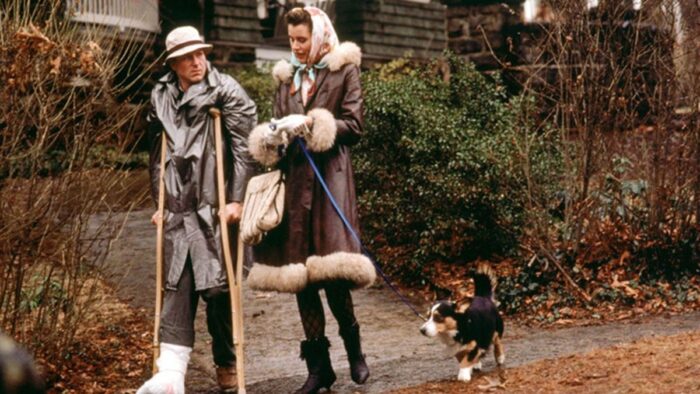
One of the lights of his life is his adorable dog Edward (a top-notch movie hound), which he brings to an animal hospital while he’s away on one of his overseas trips, which is where he meets a mildly eccentric woman who works there named Muriel (Geena Davis). Macon and Muriel start seeing each other, which causes Macon to spend more time in Muriel’s rougher neighborhood and get to know her son, who comes off as being perpetually ill and allergic to everything. You know, one of those kids. However, things become more complicated when Macon’s wife Sarah re-enters the picture right before Macon goes on a flight to Paris, which sees Muriel spontaneously following him there. This fuels suspicion from Sarah that they haven’t broken off their relationship, and that leaves Macon with a choice to make.
The Accidental Tourist is a pretty low-key movie, sometimes too low-key at times, where as much as I liked the vibe and performances, I wished the movie had been able to hook me just a little bit more. And yet, I can’t really complain too much. These types of quiet, multi-faceted stories were hard to come by in the ’80s, and seeing a film that is a very human story but also has enough scope to span several countries is also a rarity.
I especially like what the film did with having this travel writer as the center of the film, since it’s just a very fun movie profession. The way we see Macon drifting through various parts of the world without a center felt apt for a guy dealing with losing both his child and his marriage, two things that tend to give most people a sense of home. Also, the movie’s use of voice-over, which shows Macon’s writing style and his approach to travel is a nice touch. It reminded me a lot of one of my favorite “middle-aged white guy figures out his life” movies, Up In The Air.
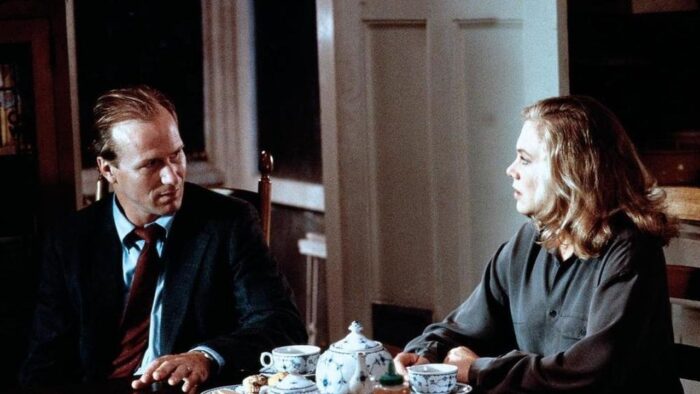
The movie also has a tricky tone to weave considering it has to deal with such heavy subject matter while using grief as its focal point. However, it manages to fit a decent amount of levity and warmth into this story without entirely losing sight of the fact that this guy is a bit of a hollowed-out mess. It’s a little surprising that John Williams was tapped to score the film, considering it’s hard to think of many smaller, character-driven movies that he’s done throughout his career. I’m not sure if he was entirely the right choice for the film, since the score is a little overbearing at times, but then again, so are the scores for most ’80s dramedies of this nature.
While Williams’ score was nominated for an Oscar, the only category the film came away with a win for was Geena Davis’s supporting turn here. It’s the kind of performance that I’m glad to see won an Oscar, since it’s not a terribly flashy performance despite the fact that this character could have been overdone. With her colorful outfits and free-spirited nature, she has the potential to come off as your typical quirky girl, but instead, the film takes great care to paint her as fully-formed human being with complicated circumstances. Overall, you have to admire that the film takes its time to give each of these characters a robust inner life, even if its unassuming nature hasn’t quite bolstered its reputation as a classic over the years.