


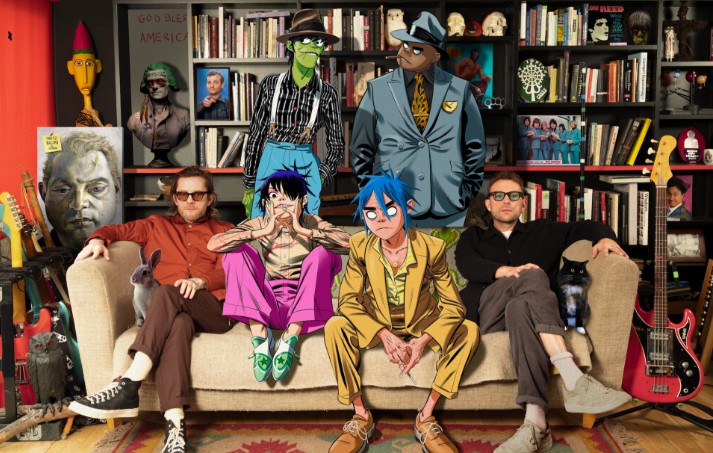
This month, Gorillaz released their ninth album, The Mountain to glowing reviews, the band is already in midst of a world tour, and a few weeks ago made their first ever appearance on SNL. Not bad for a band that sort of doesn’t exist.
What you might not know is that today, yes TODAY marks the 25th Anniversary of the band’s debut self-titled album. Twenty-five years. Christ. It feels like yesterday I was watching the “Clint Eastwood” video on Cartoon Network’s Toonami block. But no, that was the Summer of 2001. Now I’m an old-ass man. The future is comin’ on.
Regardless of what you think about the Gorillaz, there is no denying they did something no other band had ever done (maybe The Archies), as the world’s best selling “virtual band”. It makes sense. They got the hits, they got the look, and they’ve reinvented themselves time and time again.
I should know, I just listened to all nine of their albums. In fact, this was originally supposed to be a retrospective of all those albums, but I couldn’t make my own imaginary deadline of posting the whole thing on the band’s 25th anniversary. Nor do I feel like I’ve done a deep enough dive to make a tier list.
What I will say is Demon Days is hands down my favorite, followed by today’s album, and then Plastic Beach. After that? I might even put the band’s new album The Mountain. I love the world music vibe of that one. After that they all blur together (pun intended) and then Humanz and The Fall at the end because it’s a fake album.
Now let’s pull that sunshine out of a bag and do this.
Our story begins in the year of our Lord 1990, when Blur guitarist Graham Coxon invited indie comic artist Jamie Hewlett, already known in the London art scene as the co-creator, alongside Alan Martin, of Tank Girl, then running as a strip in the British comics magazine Deadline, to interview Blur.
Although Hewlett initially clashed with the cocky Britpop front man Damon Albarn, circumstances would eventually force the two into hilarious sitcom proximity. By 1997, Albarn had split from frontwoman Justine Frischmann of the band Elastica, ending one of the era’s more high-profile relationships. When she moved out of his flat in Westbourne Grove, London, Hewlett moved in.
The idea for Gorillaz emerged in that flat after the two were watching MTV one day. As Hewlett later put it, “If you watch MTV for too long, it’s a bit like hell, there’s nothing of substance there.” Albarn echoed the sentiment: “This was the beginning of the boy band explosion, and it all felt so manufactured.” Their solution was simple: create a manufactured band of their own, only make it interesting.

The idea of a cartoon or “virtual band” wasn’t new. There had been The Archies and whatever the fuck Alvin and the Chipmunks was supposed to be, but the Gorillaz were not a corporate-manufactured product or a cheap novelty. They were an art project, with fleshed-out characters, backstories, and lore. Hewlett’s characters did interviews and performed in music videos, all while recording Albarn’s great music.

Damon Albarn began piecing together tracks in 1998. It’s worth remembering Blur was still active when the first Gorillaz album was released; the band even released one more album in 2003 before their breakup that same year. Albarn has said he considers the 1997 Blur track “On Your Own “one of the first ever Gorillaz tunes” for its use of hip-hop–style drums and sonic experimentation. He even sings the words, “I’m not that good, but I’m not that bad. No psycho killer. Hooligan gorilla!” Ooh, foreshadowing.
Anything that didn’t fit into the mold of Blur evolved into the Gorillaz. In the fall of 2000, Albarn released the band’s first EP, Tomorrow Comes Today, featuring songs that would later appear on the debut album, and the band’s first music video for the title track (still my favorite Gorillaz song to date) introduced Jamie Hewlett’s creations: lead singer 2-D, timid and black-eyed; pre-teen Japanese guitarist Noodle; possessed drummer Russel; and British bad-boy bassist Murdoc.
Albarn recorded half of the album himself before bringing on producer Dan “the Automator” Nakamura, who he had previously worked together with on Dan’s hip-hop trio, Deltron 3030’s self-titled debut album in 2000. Dan brought along his Deltron 3030 collaborators DJ Kid Koala and Del the Funky Homosapien, solidifying Gorillaz as a true melting pot of musical voices with Albarn as the chef, stirring the pot.
Additional featured artists on the first Gorillaz album include singer Ibrahim Ferrer of Buena Vista Social Club, Miho Hatori of Cibo Matto, and Tina Weymouth of Talking Heads and Tom Tom Club. It’s a wild assortment of ingredients, and yet, not a single flavor feels out of place.
At first, you might convince yourself this album is Blur in disguise. Apart from the hip-hop drum beats and guest vocalists, it still carries the bones of Blur’s apathetic Britpop stylings, but the deeper you go, the more it reveals itself as a smorgasbord of turntables, samples, synths, and melodica.
Take the album’s breakout track, “Clint Eastwood.” Named for its Spaghetti Western vibe, the song was built using the “Rock 1” preset of an ’80s Suzuki Omnichord (essentially an electronic autoharp). It features an echoey melodica line and now-legendary verses from Del the Funky Homosapien.
“Clint Eastwood” sounds like nothing else. It was a brilliant way to introduce everyone, even lame suburban white kids like myself, to hip-hop and alternative sounds while still being anchored by a great melody. This is the story of most of these songs. “19-2000” (a nod to the new millennium) is a bouncy synth-funk jingle with a melody so strong it was reworked into one of the best remixes ever by Soulchild.
“Rock the House” is another Del collaboration, built on a horn-heavy sample of “Modesty Blaise” by John Dankworth. The result sounds like the coolest guy you know rapping over what could be the theme to a forgotten ’70s game show.
Speaking of samples, it was a big moment for me when I first heard the album’s closing track, “M1 A1” at the Comics Dungeon in Seattle 20-plus years ago. The song opens with audio lifted from George A. Romero’s 1985 zombie classic Day of the Dead.
I remember flipping through early issues of Teenage Mutant Ninja Turtles when I heard, “Hello! Is there anybody out there?” over the speakers and thought, “Wait ! I know this audio. Who is this band? This is so cool!” It’s funny because Demon Days also samples George A. Romero, using the track “Dank Earth” by Don Harper, as featured in Dawn of the Dead, for the album’s intro track.
The Gorillaz had something for everyone. Which is why the album went on to sell 7 million copies and notched a Grammy nomination for its hit single “Clint Eastwood”. So that must have been enough, right? Damon Albarn got his side project out of the way, returned to Blur, and we all moved on, right?
Here’s where I would have segued into my review of Demon Days, but alas that will have to wait. Could there be a Gorillaz album number ten coming up in our future? I think so, because I have seen the top of THE MOUNTAIN… and it is good.
Favorite Tracks: “19-2000”, “Clint Eastwood,” “Tomorrow Comes Today”