



On the surface, I thought I’d be walking into familiar territory with 1955’s Summertime, since its basic plot does bear some resemblance to my last movie, Now, Voyager. This is another story about a lonely woman going on a vacation in the hopes of finding herself and some peace of mind, set during a time when female independence was a bit of a rarity. But as this film shows, there are many ways to tell a similar story, as the more somber tone of Now, Voyager is miles away from the picturesque, unabashedly romantic mood of Summertime, which revels in the rebirth that a trip abroad can bring, even if such things are never meant to last.
Summertime begins on a train, where the unmarried, middle-aged secretary Jane Hudson (played by Katherine Hepburn) is eager to reach her destination of Venice after a long journey from Akron, Ohio. Once she gets there, she’s overwhelmed by a lot of things: the culture shock, the crowds of people in various plazas, the overwhelmingly beautiful architecture, and of course, all the boats and canals that define the city. As she settles in, she meets a few colorful characters that she keeps running into, such as a clueless older American couple, an ex-pat painter and his girlfriend, and a scruffy street kid named Mauro who gives off real Bicycle Thieves/Cinema Paradiso vibes.
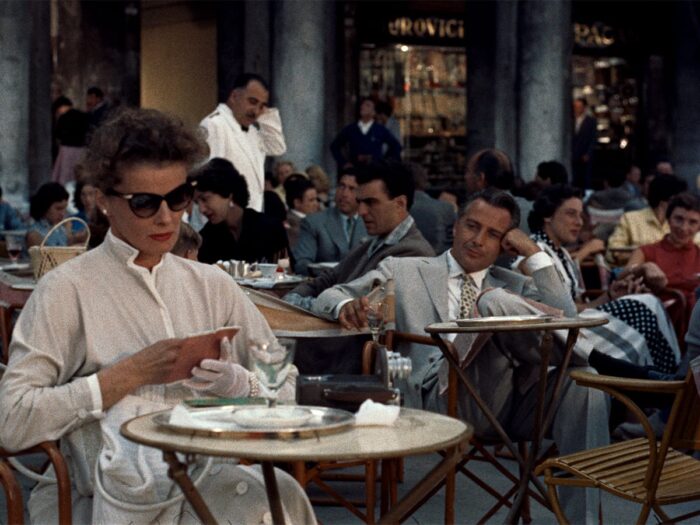
During her first day or two in Venice, Jane is awed by the various sights and sounds around town, using her trusty camcorder to document everything. However, there’s clearly an air of loneliness to her, since while walking around this most romantic city, there’s a longing that Jane feels but doesn’t really express. She then finds herself sitting at a table in Piazza San Marco, where a man sitting alone catches her eye, though Jane is too startled to do anything about it. Then the next day, she’s in a little shop looking for something to bring home, when an orange goblet catches her eye. When asking the clerk how much it is, she finds the shop is owned by Renato (Rossano Brazzi), the same man she saw in the piazza the day before, and he educates her in the fine Italian art of haggling before settling on a price.
Another day of sightseeing goes by, and Jane finds herself back at Renato’s shop, looking to run into him. However, he isn’t there, and things aren’t helped when she inevitably falls into the canal and makes a fool of herself. Luckily, Renato meets her at her hotel that night and asks her out to dinner. The two go out for a lavish night on the town and find themselves increasingly drawn to each other. Completely smitten, Jane then finds herself eagerly anticipating another date with Renato. However, things get a little more complicated as she finds out more about his personal life and must decide how she wants to spend the rest of her days in The Floating City.
Going into Summertime, the thing I was most looking forward to was seeing just how good this film looked. After all, it was shot on location in one of the most gorgeous cities in the world on Technicolor film, and by one of the movies’ most cinematic directors, David Lean. Well, this film did not disappoint in that regard. Lean milks Venice’s idyllic locations for all they’re worth, letting Jane bask in the simple joys of being a tourist in a place that’s completely foreign to you, filled with all sorts of history and weird little quirks. The fact that she’s constantly filming things also gives the film this meta quality while also justifying the fact that it’s just really pleasurable to look at all the beautiful colors and architecture.
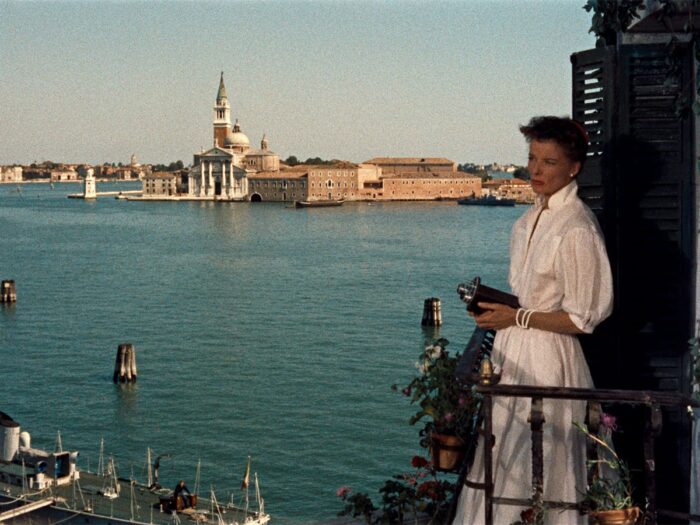
Now, that does beg the question of whether the film also stands up from a storytelling standpoint. I would say it does for the most part, as the way Lean manages to give Jane a rich inner life without giving her too much backstory is a testament to his prowess as a visual filmmaker. The movie certainly leans into a very idealized version of Venice and being a tourist, but at the same time, you do get the sense that there is something sad lurking beneath Jane’s go-getter attitude (which is also just what Katherine Hepburn always brings to a role) and that maybe there was a reason she never found love. I also like the way that Renato turns out to be a little less gentlemanly than his Italian loverman veneer would imply, but this also gets at his desire to not just be some stereotypical local for Jane to fall in love with as a part of her jetsetting fantasy.
There’s perhaps a part of me that wishes the film had made their romance a little more complicated, but at the end of the day, I think it’s the right choice that Summertime mostly wishes to indulge its blissfully romantic vibes. This is just a wonderful film to look at, and I could see myself watching it during various future summers when I need to get away without actually leaving my living room. David Lean notably referred to this as his favorite of all his films, and while that might seem like a strange choice considering he’s directed some undisputed classics, I can also see why he would say that. This was the film that got him out of the stuffy soundstages of Britain and into filming on location, showing himself (and Jane) that there’s a big, beautiful world out there, and a film camera is the perfect device for capturing it.