



The 31st Academy Awards (1959)
Nominations: 6
Wins: 0
Welcome once again to Oscar Fortnight, the time each year where we take two weeks to look back on past films that have achieved Oscar glory, or in the case of my first film, was happy just to be nominated. This year, we’re doing things a bit differently, since a certain recent bachelor party derailed our plans of posting a review each day leading up to Hollywood’s Biggest Night. So instead we’re doing these reviews preceding the Oscars ceremony last night in what we’ve referred to as our March of The Ten Wins (Sean’s idea, not mine). Considering Anora‘s big wins last night, it feels appropriate to start things off with another film showing that every once in a while the Academy will give a little love to a kooky comedy.
Based on the 1956 stage play by Jerome Lawrence and Robert Edwin Lee, the titular Mame Dennis (played by Rosalind Russell) is a wealthy socialite who lives in a frequently renovated Manhattan apartment where she throws lots of lavish parties frequented by plenty of colorful characters. The loose plot of the film is set in motion when Mame’s nephew Patrick (Jan Handzlik) comes to live with her after his snobby father passes away unexpectedly. What proceeds from there is a mostly episodic series of comedic set-pieces involving some pretty broad characters and some eye-popping decor exquisitely captured in Technirama Technicolor.
The main crux of the plot involves Mame being bankrupted by the 1929 stock market crash and needing to find a way to get by and preserve her opulent lifestyle and support Patrick. This first involves a series of gigs that go badly, including becoming an actress and a telephone operator, but she ultimately finds her way back to wealth by coming into contact with a Southern oil baron, the ridiculously-named Beauregard Jackson Pickett Burnside (Forrest Tucker). However, when Mame moves down South to Bearegard’s plantation, she has a bit of a hard time adjusting, though finally wins over his family with her improvised ability to ride a horse sidesaddle. However, after traveling the world a bit with Beauregard, he dies tragically (and also somewhat comically) in a hiking accident in the Swiss Alps.
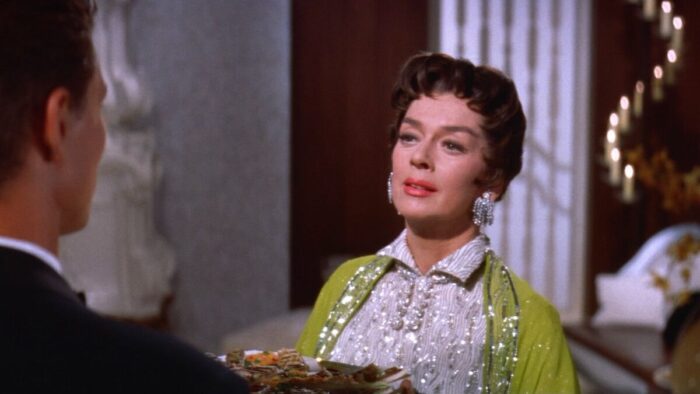
Mame then moves back to her fabulous apartment in New York and starts writing her autobiography with a ghostwriter. Patrick has also grown up considerably (and is now played by the older Roger Smith) and has began courting a wife while away at college. However, Auntie Mame fears that Patrick has begun to embrace the bourgois mindset that she’d tried to extricate him from when he was a child. This then ends in one final absurd set piece where all of Auntie Mame’s various eccentricities come out while meeting with the parents of Patrick’s supposed future fiancée.
Auntie Mame is a film I recently became interested in while watching a special feature documentary on my Some Like It Hot Blu-ray, which talked about the career of costume designer Orry-Kelly. One interviewer in the documentary regarded Auntie Mame as Kelly’s finest moment as a costume designer, and considering all of Mame’s lavish, colorful costume changes throughout the film, it’s hard to disagree. I wish I had more of a vernacular to talk about the fashion in the film, but the way the costumes embody both the heightened nature of the comedy while also just being really decadent and playful suits the film wonderfully, and is a great reminder that there’s a reason why the Academy gives awards to crafts outside of just acting, directing, and writing. Not that they even nominated the film for Best Costume Design.
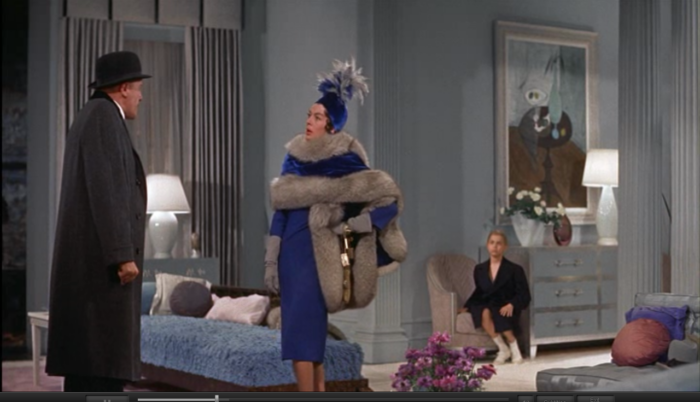
While the film’s silliness doesn’t make it too surprising that Auntie Mame came home empty-handed on Oscar Night 1959 (a big year for the somewhat forgotten Gigi), it feels like Rosalind Russell’s performance as Auntie Mame had a sizable chance of bringing home the gold. The Oscars always loves a redemption story, and Russell was a long way from her heyday of screwball comedies in the ’30s. Here, she brings that same madcap banter to a more bohemian 1950s aesthetic and it’s just fantastically fun to watch. Sure, some of the comedy is a little too broad, but Russell throws herself into it with a gusto that embodies the movie’s most famous line: “Life is a banquet, and most poor suckers are starving to death!”
Considering it’s a word I’ve already used in this review, “lavish” is what comes to mind when talking about Auntie Mame. This mostly refers to the costumes and set design, but also to the fact that this thing goes in a lot of weird directions, with an overstuffed running time of 143 minutes. While the film’s pitched-up tone does wear out its welcome a bit toward the end, there’s still a lot to enjoy about it.
It’s not surprising that with the film’s proto-camp nature, it has been a big favorite in the queer community for years, especially since there are a number of characters throughout who could be coded as gay (including Mame herself). But since this is the ’50s, these things had to be ludicrously subtle (unlike the rest of the film). It also ends up becoming in the end a film about finding a community of weirdos outside of the typical nuclear family, and considering it came out in the conformity-obsessed ’50s, that’s something worth reveling in.